
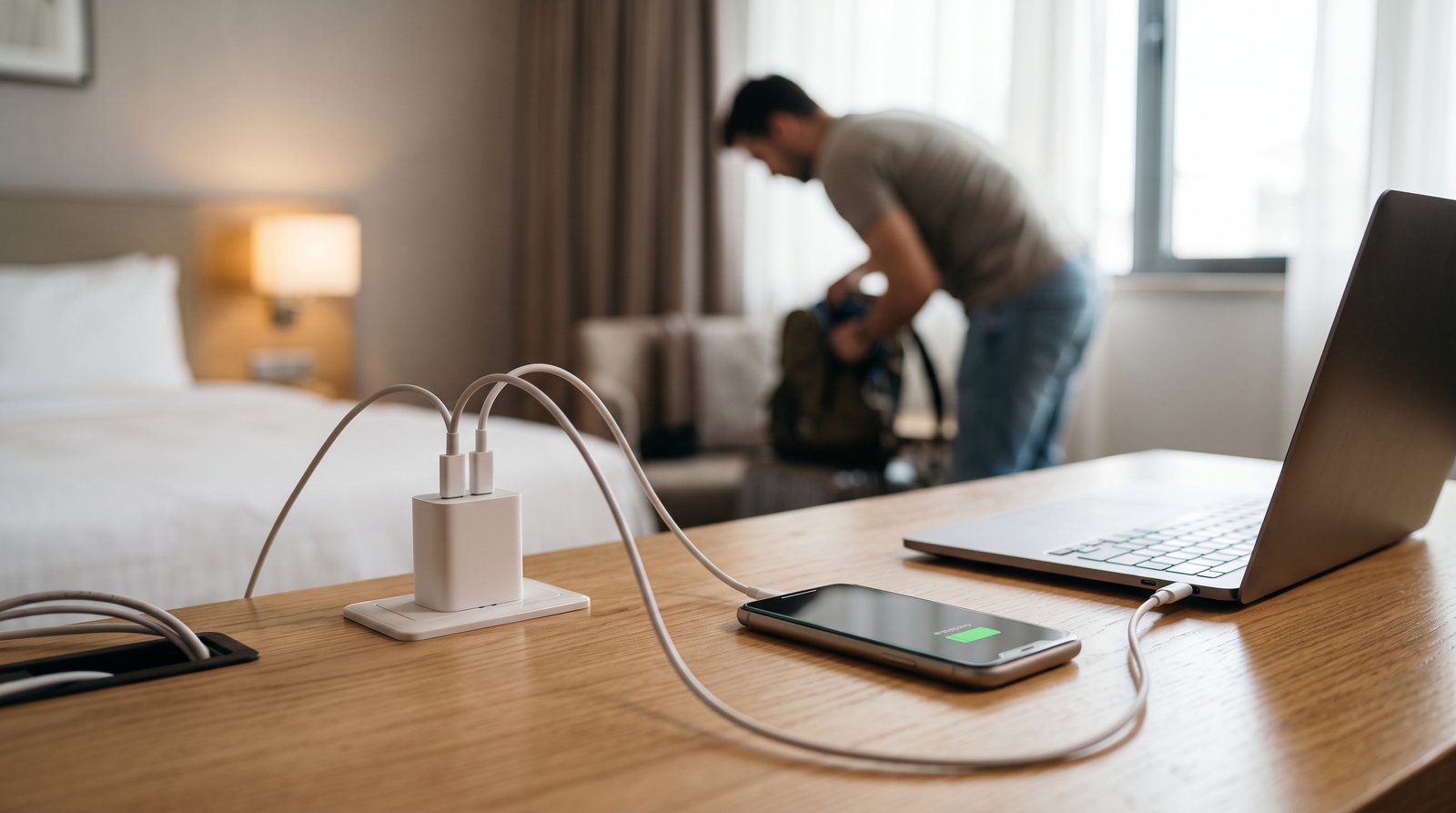
The scene plays out in every hotel room and on every coworking desk. Someone opens the backpack and takes out three chargers: the laptop's, with its brick and thick cable, the phone's, and the one for the earbuds or the tablet. There is only one wall socket, usually behind the bed, and someone ends up charging the phone from the laptop, which is slow. On the way home, one of the three is left behind in the room.
This week's find solves that with a piece that fits in the palm of a hand and has three or four ports. The end customer gets it in two seconds. What matters to the importer is something else: this product swaps three cheap purchases for one purchase worth paying for, and it comes off the same chain of factories that already supplies the rest of the accessories counter.
What a multiport GaN charger is
GaN is the chemical shorthand for gallium nitride, a semiconductor that has replaced silicon in the charger's power transistors. In practice it switches on and off much faster and loses less energy as heat. That lets the transformer and the components around it be much smaller, and a charger that once needed a block the size of a brick now fits in a cube a few centimetres across, with enough power for a laptop.
On the outside the product is a wall charger with two to four ports, almost always USB-C, sometimes with one USB-A for an older device. On the inside it talks to each connected device through the USB Power Delivery standard, agrees the right voltage with each one and shares the total power across the ports. The same cube charges the laptop at 65 or 100 watts and, alongside it, the phone and the earbuds.
And here the product has a Chinese side that never shows on the packaging. China accounts for almost all the primary gallium produced in the world and, since 2023, has controlled its export. Chinese GaN chipmakers such as Innoscience, in Zhuhai, produce at scale the component that used to come from a handful of suppliers abroad. The charger shrank and got cheaper at the same time because the whole chain, from ore to chip and from chip to finished cube, ended up in the same country. It is the same supply-chain logic told in the map of China's industrial clusters.
Models and variations
At the fair, a GaN charger is not one product, it is a ladder. Each rung serves a different customer, and whoever builds the range picks the rungs before picking the factory.
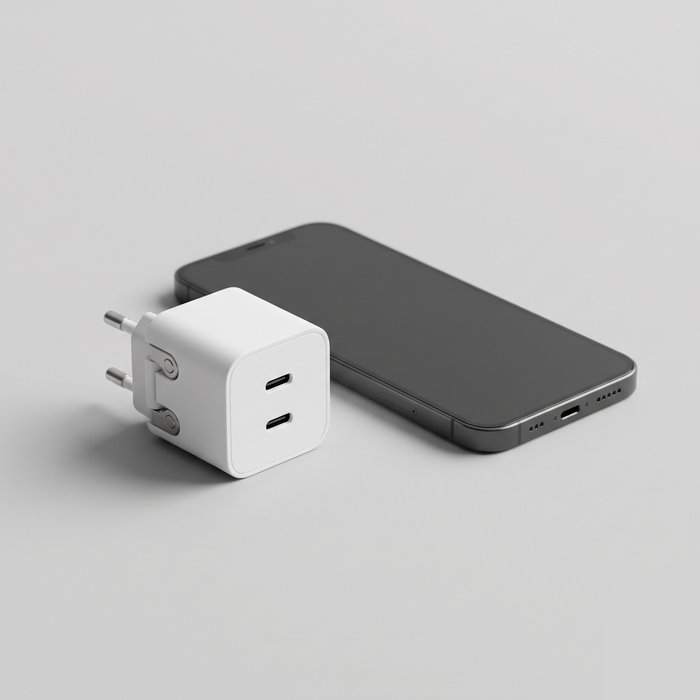
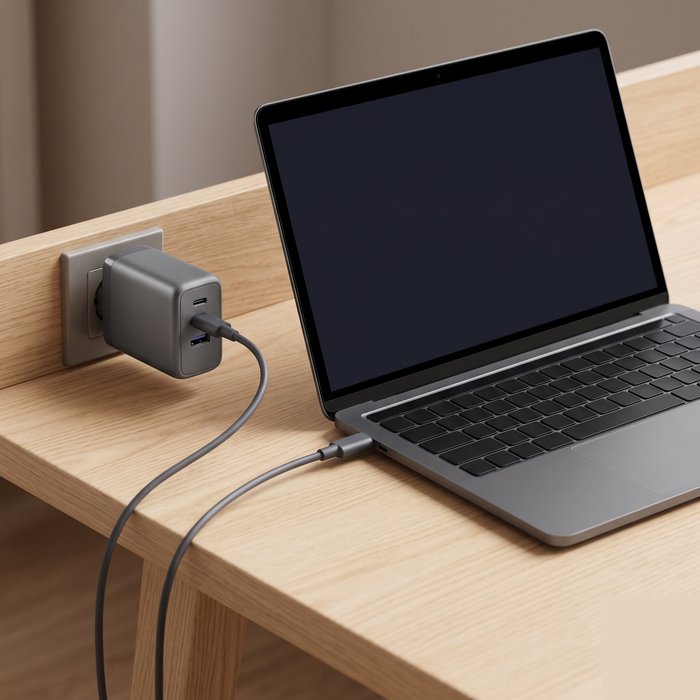
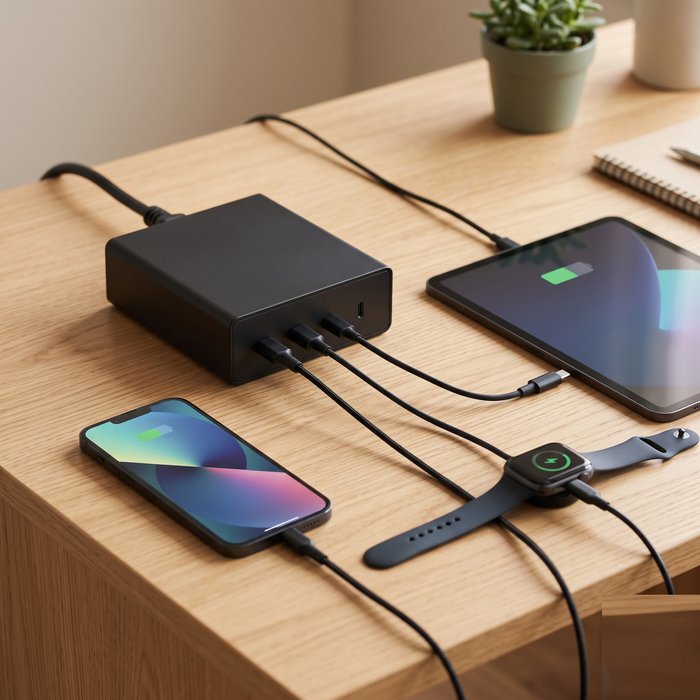
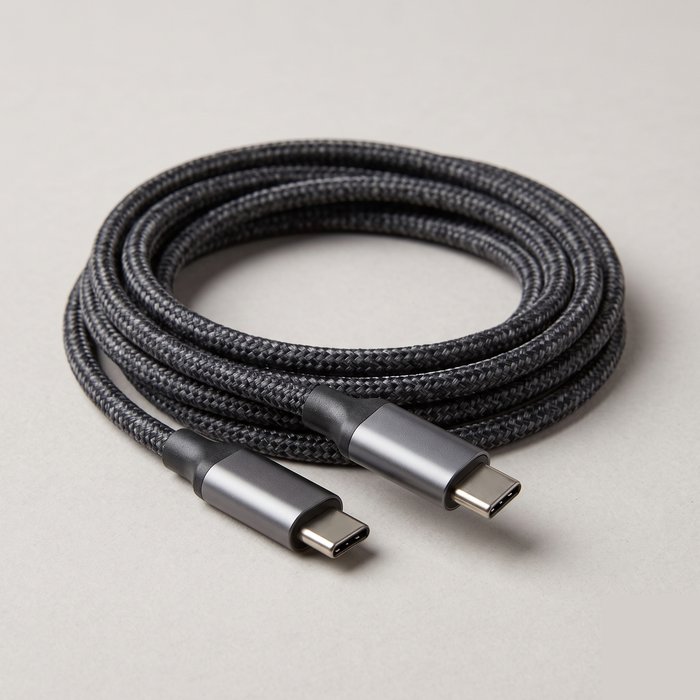
The cable is on the list on purpose. It is the sale that goes with the charger, and it is also where a good product tends to reach the customer as a weak one, for reasons the FAQ below explains. Choosing the rungs, and the cable that completes each one, among hundreds of factories that make all four, is exactly where BCVN comes in.
Why this is an opportunity for Brazil
- One purchase worth paying for instead of three cheap ones. A generic phone charger is a price product, bought on impulse without a glance at the brand. A multiport charger is bought for what it replaces, and the customer accepts paying more because they carry fewer things. It is margin the ordinary charger lost a long time ago.
- The buyer is whoever works on a laptop, and that group keeps growing. Remote and hybrid work, business travel, students with a laptop and a tablet: people who feel the weight of the original brick in the backpack and will pay to be rid of it.
- The cable opens a second sale in the same visit. A powerful charger needs the right cable, and the right cable is not the one-dollar cable from the bargain bin. Selling the two together raises the average ticket and cuts returns.
- It does not compete with what is already in the Showcase. The magnetic power bank charges the phone on the street, with no socket. The cable organiser and charging station tidies the desk. This one is the power source at the socket, and it is the product that connects the other two.
- Evergreen, and that is why it can absorb the lead time. It depends on no season and no date: it depends on people owning more than one device, which only grows. With 60 to 120 days between order and shelf, a container closed now serves the whole of next year, as the guide to planning your imports from China in 2027 shows.
One pitch trap before closing the range: the big number on the box is not what sells this product. Every factory advertises 65, 100, 140 or 200 watts, and a customer who compares only that number buys the cheapest one with the highest figure. The argument that holds the price is a different one: how many devices the cube replaces, and whether it charges the phone in the customer's pocket at the speed that phone accepts.
Before importing: in Brazil, a charger used with mobile phones is a product that requires mandatory Anatel certification, and Act 5155 of 17 April 2024, in force since 14 October 2024, made the tests tougher: 100 free falls, 1,000 cycles of plugging into and pulling out of a standard socket, pin torsion and behaviour at high temperature, covering wall, car and inductive chargers. After the tests, the pins must not deform enough to hinder insertion, and no part may come loose enough to expose a live contact. The folding pin of the pocket model is precisely the part that suffers most in that test. Certification belongs to the exact model, not to the line or to something similar, so ask the supplier for the number and check it in the Anatel system before paying for production. The guide to Anatel and INMETRO certification for electronics from China shows the way. A multiport charger is always sold for phones too, so it falls under the rule even when the pitch is the laptop. The INMETRO classification should come in writing from an accredited certification body, with the datasheet in hand, because compliance rules change by ordinance. In other markets, the certification required in the destination country takes this place. And there is a labelling warning that comes back as complaints: the advertised power is the total, not the figure per port. A 100-watt charger with three ports does not give the laptop 100 watts while the phone and the earbuds are plugged in beside it, and the packaging has to state what each port delivers in each combination.
Put your own brand on it
A charger is one of the accessories where a private label pays back fastest, because it lives on the desk, in plain sight, and a customer who likes it buys the same brand again for the house, for the car and as a gift.
- Your brand on the product and the packaging (private label / OEM): logo engraved or printed on the body, and a box designed for a counter hook or an electronics display.
- Colour, finish and kit composition of your choice, including the combination the factory does not sell ready-made, such as the charger and a cable of the same power rating in one box.
- Packaging and manual in the buyer's language, with a simple table of what each port delivers in each combination, which is what stops returns before they happen.
Customisation usually calls for a slightly larger minimum order, and BCVN finds the right factory, negotiates the customisation, validates the sample and makes sure the product arrives exactly as you asked for it.
It is worth understanding how this works in practice before requesting the first sample: the guide on own brand in China: private label, OEM and ODM explains the difference between the three models and what each one changes in the minimum order and the lead time.
Where to buy GaN chargers in China
The charger supply chain is concentrated in Shenzhen and the neighbouring cities of the Pearl River Delta, home to the factories for power supplies, boards and cables. The guide Shenzhen from the inside explains why the factory is rarely where the sales office is, and what that changes in the price.
- Canton Fair, Phase 1 (electronics and accessories): the main aisle, and the place to set ten competing chargers side by side and test what matters, which is how much each port delivers with the laptop and the phone connected at the same time.
- Hong Kong Electronics Fair: where the higher-finish lines and the factories that serve international brands show up first, usually with their certification already in order.
- Yiwu Fair: serves what goes with the charger, from cables and adapters to counter displays, with low minimum orders. The charger itself has its factory price in Shenzhen.
Autumn 2026 Canton Fair: Phase 1 of the autumn Canton Fair runs from 15 to 19 October 2026 in Guangzhou. For anyone who cannot make it in time, the next one is the spring 2027 edition (the 141st), with Phase 1 expected on 15 to 19 April following the fair's usual pattern, with no official calendar yet, and the spring Hong Kong Electronics Fair expected on 13 to 16 April, the days just before. The Canton Fair 2027 guide has the dates and what is still to be confirmed, and the China trade fair calendar 2027 shows the whole year.
The decision that makes money here is not the wattage, because every factory advertises the same numbers. It is building the right ladder for the customer your shop serves: which rung goes in first, which cable goes with it, whether the charger speaks the language of the phone that dominates the region, and whether the packaging tells the truth about each port. Get that combination right and you sell one purchase worth paying for instead of three cheap ones. Buy from the catalogue photo and you land a handsome cube that charges the phone slowly.
Frequently asked questions about importing GaN chargers
Does a GaN charger charge any phone and any laptop?
It charges almost anything with a USB-C port, but the speed depends on the device and the charger speaking the same language. The common standard is USB Power Delivery, which serves iPhones, laptops and tablets. Samsung phones, which lead the Brazilian shelf, only reach their fastest charging with an extension called PPS, and a charger without PPS charges them at basic speed, which the customer reads as a fault. The laptop needs a different kind of care: it needs the power its original brick delivered, and a multiport charger splits its total power across the ports in use. On the datasheet, what matters is how much each port delivers while the others are busy, not the big number on the box.
Does a GaN charger need Anatel certification?
In Brazil, yes. A charger used with mobile phones is a product that requires mandatory Anatel certification, and Act 5155 of April 2024, in force since 14 October 2024, updated the tests: 100 free falls, 1,000 cycles of plugging into and pulling out of the socket, pin torsion and behaviour at high temperature, covering wall, car and inductive chargers. Certification belongs to the exact model, not to the line or the manufacturer, so ask for the number before closing the order and check it in the Anatel system. A multiport charger is always sold for phones too, so it falls under the rule even when the sales pitch is the laptop. The INMETRO classification should come in writing from an accredited certification body. In other markets, check the certification required in the destination country before ordering.
What is the difference between an ordinary USB-C cable and a 100 W or 240 W cable?
From the outside they look the same, and that is exactly the problem. An ordinary USB-C cable handles up to 3 amps, which caps charging at around 60 watts. Above that, the cable needs 5 amps and a small chip in the connector, called an e-marker, which tells the charger what the cable can carry. Without the chip, the most powerful charger delivers only 60 watts, and the laptop charges slowly or not at all while in use. The 240-watt cable follows the newest version of the standard, called Extended Power Range. For the importer the rule is simple: the cable in the box, or sold next to the charger, has to match its level, otherwise a good product reaches the customer as a weak one.