There is a simple test for whether a technology has become a business: ask who signs off on the purchase. While the robot was bought by the marketing department, to stand in reception, it was a display item. Once it started being bought by whoever answers for the cleaning payroll, it became equipment.
This guide looks at Chinese service robotics from the point of view of somebody thinking of reselling it: what exactly became cheap, in which applications the numbers already work, where they do not, and what wall separates importing a sample from sustaining a product line. The content is from the Chinese side, so it holds for importers in any country; the regulatory part uses Brazil as its example, and the principle translates to the agency of each market.
What changed, and it was not artificial intelligence
The easy explanation is that robots got clever. It is a half-truth that gets in the way of the buying decision, because it leads the importer to assess the software when what decides the numbers is the hardware.
What happened was more prosaic. Four components that accounted for most of the cost of a mobile robot became cheap at the same time, each pulled along by an industry with nothing to do with robotics:
- The brushless motor and the gearbox became commodities because of the drone and the electric bicycle, which need exactly the same kind of compact, efficient drive.
- The lithium battery fell in price in the wake of the electric car, and with it came the iron phosphate cell, safer and with far more cycles, which is what equipment used every day needs.
- The laser distance sensor, the LiDAR, used to be the most expensive item in any mobile robot and came down an order of magnitude once the automotive industry started buying it by the million.
- The processing power came from the mobile phone: the same kind of chip that runs a camera with scene recognition runs a robot's navigation.
Notice that none of those four chains is a robotics chain, and that China dominates the manufacture of all four. That is why a robot assembled there is born with a cost structure nobody can match by assembling elsewhere. It is not subsidy nor cheap labour, it is supplier proximity, and it is the same mechanism the map of industrial clusters describes for other categories. Robotics is one of ten categories that crossed the same line at the same time, and the other nine are in the guide to the Chinese technologies arriving in 2027.
The commercial consequence: in a service robot, most of the value sits in parts China makes better and cheaper than any other country, and a small part sits in software anybody copies within eighteen months. That explains why the category has so many brands and so few real manufacturers.
Service robotics is not industrial robotics
Confusing the two is the most common cause of a wrong purchase, because they look like the same thing in a catalogue and are opposite businesses.
| Industrial robotics | Service robot | |
|---|---|---|
| Where it lives | Bolted to the floor, inside a fenced cell | Loose, in an environment built for people |
| What is demanded of it | Repeating the same movement to a tenth of a millimetre | Not colliding, not falling and finishing the task despite the unexpected |
| The technology that decides | Mechanics, rigidity and servo control | Autonomous navigation, sensors and battery endurance |
| Who buys it | Industry, with an engineering project behind it | Retail, hospitality, residential buildings, cleaning contractors |
| Sales cycle | Long, with an integrator and training | Short, with an on-site demonstration |
| What holds resale back | Machinery safety standards and technical liability | Spare parts, battery and software support |
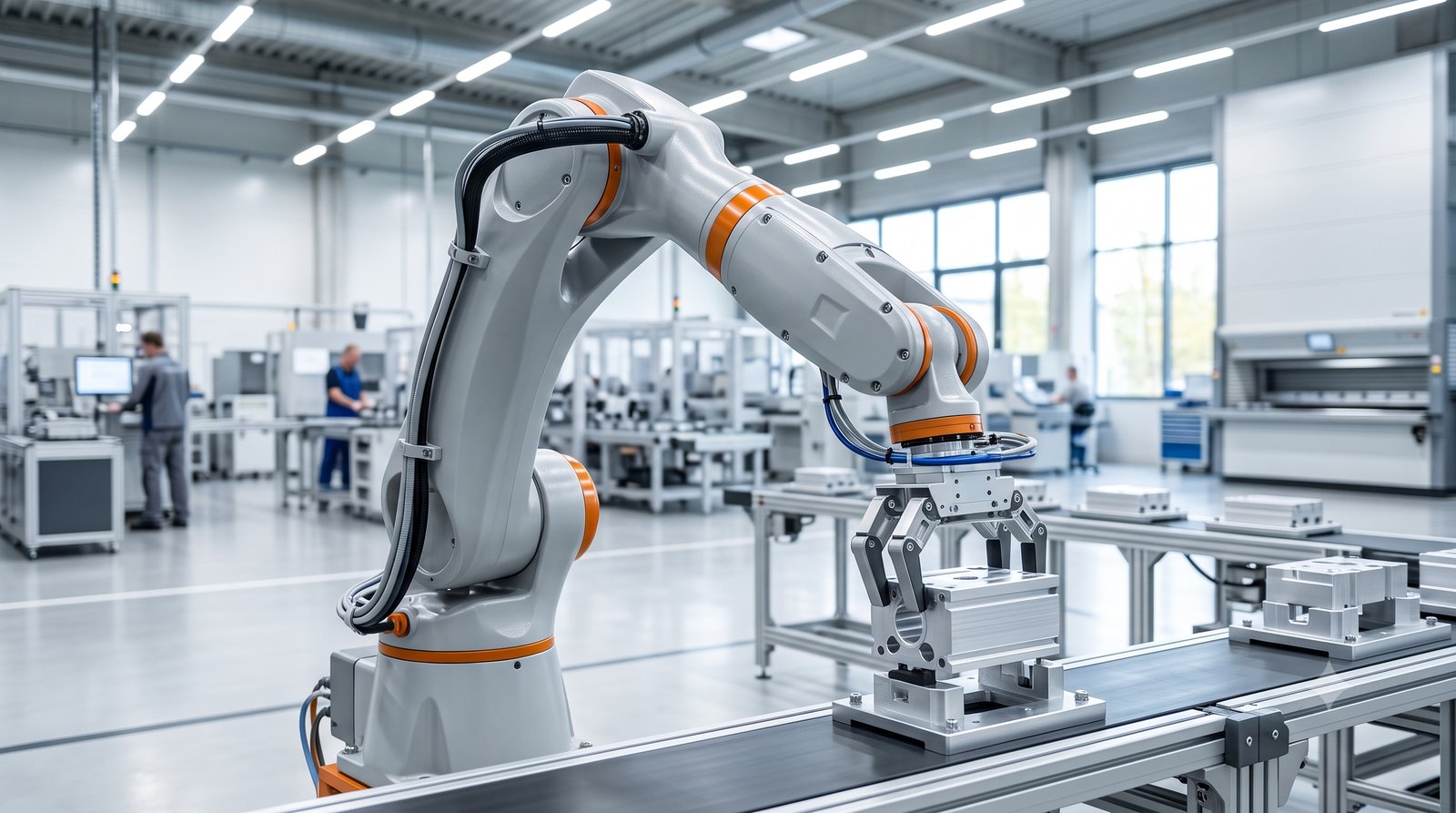
Between the two sits a third family that has grown fast: the cobot, the collaborative arm that works alongside a person with no fence, with force limiting and stop-on-contact. It is industrial in function and service-like in how it is sold, because it fits on a bench and is bought by small workshops, not only by assembly lines. The Showcase's industrial robotic arm shows how that category reaches the market.
The five fronts where the numbers already work
A service robot does not sell because it is a robot. It sells when it swaps a recurring cost for an acquisition cost, and that only happens when three conditions appear together: a repetitive task, a stable layout and labour that is expensive or hard to retain. Where one of the three is missing, the machine becomes an ornament.
Where all three appear, today, in the Brazilian market:
Floor cleaning across large areas
This is the most mature application of all, and the one with the easiest sum to do, because the client already knows what the cleaning hour they pay for today costs. The autonomous machine works through the night, unsupervised, and what it delivers is square metres per hour with a uniform result. The detail of the category, with the NR-12 wall and the difference between a sealed battery and a lithium one at shipping, is in the Showcase entry on the professional floor scrubber.
Internal transport in restaurants and hotels
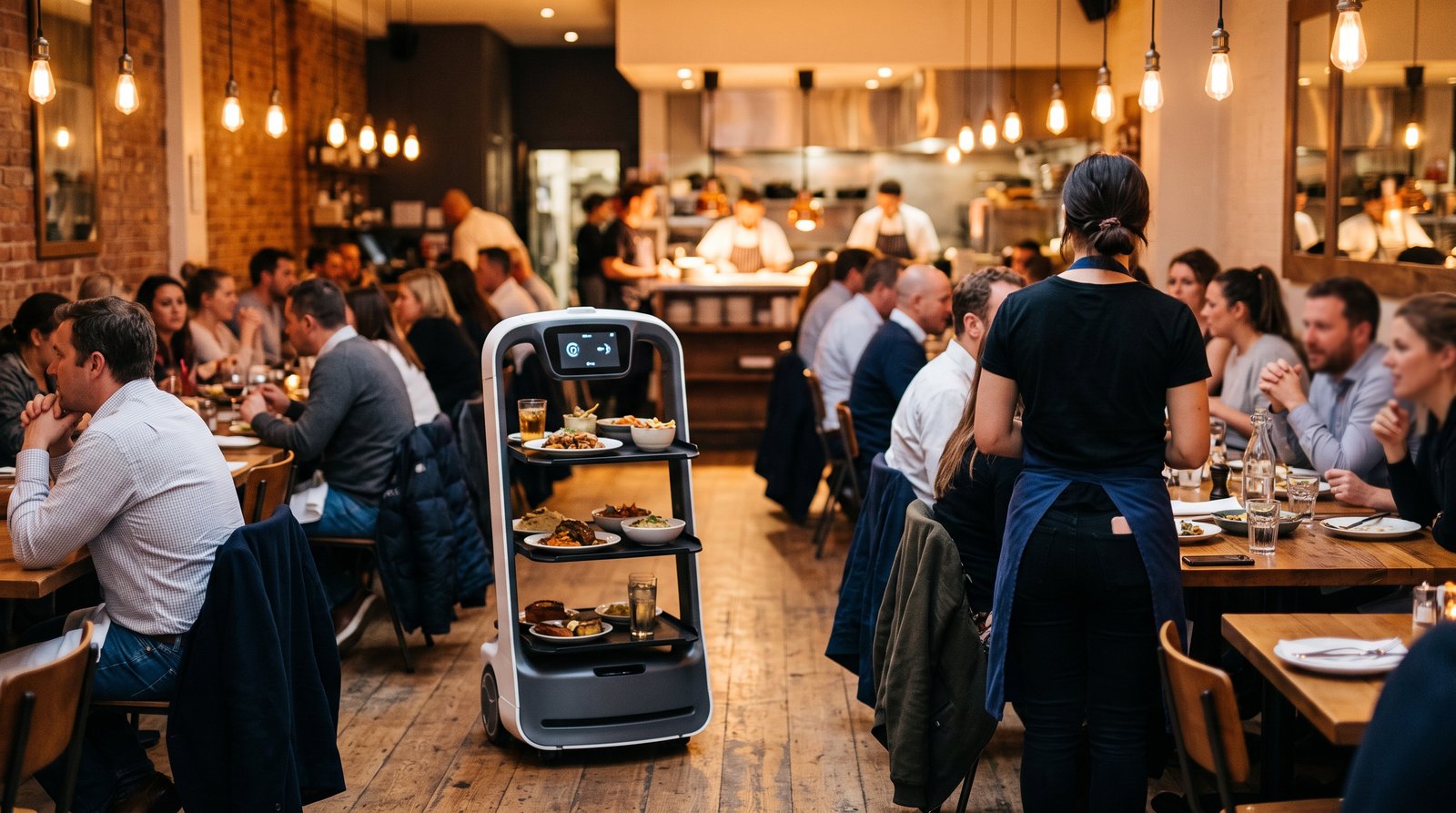
The tray robot does not replace the waiter, and selling it that way is the mistake that burns the client. What it replaces is the walking: the route between kitchen and dining room, or between linen room and bedroom, which eats a large share of a small team's shift. The gain shows up in long dining rooms, in hotels with long corridors and in operations that cannot recruit. That is the logic of the service robot for restaurants and hotels.
Mowing large lawns
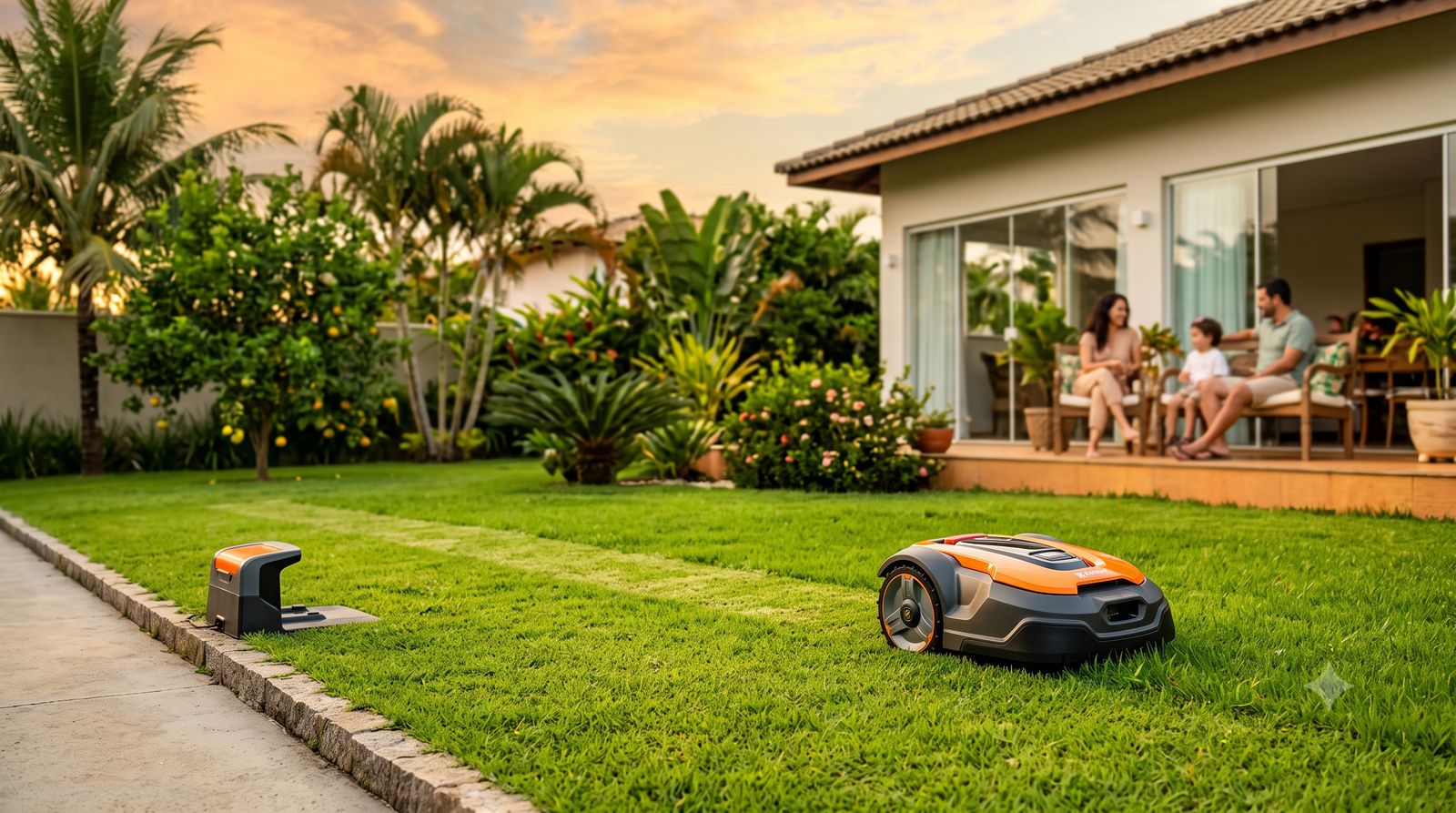
Residential complexes, clubs, smallholdings and small properties with a continuous stretch of grass are the case where the machine works alone for hours and the value lies not in cutting better but in cutting without assigning anybody. The satellite-navigation generation did away with the buried guide wire, which was what held installation back. See the robotic lawn mower.
Swimming pool cleaning
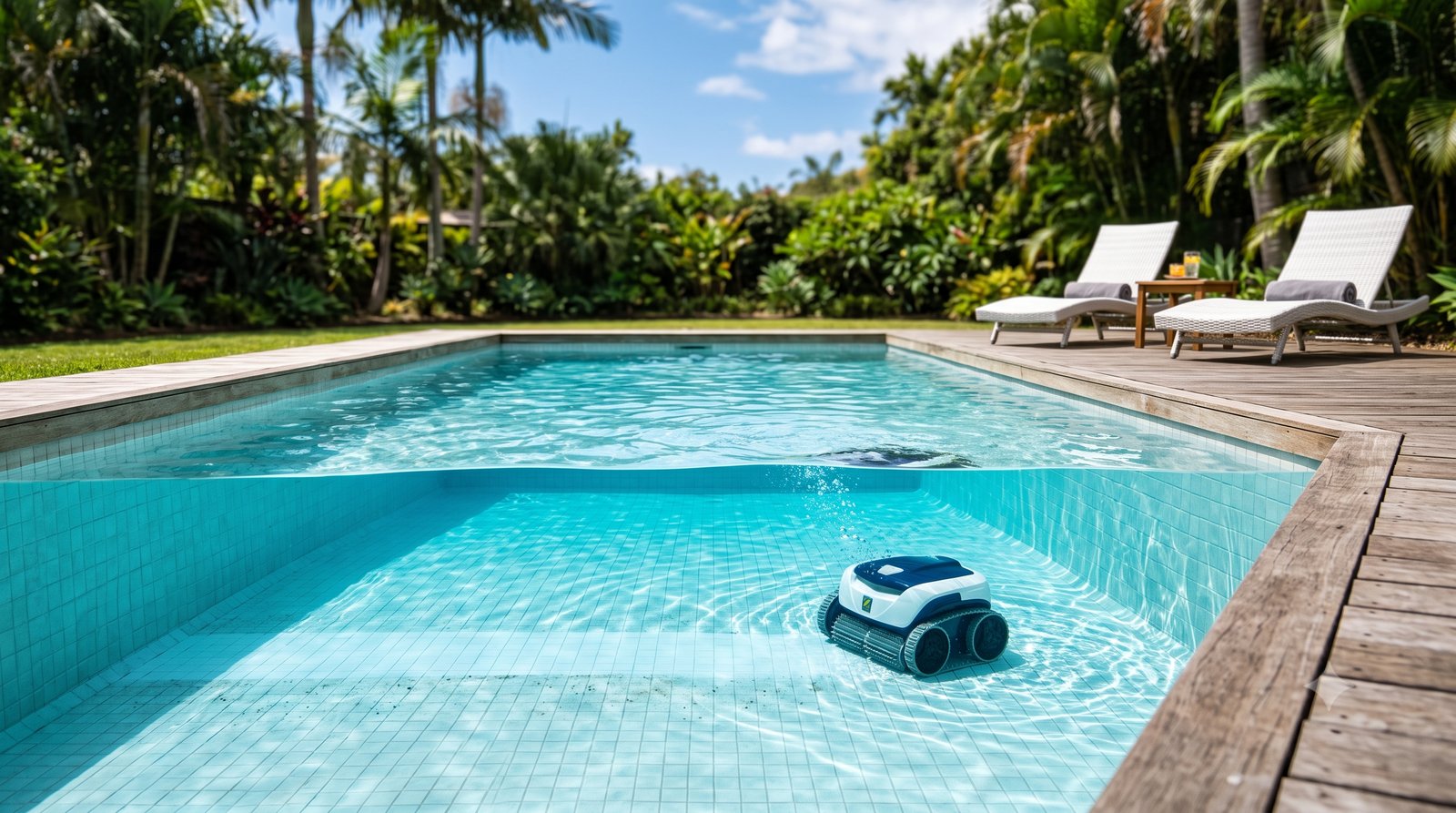
This is the front closest to consumer goods and the one with the shortest sales cycle, because the buyer compares it with the monthly cost of the pool service. The cordless machine changed the category: no external power supply, no hose, with endurance per charge. See the pool cleaning robot.
Domestic vacuuming, which became the category's floor
The robot vacuum is the product that educated the whole market. It is now a mature consumer category, with well-defined price bands and real differentiation in self-emptying bases and mop washing. It serves as the benchmark of expectation for every other front: it is where the buyer gets the idea of what a robot ought to be able to do. See the robot vacuum.
The calculation the buyer actually runs
Anyone reselling service robots needs to understand that they are not selling technology, they are selling a cost substitution. And the buyer, even a small one, always runs the same sum in their head, in three lines:
- What the task costs me today, per month, counting the working hour, the payroll charges, the turnover and the supervision time.
- What the machine costs, adding the price, the installation and what gets spent per year on consumables, battery and maintenance.
- In how many months one covers the other, and whether the machine comfortably outlasts that period.
The rule of thumb observed in the market is that the sale becomes easy when that period fits inside eighteen months, and difficult once it passes thirty, because beyond that the buyer starts comparing it with the uncertainty of their own business. Not because the numbers stop working, but because they stop believing their own projection.
The positioning mistake that kills the category: selling the robot for what it has, rather than for what it takes off the client's cost sheet. A datasheet with runtime, suction power and tank capacity does not close a sale with somebody calculating cost per square metre. Always translate specification into productivity and into cost avoided.
It is worth noting what that calculation implies for the importer: the purchase price in China is only one of the three lines, and the one that varies least. A robot 15% cheaper that needs its battery replaced a year earlier is more expensive for the end client, and the end client finds that out in the second year, which is exactly when they would have decided to buy ten more.
What still does not work, and is worth saying
A category only matures when the people selling it know where it fails. Four limits still stand:
- An environment that changes every day. Autonomous navigation depends on a map. A warehouse where the pallet moves every week, a shop that rebuilds its displays, a building site: the robot redraws the map and loses efficiency, or freezes.
- Steps, level changes and uneven floors. Almost the whole category is built for flat, continuous flooring. Stairs and high steps remain the physical limit, and no catalogue photograph says so.
- Fine manipulation. Picking up objects of varying shapes, with the right force, remains expensive and fragile outside a controlled environment. That is why the restaurant robot carries the tray and does not put the plate on the table.
- Interaction with an untrained public. In a space with many people the robot stops constantly, because the safety rule says stop. It works better at night, or on a route kept apart from the flow of people.
None of those limits prevents a sale. What they prevent is a badly made sale, the kind where the client buys expecting something else and returns the machine within three months, rightly.
The importer's wall: what has to be settled before the container
This is where the category gets demanding, and where most amateur operations trip up. A robot combines, in a single product, four different regimes of requirement.
The radio, which hardly anybody remembers
Practically every service robot has Wi-Fi or Bluetooth, because that is how it is configured, updated and controlled through the app. That means the product contains a radiofrequency module, and a radiofrequency module requires ANATEL approval. It is a requirement that slips by because the product does not look like a telecoms item. The route is set out in the guide to ANATEL and INMETRO approval.
Electrical safety
Depending on the product family and its intended use, the robot may fall under an INMETRO conformity assessment programme. That depends on the product, not on the word robot, and it is a check made before closing the order, not after the cargo arrives. The overview of what requires registration is in the guide to products with INMETRO requirements.
The machinery standard, where there is a dangerous moving part
Robotic arms and operator-ridden floor equipment come within the scope of NR-12, and the point that usually surprises people is that the standard reaches manufacture, import and sale alike. In practice, whoever imports answers as though they had manufactured: a manual in the local language, an accessible emergency stop, guarding of moving parts and technical documentation are your obligations, not the Chinese supplier's.
The battery, which is dangerous goods
The lithium cell is classified as class 9 dangerous goods in transport, requiring a UN 38.3 test and a safety data sheet. That changes three things at once: the carrier may refuse it or charge more, the paperwork grows, and the shipping lead time stretches. It is an item of cost and of calendar, not a formality, and it enters the plan alongside the rest of freight from China to Brazil.
After-sales, which is the real risk
The four points above can be resolved with checking and patience. This one cannot be resolved later: either it is in the contract, or it becomes a liability. A robot is a durable good that breaks in predictable parts, brush, wheel, filter, sensor and above all battery, and that depends on firmware to keep working. Before closing, three things have to be in writing:
- A spare parts list with prices and lead times, and a commitment to keep them available for a defined number of years.
- Access to firmware updates, and a guarantee that the equipment keeps working if the manufacturer's server changes or goes offline.
- App and manual in the local language, which is a legal requirement in some cases and always a commercial one.
How to choose a supplier in this category
Service robotics has one characteristic that changes the sourcing method: there are far more brands than manufacturers. A good share of what you see at a fair comes out of a small number of real factories, carrying the logo of whoever ordered it. That is not a problem, it is the logic of own brand and ODM, and it can be an opportunity. But it does oblige you to know who you are talking to.
01 Find out whether it is a factory or a brand
Ask who makes the board, who makes the chassis mould and where the assembly line is. A factory answers naturally and shows you. A brand deflects into technology talk. Neither is disqualifying, but the price, the lead time and the capacity to customise change completely.
02 Ask for the same unit as two samples
A robot is an assembled product, and assembly varies. Two units from the same batch reveal more about a factory's quality control than any certificate. If the two behave differently on the same route, the problem will show up at scale.
03 Test the runtime with a dirty robot, not a new one
Declared runtime is usually measured in ideal conditions, with a new battery and an empty tank. The number that matters is the one for a loaded robot, with a worn brush, on the flooring your client actually has. That is the difference between the specification and the promise you are going to make.
04 Confirm the battery strategy before the price
Ask about the cell chemistry, the declared cycle count, whether the battery is user-replaceable and what a replacement costs. A battery that cannot be swapped, or that costs too much, turns a five-year piece of equipment into a two-year one.
05 Check the supplier before sending money
The usual routine applies here, and in this category it applies twice over, because the middleman presenting himself as a manufacturer is common. The route is in the guide on how to check a Chinese supplier, and the batch check before shipment is in the one on quality inspection.
Where you get to see this up close
A robot is a product you do not buy from a photograph, and that is meant literally: the difference between two similar machines shows up when both run the same corridor, with the same load, in front of the person who is going to sell them. That is why the category is one of the most rewarding to travel for.
In practice there are two places where it concentrates. The first phase of the Canton Fair, which gathers electronics, machinery and automation in the same aisles, and the vertical industrial automation fairs, where the cobot and internal logistics equipment appear. To fit either into the year, the 2027 sourcing plan shows from when the decision to travel has to be made.
And it is worth saying what a fair does not settle. It shows the machine working in the best possible scenario, on a stand designed around it: smooth flooring, short route, no public. What decides the purchase is the behaviour outside that, the price of the part two years from now and the existence of somebody who picks up the phone when thirty units stop at once. That is not on the stand, it is at the factory, and it is the kind of thing you verify by going there.
Frequently asked questions about Chinese service robotics
What is service robotics, and how does it differ from industrial robotics?
Industrial robotics is the arm bolted to the floor, inside a fenced cell, repeating a programmed movement to a tenth of a millimetre. Service robotics is the machine that moves through an environment built for people, with no cage, and that has to cope with the unexpected: a blocked corridor, a child, a step. The main technical difference is that the service machine needs autonomous navigation and sensors so as not to collide, while the industrial one needs repeatability.
Why did service robots become cheap, and why in China?
Because almost every expensive part of a robot became cheap at the same time, and for reasons that had nothing to do with robotics. The brushless motor and the gearbox came from drones and electric bicycles, the lithium battery came from the electric car, the laser distance sensor fell in price alongside the automotive industry, and the processing power came from the mobile phone. China concentrates the manufacture of those four chains, which is why a robot assembled there is born with a parts cost nobody else can match.
In which applications does a service robot already pay for itself?
In those that repeat the same task for many hours, in a space with a stable layout, where labour is expensive or hard to retain. Floor cleaning in large commercial areas, moving plates and bed linen between the kitchen or the linen room and the floor, mowing large lawns, cleaning swimming pools and moving parts on a bench. Outside that profile, a robot tends to be a purchase made out of curiosity rather than out of arithmetic.
What certifications does a robot imported from China need in Brazil?
It depends on what the robot is. Practically all of them carry Wi-Fi or Bluetooth, which triggers ANATEL approval of the communication module. Those that are household appliances or general-use electrical equipment fall under an INMETRO regime according to the product family. The robotic arm and the operator-ridden floor machine come under NR-12, which places responsibility on whoever imports and sells as well. And the lithium battery is class 9 dangerous goods in transport, with a UN 38.3 test requirement.
What is the biggest risk in importing service robots for resale?
After-sales, not the product. A robot is a durable good that breaks in specific parts, brush, wheel, battery, sensor, and that depends on firmware to work at all. Anyone importing a container without a written spare-parts agreement, without access to firmware updates and without the app in the local language takes on the maintenance of a fleet they cannot repair. That is what turns a good sales margin into a service liability.
Can I put my own brand on a Chinese service robot?
In most cases yes, and that is in fact the dominant practice in this category: most of the brands on the market are ODM output from a small number of manufacturers. What changes with volume is the depth of the customisation, which runs from a simple logo and packaging swap all the way to an app carrying your identity and firmware adjustments. It is worth confirming beforehand what is genuinely customisable and what is only a sticker.
BCVN — Brasil China Viagens e Negócios has connected Brazilian companies to the best suppliers in China and Asia since 2008. Find out about our services in commercial intermediation, quality inspection, factory audits and guided business trips to China's main trade fairs.
The robots in the China Showcase
Real products from the Chinese trade fairs, each with its cost and resale logic. See more in the China Showcase.