
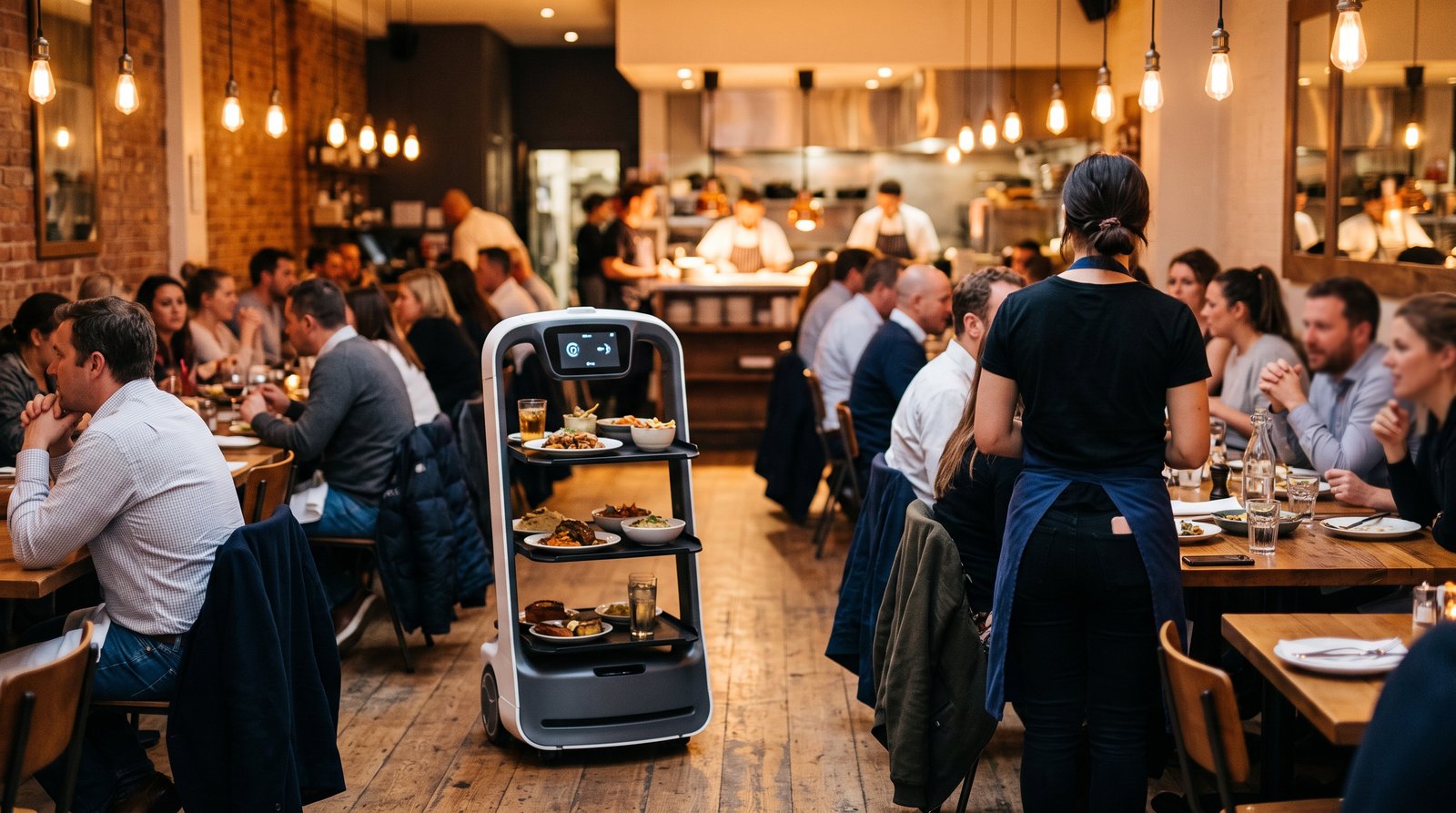
In a full restaurant, the waiter spends most of the night walking. Over to the pass, pick up the plate, cross the room, deliver it, clear the table next door and walk back. Add it all up and it comes to several kilometres per shift, spent on a task that needs none of the skills they were hired for. That is exactly the slice of the job China turned into equipment, because the labour problem in service arrived there earlier and arrived harder.
For anyone supplying food service equipment in Brazil, the relevant detail is not the technology. It is that the buyer has changed the argument. They no longer ask for a machine that does the job better: they ask for one that does the job without depending on someone they cannot hire. That buyer decides quickly, works out the return against the payroll, and comes back when they open the second site.
What a restaurant service robot is
It is a low autonomous vehicle with trays on several levels that moves around the dining room on its own. It takes the plates at the kitchen pass, travels to the table it was given and comes back carrying the dirty crockery. Navigation relies on distance sensors and on a map of the room surveyed at installation, which lets it avoid people in motion, chairs left out of place and a rucksack on the floor. When someone crosses in front of it, it stops and waits.
What is being sold is not robotics, it is the walk. The waiter no longer crosses the room to fetch and return, and stays where the customer is. In an operation with full tables, with drinks and starters going out in waves, that changes delivery times during the rush without adding anyone to the rota. It is a sales argument that is simple to demonstrate and very hard to turn down, and that is why the equipment left the curiosity stage and became a category with dozens of factories behind it.
Models and variations
It is not a single product. At the Chinese trade fairs the category shows up as a whole family, and each format solves a different piece of the operation:
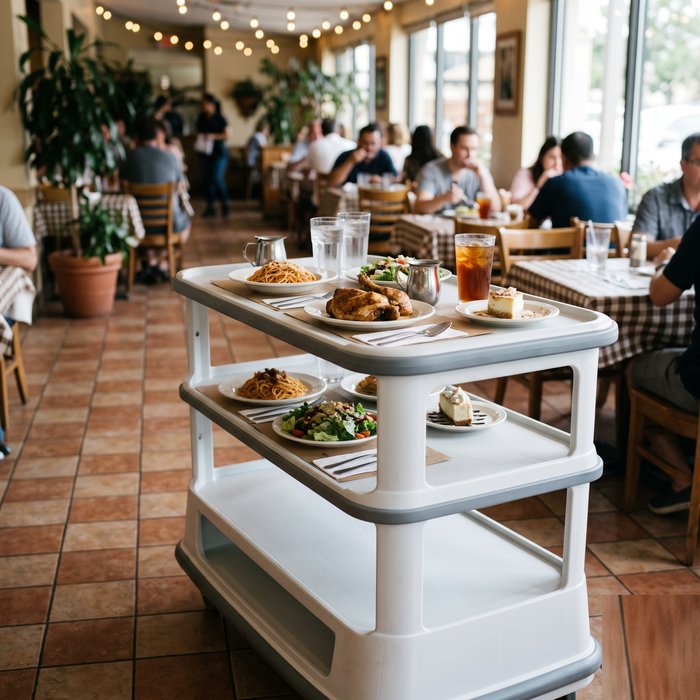
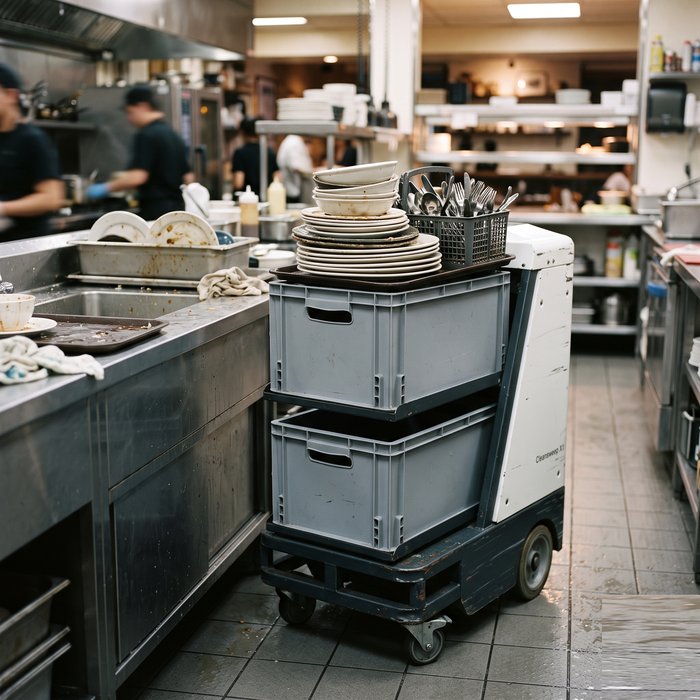
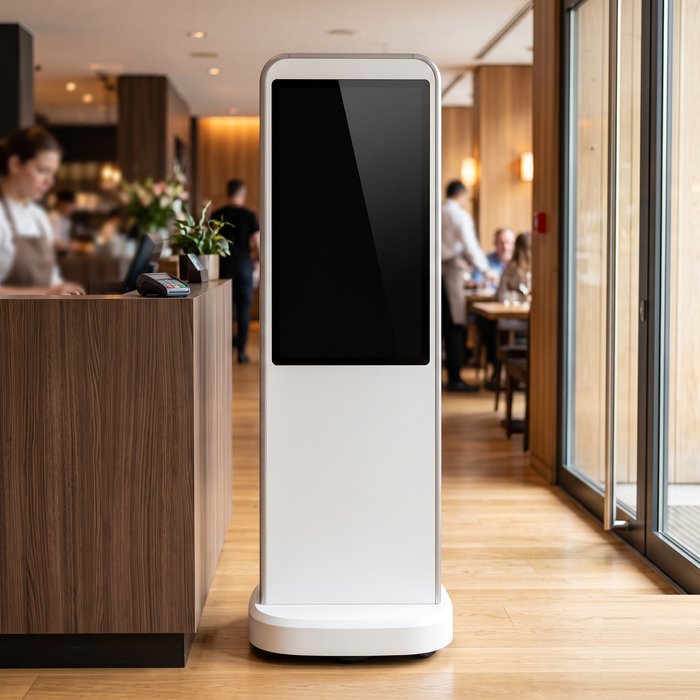
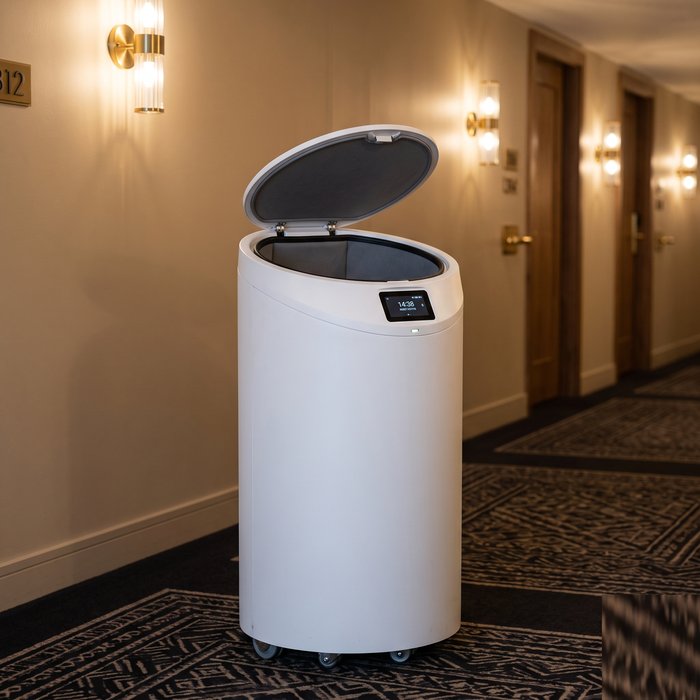
The tray robot is the first purchase for almost every client, and the easiest to demonstrate. The clearing robot solves the forgotten half of the problem, the crockery coming back, and is usually the same client's second order. The reception robot suits the restaurant with a queue at the door and the shopping centre hall, where the value is in greeting and guiding. And the hotel robot, with a closed compartment and lift integration, is the highest ticket model and the one with the least competition in Brazil, because it has to talk to the building's automation. Whoever offers the whole family serves the client from the first machine to the fifth; whoever offers a single format serves them once.
Why this is an opportunity for Brazil
Eating out is one of the sectors that employs the most people in the country and one of those that suffers most from turnover in support roles. This is not a trend that might arrive, it is a difficulty the restaurant owner already lives with every month, and one they currently solve by paying overtime, accepting a queue or reducing the number of tables seated at the same time.
- The buyer has the problem before they know the product: there is no demand to create and no pain to explain. They arrive with the pain fully formed, which shortens the sale and removes the persuading.
- The arithmetic is about payroll, not taste: the client compares the equipment with the monthly cost of keeping a role they cannot fill. It is the most favourable comparison a piece of dining room equipment can have.
- Today they buy through the middleman: the category reaches Brazil almost entirely through resale, with an importer's margin stacked on the seller's margin. Bringing it in at source changes the entry price, which is precisely the barrier that stops the average restaurant.
- Chains buy standardised: franchises and restaurant groups want the same model in every site, so they can train once and stock a single spare part. One client like that is worth dozens of one-off sales.
- Hotels are the widest gap: room delivery has a high staffing cost and awkward hours, and the closed compartment model has almost no structured supply in the country.
- Timing: the typical lead time is 60 to 120 days. Anyone closing during the October fair season receives in time to serve the wave of openings and refits in the first half of the year.
Before importing: the robot connects over Wi-Fi and many models also carry a wireless calling module, so the radio side depends on ANATEL homologation, as the guide on ANATEL and INMETRO homologation explains. Whether it falls under INMETRO varies with the model and the power supply and has to be confirmed before the order rather than after: it is worth checking the list of products that require INMETRO. The lithium battery is what delays shipping most in this category, because it has its own international transport rules and changes paperwork, timing and sometimes the mode itself, which the guide on freight from China to Brazil sets out. And there is one item that does not come in the box: installation and mapping of the dining room, plus the support of whoever does that in Brazil. Selling the robot without that part resolved is the fastest way to turn a happy client into a machine standing still.
Customise the specification (OEM)
Dining room equipment is bought for an operation, and the specification decides whether it helps or gets in the way. It is worth settling all of this in the order rather than discovering it on delivery:
- The client's brand on the equipment: colour, decals and standby screen following the chain's identity, which is what turns the robot into part of the room instead of a borrowed gadget.
- Interface and voice prompts in Portuguese, set per batch and tested on the sample, because a robot speaking another language on the floor becomes a service problem.
- Voltage and charger: 127V or 220V depending on the region, at 60 Hz, with a charging dock that fits the Brazilian socket.
- Tray layout: number of levels, clearance and retaining lip according to the crockery and the drinks the client serves.
- Battery life and charging time: this is what decides whether one robot covers the whole shift or the client needs two.
- Spares and support: battery, drive wheel, sensor and power supply negotiated within the order, since dining room equipment standing still in the middle of the night has no substitute.
This calls for direct negotiation with the manufacturer and validation before production. BCVN finds the right factory, settles the specification, handles compliance and validates technical support before shipping.
Where to buy restaurant service robots in China
The category sits at the crossroads of two worlds, robotics and hospitality, and that is why it shows up at different addresses:
- CIIF Shanghai (automation and robotics): from 12 to 16 October, where the engineering of the category lives, including navigation, sensors and the factories that develop the platform.
- Canton Fair, Phase 1 (electronics and machinery): from 15 to 19 October, the aisle for anyone who wants to compare dozens of suppliers in a single day and negotiate volume.
- FHC Shanghai (food, drink and hospitality): from 10 to 12 November, the address for anyone thinking about the whole operation of the dining room and the hotel, not just the equipment on its own.
- Guide to kitchen and food service equipment: what has to be settled before closing an order for restaurant equipment.
The diary clash the season creates: CIIF (12 to 16 October, Shanghai) and Canton Phase 1 (15 to 19 October, Guangzhou) overlap in two different cities, and anyone travelling without an itinerary loses one of the two. Here they are complementary: CIIF shows who develops the platform, Canton shows who manufactures at scale and negotiates volume. See the full 2026 trade fair calendar.
It is also worth looking at the industrial robotic arm, which is the same logic applied to the factory floor, the micro market equipment, which attacks the same staffing cost from the retail side, and commercial refrigeration, which usually goes into the same order from anyone equipping a restaurant.
Automation in service is usually sold as the future, and that is why it takes so long to enter a budget. In the restaurant dining room it came in by a far less glamorous route: the job does not get filled, the rush arrives at the same hour and someone has to carry the plate. For anyone supplying equipment, that is the best possible selling condition, because the client already knows the size of the problem and only needs a proposal that fits their arithmetic. Buying at source is what makes that proposal fit.
Frequently asked questions about importing restaurant service robots
What does a restaurant service robot do?
It handles transport inside the dining room. It takes the plates at the kitchen pass, travels on its own to the table it was given and comes back carrying the dirty crockery. It navigates using sensors and a map of the room, avoids people and chairs left out of place, and stops when someone crosses in front of it. It does not take orders, it does not talk to the customer and it does not replace the waiter: it removes from the waiter the part of the job that is pure mileage, which on a busy night is most of the shift.
Does a restaurant service robot imported from China need certification?
The radio side depends on ANATEL homologation, because the robot connects over Wi-Fi and many models also use a wireless calling module. Whether it falls under INMETRO depends on the model and on the power supply, and it has to be confirmed before the order rather than after. The lithium battery has its own international transport rules, which change the paperwork and the shipping schedule. The party that answers to the Brazilian authorities is the company that imported, not the Chinese factory.
Does a service robot replace the waiter?
No, and selling it that way tends to burn the deal. The robot covers the trip between the kitchen and the table, which is the support role that is hardest to keep filled. Service stays with the team, which now stays on the floor instead of spending the night walking back and forth. The argument that closes the sale in Brazil is not cutting staff, it is running the same dining room with the reduced team the restaurant already has, without wrecking delivery times during the rush.
Why does importing a service robot from China pay off?
Because China concentrates the manufacturing of the whole category, from the tray robot to the hotel robot with a closed compartment, and in Brazil it still arrives almost entirely through middlemen, with an importer's margin stacked on top of a reseller's margin. Buying at source changes the entry price of the equipment, which is exactly the barrier that stops the average restaurant, and it also lets you set voltage, interface language and spare part supply inside the same order.
Can I import a single robot just for my own restaurant?
BCVN is an import consultancy for companies and resellers, not a retail shop, and it does not sell single units. Importing only adds up in volume: freight and paperwork are diluted across the batch, and every factory works with a minimum order. Anyone who just wants to equip one dining room buys from a distributor in Brazil. Anyone who is going to resell the equipment, serve a chain or set up a rental operation imports at source, and that is where the saving shows up.