
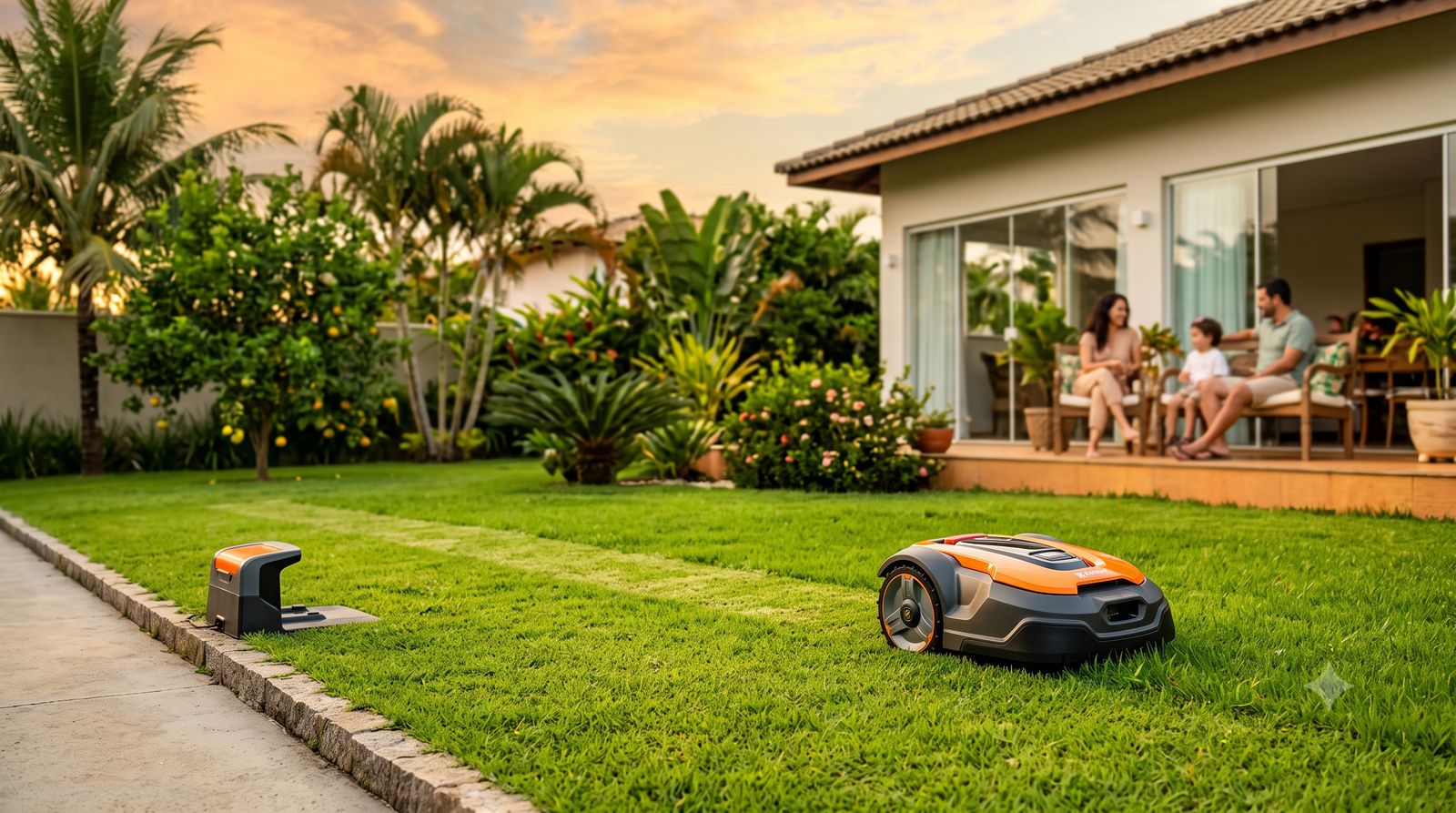
Mowing the lawn is the kind of chore that resists time: it takes a whole afternoon, it is noisy, and the result lasts two weeks. Anyone with a large garden hires someone, and anyone with a small one pushes the mower in the sun. The alternative has existed for years in Europe, where the garden robot is a standard item in DIY shops, and it reached China in a competitive format, with dozens of manufacturers chasing the same customer. In Brazilian retail, however, the category remains almost invisible: it shows up in one-off import listings, priced like a rare product, and not on a shop shelf with a brand, a warranty and after-sales support. That gap is what matters to importers.
What a robotic lawn mower is
It is an autonomous robot that lives in a charging station in the garden and heads out on its own, at the programmed frequency, to trim the lawn. It does not cut a lot at once: it cuts a little, several times a week, and the clippings stay on the ground as mulch, so there is nothing to collect. When the battery runs low, it returns to the base by itself. Rain, obstacles and slopes are handled by sensors, and the blades stop when the mower is lifted off the ground.
How the area is bounded is what separates the generations. On entry-level models, a perimeter wire is pinned along the edge of the lawn and physically defines where the mower may go. On recent models, there is no wire at all: mapping is done through an app and satellite positioning with an RTK antenna, which allows the ground to be split into zones and everything to be changed from the phone. For anyone selling in Brazil, that difference is a counter argument, not a technical detail, because the typical Brazilian garden usually has trees, and dense foliage interferes with the signal.
Models and variations
The category has already organised itself into well defined tiers, and it is that variety that makes it possible to build a line rather than bring in a single product:
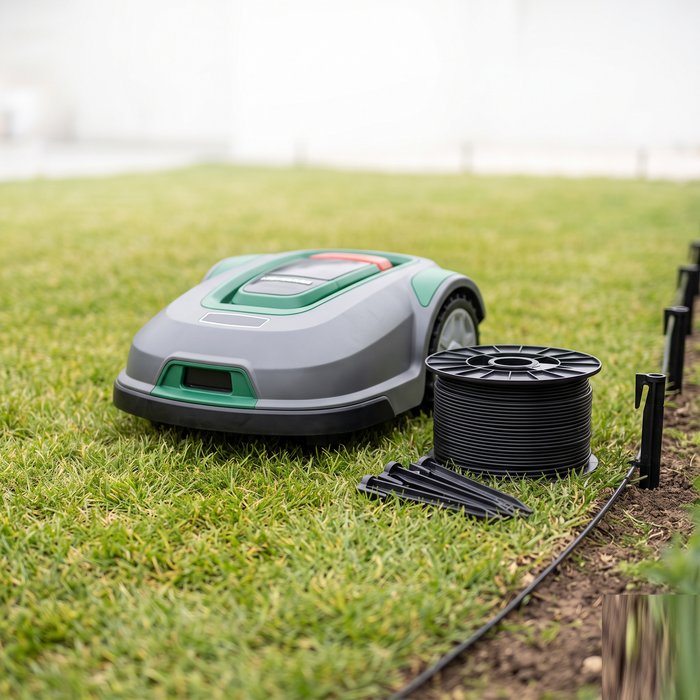
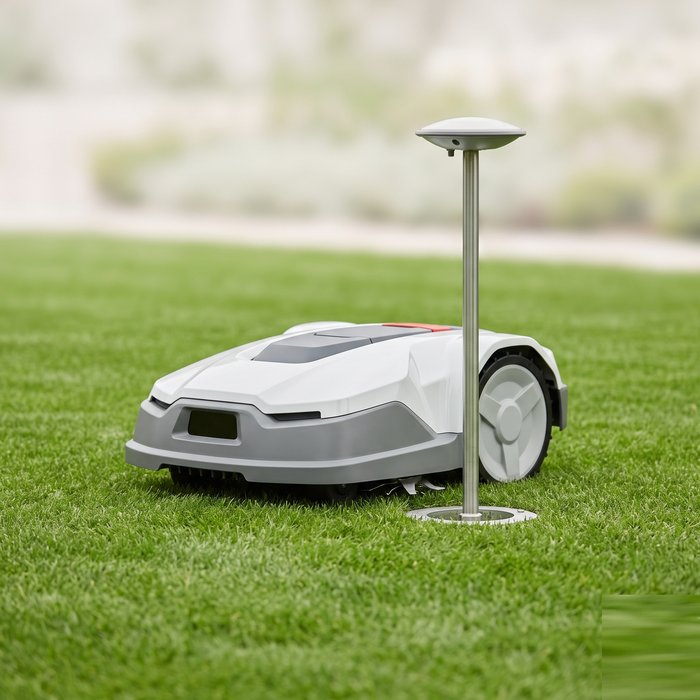
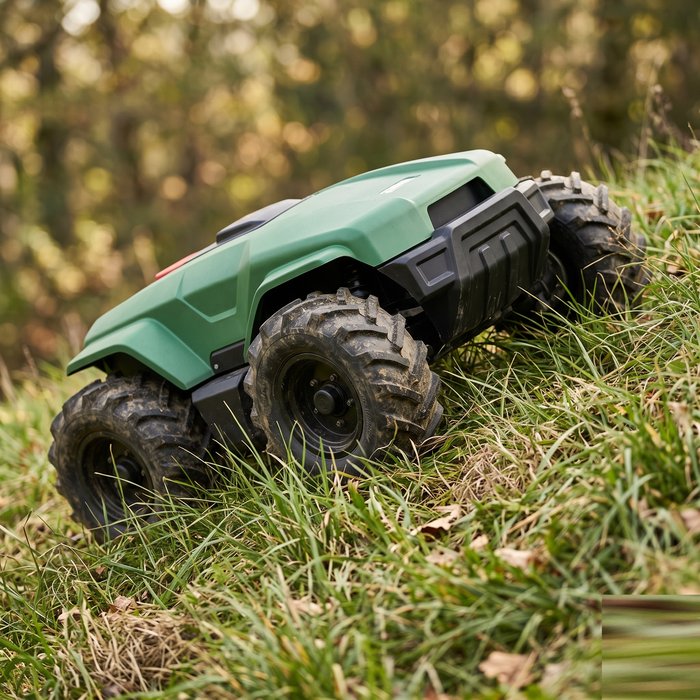
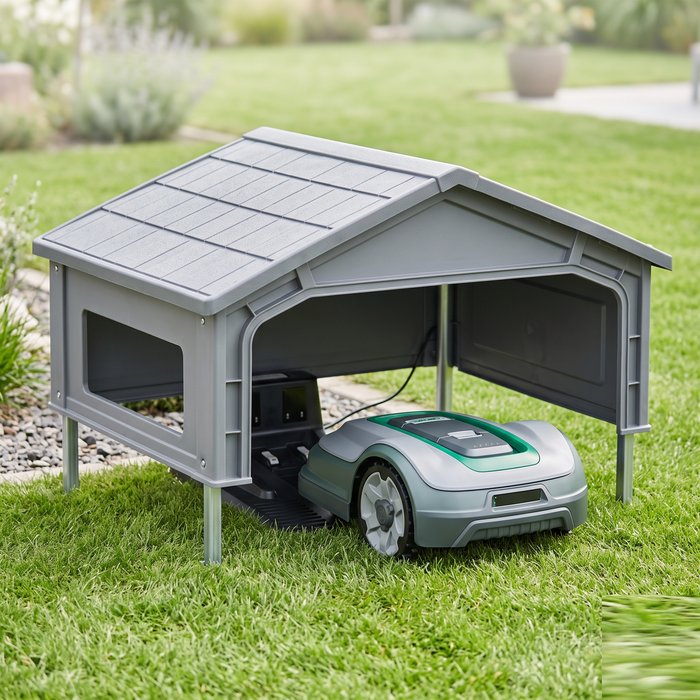
The wired model is still the safest sale for the tree-filled Brazilian garden, and it has the lowest entry price. RTK is what impresses in a demonstration and handles larger, more open areas, with an installation that requires burying nothing. The version with reinforced traction opens up the market of smallholdings, rural plots and sloping ground, where an ordinary mower is a genuine problem. And the station with a shelter is the accessory almost nobody leaves behind, because the equipment sits out in the weather all year round.
Why this is an opportunity for Brazil
This is one of those rare combinations where supply at source is already mature and demand here has not yet been met. Brazil is a country of houses with gardens, horizontal housing estates, smallholdings and green areas around blocks of flats, with grass that grows all year and takes off in the heat.
- A category with little competition: whoever arrives first sets the price instead of fighting over it. It is the opposite of what happens today with earphones, speakers and air fryers.
- High ticket with visual appeal: the product explains itself in a video, which cuts the cost of convincing and raises the chance of the shop becoming the reference in the category.
- It pulls services along: installation, mapping and set-up are additional revenue, and they tie the customer to the retailer rather than to the marketplace.
- A wider audience than it looks: beyond the homeowner, it takes in horizontal housing estates, guesthouses, schools and the gardening service provider, who can then serve more customers with the same team.
- Timing: grass really grows between spring and summer, and the lead time is 60 to 120 days. Whoever buys now is on the shelf in the right season.
Before importing: the electrical items and the battery fall into the regulated families depending on the case, and the classification of the exact model should be confirmed before the order: see the list of products that require INMETRO. The most overlooked point, though, is the radio: since practically every current model has Wi-Fi, Bluetooth or a positioning module, ANATEL homologation applies, the subject of the guide on ANATEL and INMETRO homologation for electronics. Also confirm the safety sensors, for lift and tilt, which stop the blades when the mower is raised, and the rain protection rating, because the equipment lives outdoors. It is worth inspecting before shipment with the mower actually cutting grass, and not merely switched on atop a table.
Put your own brand on it
In a category almost nobody occupies, own branding is worth even more: whoever gets in first under their own name is not compared item by item with ten identical listings:
- Your brand on the product and the packaging (private label / OEM): logo on the body of the mower, on the station and on the box.
- Colour and finish to your choice, which in this category is what most visually distinguishes one model from another.
- App and language: confirm with the factory what can be customised in the app and secure a Portuguese interface, which is what reduces support later.
- Packaging and manual in Portuguese, with a well made step-by-step installation guide, because that is the stage where the customer gives up and returns the product.
Customisation usually calls for a slightly larger minimum order, and BCVN finds the right factory, negotiates the customisation, validates the sample and makes sure the product arrives exactly as you asked for it.
It is worth understanding how this works in practice before requesting the first sample: the guide on own brand in China: private label, OEM and ODM explains the difference between the three models and what each one changes in the minimum order and the lead time.
Where to buy robotic lawn mowers in China
The category lives on the border between garden tool and consumer electronics, and so it shows up in more than one hall:
- Canton Fair, Phase 1 (Electronics and Tools): from 15 to 19 October, where the manufacturers of garden robots, batteries and power tools are.
- Canton Fair, Phase 2 (Home and Garden): from 23 to 27 October, the hall for everything outdoors, from garden accessories to furniture.
- Yiwu Trade Fair: from 21 to 24 October, useful for accessories and for rounding out the garden line, with a low minimum order.
The itinerary the season sets out: all three fall in the same October window, across two cities, with Yiwu (21 to 24) between the Canton phases. Since this category sits between electronics and gardening, seeing both phases is what stops you closing with a supplier before comparing. See the full 2026 trade fair calendar.
It is also worth looking at the robot vacuum, which is the same promise indoors and has already become a commodity, the gardening tool kit and the decorative solar light, which round out the outdoor line.
The story of the robot vacuum has already shown how it ends: it starts as an expensive curiosity, becomes an ordinary product and, when that happens, whoever got in early has already built a brand while whoever got in late fights over pennies. The lawn mower is at the start of that curve in Brazil, with the advantage that manufacturing at source is already mature and cheap. For the retailer, it is the rare chance to open a category instead of joining one. And the season when the lawn grows and the product sells begins a few months from now.
Frequently asked questions about importing robotic lawn mowers
How does a robotic lawn mower work?
It leaves the charging station on its own, covers the area at the programmed frequency and returns to recharge when the battery runs low. Cutting is done by small blades that trim a little at a time, several times a week, instead of cutting a lot in one go, and the clippings stay on the lawn as mulch. The area is bounded in two ways: by a perimeter wire buried or pinned along the edge, on entry-level models, or by no wire at all, using satellite positioning with an RTK antenna and sensors, on the more recent models.
What is the difference between a perimeter wire mower and an RTK mower?
On the wired model, a cable physically bounds the area and installation takes a few hours, with the advantage of working under trees and beneath any cover. On the RTK model, mapping is done through an app and satellite positioning, with no cable at all, which makes installation far simpler and allows the ground to be split into zones, but it depends on a visible sky and struggles where there is dense foliage or a tall obstacle. For resale in Brazil this matters: the wire is still more tolerant of the wooded ground typical of a back garden or a smallholding.
Does a robotic lawn mower imported from China need certification?
The electrical items and the battery fall into the regulated families depending on the case, so the classification of the exact model needs to be confirmed before the order. And since practically every current model has Wi-Fi, Bluetooth or a positioning module, there is ANATEL homologation for the radio part, which is the most overlooked requirement in the category. It is also worth checking the safety, lift and tilt sensors, which stop the blades when the mower is picked up, because that is the item protecting both the end customer and the retailer.
Why does importing robotic lawn mowers from China pay off?
Because the category is mature and competitive at source, with dozens of manufacturers, and is barely offered in Brazilian retail, which is a rare combination. Whoever arrives first sets the price instead of fighting over it, and the product has a high ticket, strong visual appeal and a clear audience: houses with gardens, smallholdings, housing estates and gardening service providers. It is also a sale that pulls installation and set-up work along with it, which helps the retailer defend the margin.
Can I import just one robotic lawn mower for my own home?
BCVN is an import consultancy for retailers and companies, not a retail shop, and does not sell single units. Import maths only works on volume: freight and paperwork are diluted across the batch, and every factory works to a minimum order quantity (MOQ). Anyone who wants a mower for their own garden should buy from a retailer in Brazil; anyone who is going to resell, open the category in their shop or build an own-brand line imports at source, and that is where the savings show up.