
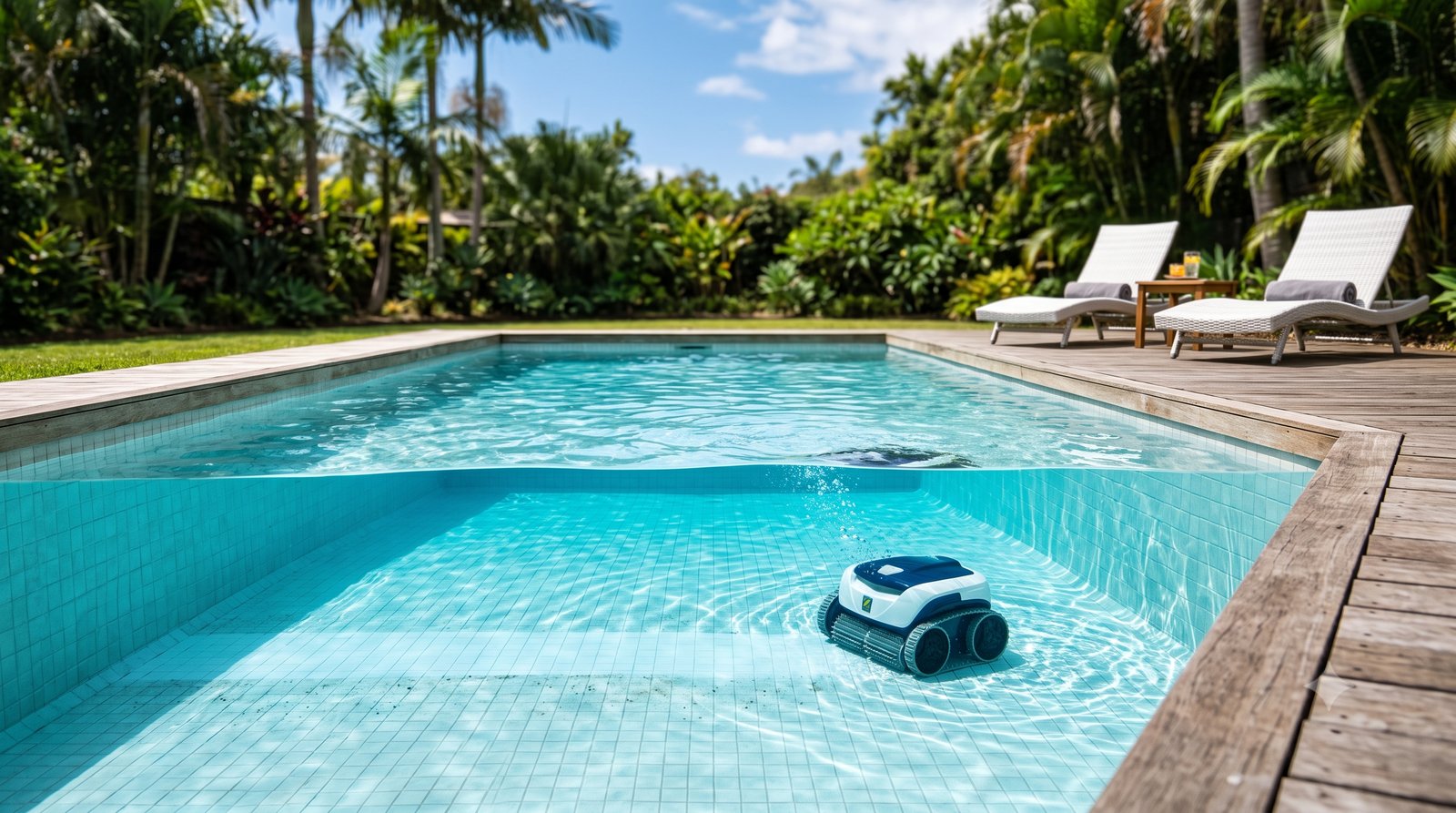
The Brazilian pool is a status item that turns into a household chore. Once the building work is paid for, the routine begins: vacuum the floor, brush the wall, collect the leaves, dose the chemicals, wash the filter. Those who can afford it hire a maintenance professional; those who do not do it at the weekend, precisely on the day they wanted to use it. There is a product category that attacks the dullest part of that routine, it is already common in warm climate markets and it reaches Brazil timidly, almost always through one off imports and at the price of a rare item.
For the retailer, it is the shape of the sale that stands out. The pool customer is a qualified buyer by definition: they have already paid out the expensive part, they already pay for maintenance and chemicals every month, and they are not weighing up whether the pool is worth investing in, they are weighing up how to suffer less with it.
What a pool cleaning robot is
It is an autonomous unit that works submerged, travelling across the floor and vacuuming the dirt into its own internal basket, without relying on the pool pump or filter. Once the cycle ends, the basket is removed and rinsed. In cordless models everything runs on battery and the robot climbs back to the edge on its own when it finishes, which removes the need for a socket nearby and gets rid of the tangling cable. In corded models the power is continuous, which allows long cycles and the climb up the wall to the waterline, which is where grease and dirt build up most and where manual cleaning is the most thankless.
On the shelf that translates into two different sales: the cordless one serves the average residential pool and is the one that charms most in a demonstration; the corded one serves the large masonry pool and the professional who works with several a week.
Models and variations
The category has already organised itself by pool size and by who does the cleaning, and it is that variety that lets you build a range instead of bringing in a single model:
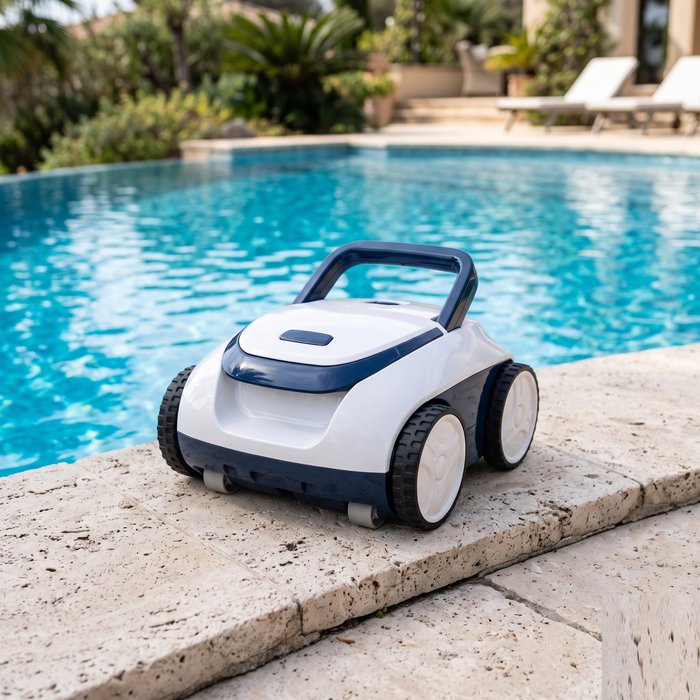
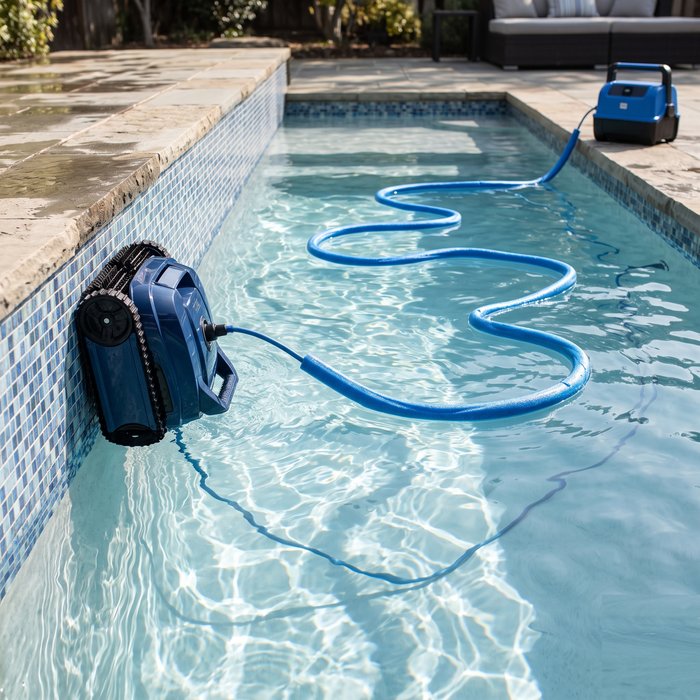
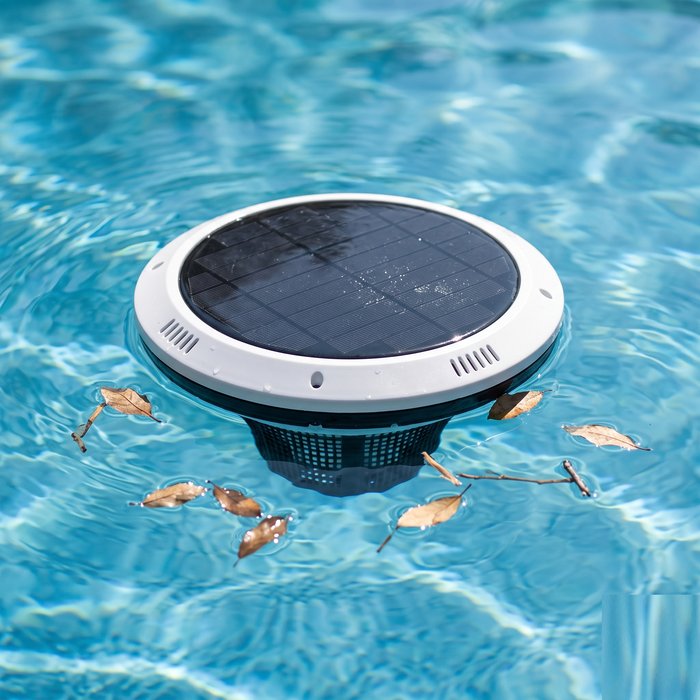
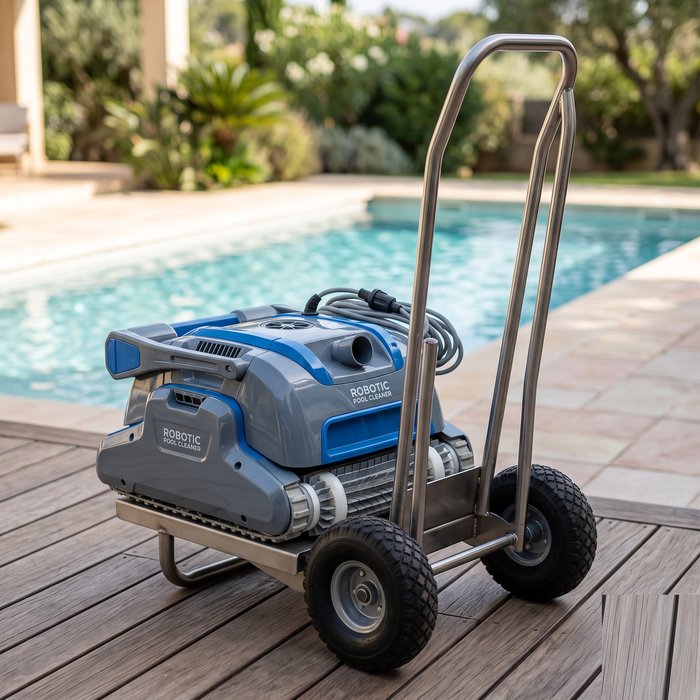
The cordless model has the widest appeal and is the easiest to demonstrate on video. The corded one is what solves a real pool, wall and waterline included, and tends to be the choice of someone who has already understood the problem. The solar skimmer is a clever entry item, because it attacks the leaves while they are still on the surface, before they sink and become work, and it carries an impulse purchase price. And the professional size version, with its transport trolley, opens the channel of the pool service professional, the condominium and the club, who buy in quantity and come back.
Why this is an opportunity for Brazil
Brazil has pools in houses, in condominiums, in guesthouses, in clubs and on country properties, with a long season and heat that stretches use across much of the year. It is an enormous installed base, and the upkeep of it is still done almost entirely by hand.
- The buyer is already qualified: owning a pool is proof of willingness to spend on it. The robot costs a fraction of what the pool cost and solves the part nobody enjoys.
- Two channels in the same product: the pool owner buys one; the maintenance professional buys several, because they serve dozens of clients. The second channel is the one that brings volume.
- High perceived value: it is a product that explains itself on video and whose demonstration is the sales argument in itself, which cuts the cost of convincing.
- A full range from the same supplier: from the impulse skimmer to the professional robot, you can cover several price brackets without changing factory.
- Timing: the season runs from December to March and the lead time is 60 to 120 days. Whoever buys now reaches the shelf before the heat; whoever waits for demand to show up loses the whole season.
Before importing: the electrical items and the battery fall into regulated families depending on the case, and the exact model's classification should be confirmed before the order, as the list of products that require INMETRO shows. The bigger risk, however, is technical: this is equipment that lives submerged, and the sealing decides whether it lasts years or a single season. Check the protection rating, the quality of the seal and, above all, how the battery is replaced, because a sealed robot with a non replaceable battery becomes expensive rubbish in its second summer. Add to that the lithium battery, treated as dangerous goods on shipment, with its own packaging and paperwork, the subject of the guide on freight from China to Brazil. It is worth inspecting before shipment with the robot in the water, running a full cycle, and not merely switched on out of it.
Put your own brand on it
In a category where the customer compares little and trusts the seller, an own brand is worth a great deal: it turns a generic product into a range only your shop has:
- Your brand on the product and the packaging (private label / OEM): logo on the robot body, on the trolley and on the box.
- Colour and finish of your choosing, in a product where nearly every competitor is the same blue and white.
- Basket, brush and battery as spare parts under your brand: they are wear items, and whoever controls replacement keeps the customer in their own shop.
- Packaging and manual in Portuguese, with clear instructions on maintaining the seal and the basket, which is what cuts returns in this category.
Customisation usually calls for a slightly larger minimum order, and BCVN finds the right factory, negotiates the customisation, validates the sample and makes sure the product arrives exactly as you asked for it.
It is worth understanding how this works in practice before requesting the first sample: the guide on own brand in China: private label, OEM and ODM explains the difference between the three models and what each one changes in the minimum order and the lead time.
Where to buy pool robots in China
The category sits between consumer electronics and outdoor goods, and for that reason it turns up in more than one hall:
- Canton Fair, Phase 1 (Electronics and Home Appliances): from 15 to 19 October, where the robot, battery and motor manufacturers are.
- Canton Fair, Phase 2 (Home and Outdoor): from 23 to 27 October, the pool, garden and leisure hall, useful for rounding the range off with accessories.
- Yiwu Trade Fair: from 21 to 24 October, good for fast moving pool accessories with a low minimum order.
The itinerary the season draws: all three fall in the same October window, in two cities, with Yiwu (21 to 24) between the Canton phases. Since the robot lives in electronics and the accessory lives in home goods, seeing both phases is what lets you close the entire range in a single trip. See the full 2026 trade fair calendar.
It is also worth seeing the inflatable pool and the floats, which serve a different customer and a different moment, the robot lawn mower, which solves the other tedious job outdoors, and the robot vacuum cleaner, which made the same journey indoors.
A pool is one of the few purchases where a person pays dearly to create a new chore for themselves. Every product that gives the weekend back to someone who has already paid for it finds a willing buyer, and that is why this category sells without needing a discount. For the retailer, it is a high perceived value sale to a customer who does not hunt for pennies. And the season it happens in starts in December, which puts the buying decision exactly now.
Frequently asked questions about importing pool robots
How does a pool cleaning robot work?
The robot is placed in the water and works on its own, travelling across the floor and vacuuming dirt into an internal basket, without relying on the pool pump or filter. Cordless models run on battery and climb back to the edge on their own when they finish or when the charge runs out. Corded models have continuous running time and usually climb the wall and clean the waterline, which is where grease and dirt build up most. In both, the basket is removed and rinsed at the end of the cycle.
What is the difference between a corded and a cordless pool robot?
The cordless one is more practical, it does not tangle and does not need a socket nearby, but its running time is limited by the battery and it tends to concentrate on the floor. The corded model has continuous power, which allows long cycles and the climb up the wall and the waterline, at the cost of managing the cable and depending on a power source out of the water. For resale, the two sell to different audiences: the cordless one to the average residential pool, and the corded one to whoever has a large masonry pool or works as a professional.
Does a pool robot imported from China need certification?
The electrical items and the battery fall into regulated families depending on the case, and the exact model's classification needs to be confirmed before the order. But the critical point in this category is technical before it is regulatory: this is equipment that works submerged, so the sealing defines whether it lasts years or one season. Check the protection rating, the quality of the seal and how the battery is replaced, because a robot that takes on water has no repair worth paying for.
Why does importing pool robots from China pay off?
Because the customer in this category has already proved they spend on the pool: they paid for the construction, they pay for maintenance and chemicals every month. The robot is a fraction of that and solves the tedious part, so it is a high perceived value sale to a qualified buyer. Add to that the second channel, the pool maintenance professional, who buys in quantity because they serve dozens of clients, and the category sustains volume all year, peaking in summer.
Can I import just one pool robot for my own home?
BCVN is an import consultancy for retailers and companies, not a retail shop, and it does not sell single units. The maths of importing works on volume: freight and paperwork dilute across the batch, and every factory works with a minimum order quantity (MOQ). Anyone who wants a robot for their own pool buys from a reseller in Brazil; anyone who is going to resell, work as a maintenance professional or build a range under their own brand imports from the source, and that is where the saving appears.