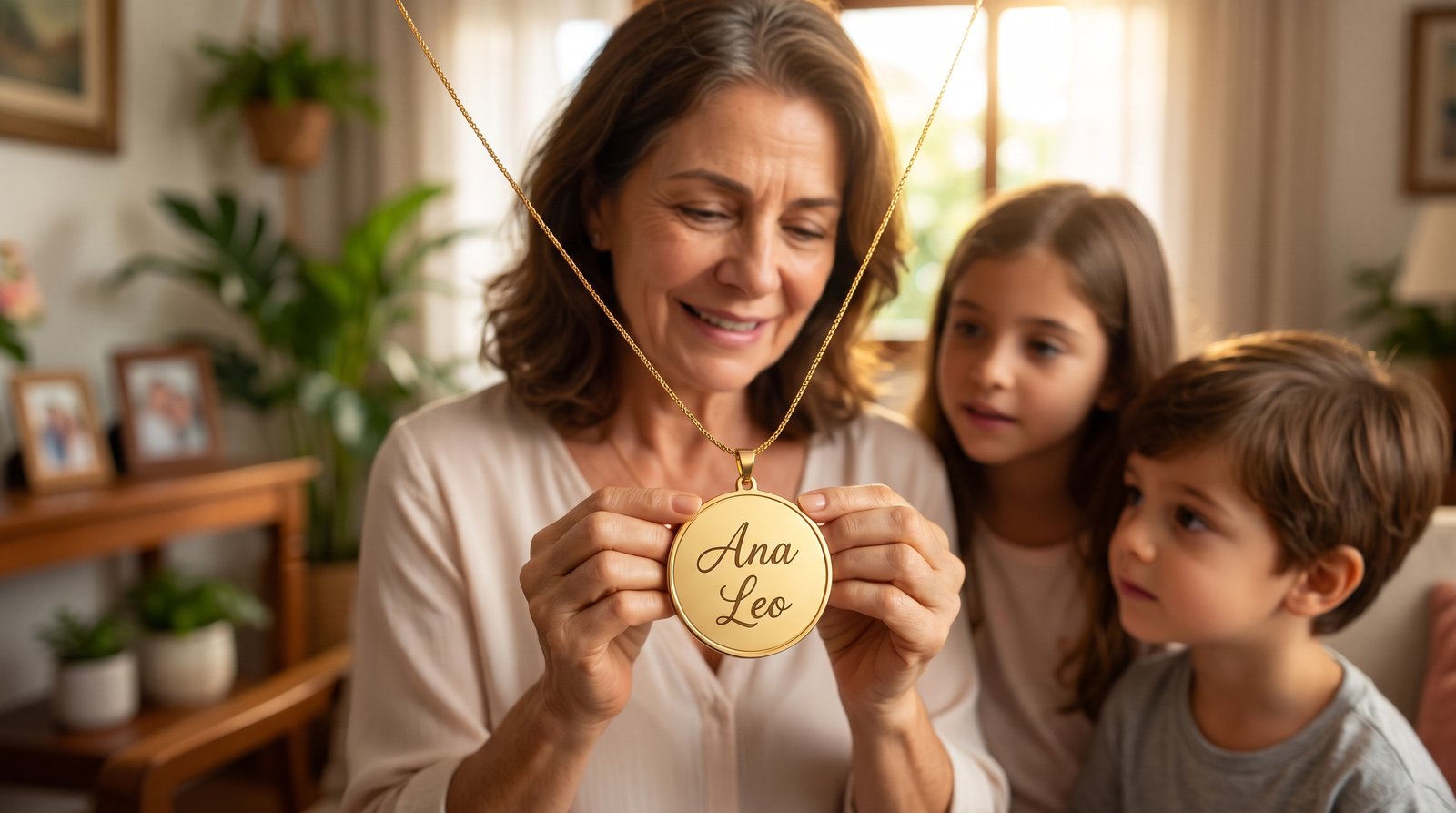
The May customer is easy to recognise. She comes in a hurry, looks at the necklaces, picks up two, puts both back and asks the question that decides the sale: do you have anything different? She is not looking for a more expensive piece. She is looking for one her mother does not have yet, and her mother, at sixty, already has them all.
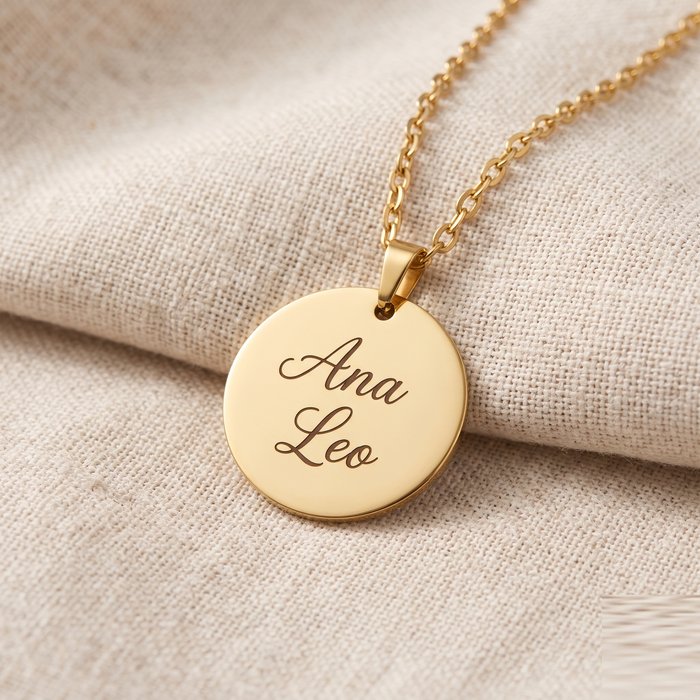
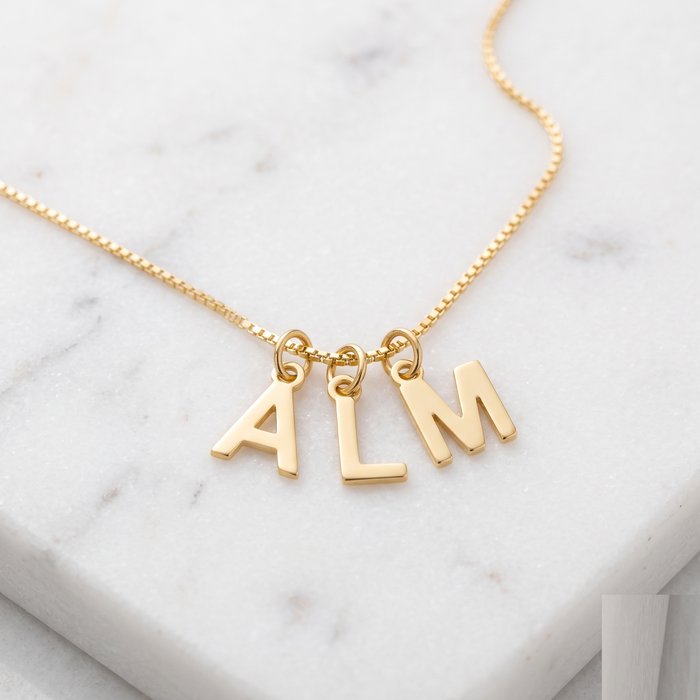
The answer that closes the sale is an old one, and it is back in force: jewellery with the children's names. A medallion with two names, a bracelet with the date each one was born, each grandchild's initial on a single chain. Nobody compares that gift with another, because there is no other like it. What matters to the importer is the part the customer does not see: the piece comes blank from China, in quantity, and the name is engraved here, on the spot, with a machine that fits on a workbench.
What engraved personalised jewellery is
It is two separate purchases that only become a product together. The first is the blank piece: medallions, tags, hearts, discs and bangles with nothing written on them, made to be engraved. The best come in 316L stainless steel, in silver or gold by PVD (a coating applied in a vacuum, far tougher than ordinary plating), and in 925 silver for the higher price point. It is the same supply chain as the factories of stainless steel jewellery, with one difference that is worth money: a single blank model serves any name, so there is no stock of wrong names left unsold.
The second is the fibre laser engraver, a benchtop machine the size of a printer, connected to a computer. It marks metal, which is what the CO₂ or diode laser engraver, the one in the desktop CNC engraver find, does not do well: the fibre laser writes on steel and silver with a fine, permanent line, and a name on a medallion takes from a few seconds to a minute. This is where the Chinese side of the product lies. The laser source, the expensive part of the machine, came to be mass-produced in China by companies such as Raycus, from Wuhan, and Max Photonics, from Shenzhen, and that is what took a factory technology to a shop counter.
Models and variations
In practice, the range is built from a few blank models and many combinations. These are the formats that sell most around the date, and the machine that transforms them:
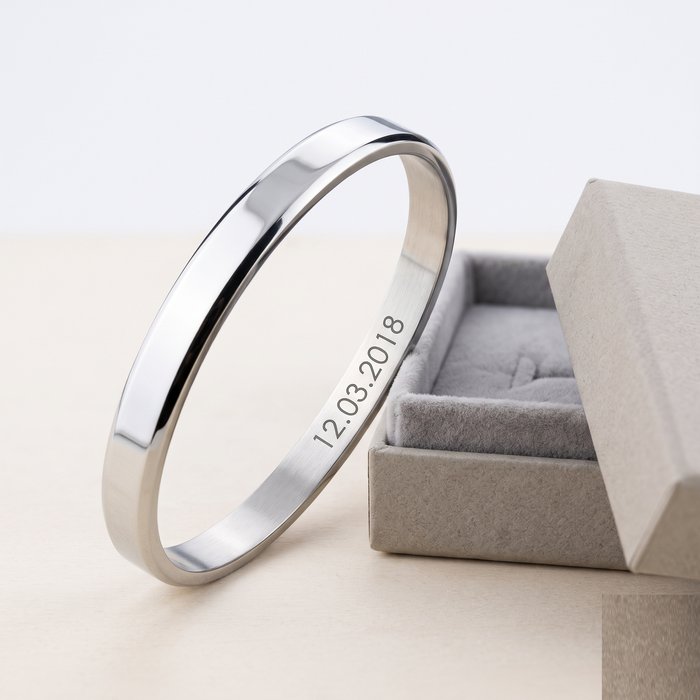
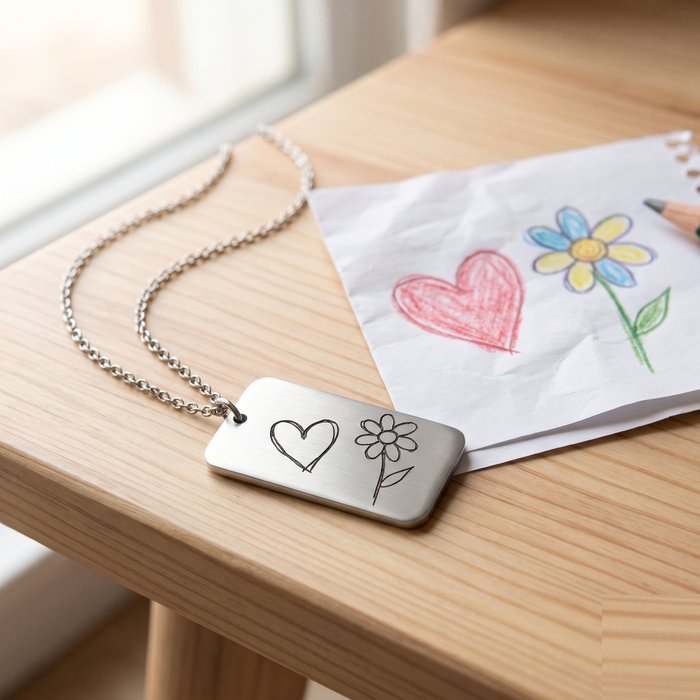
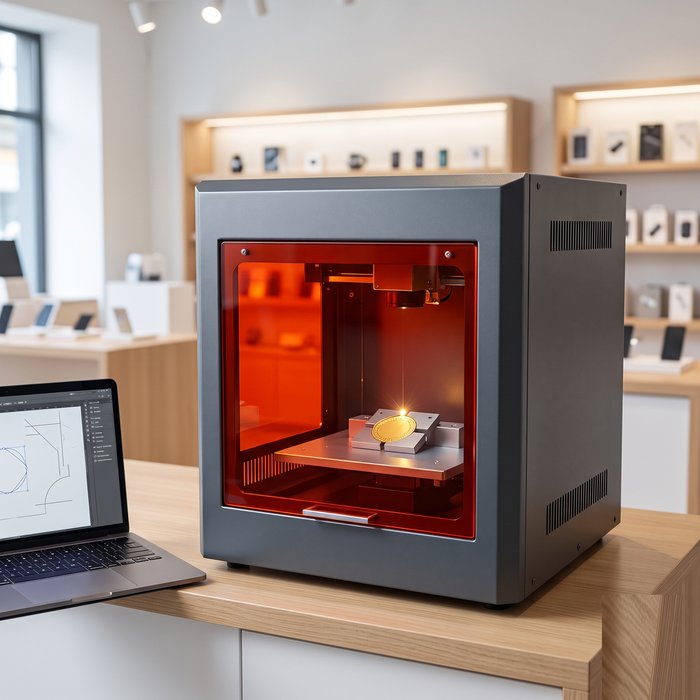
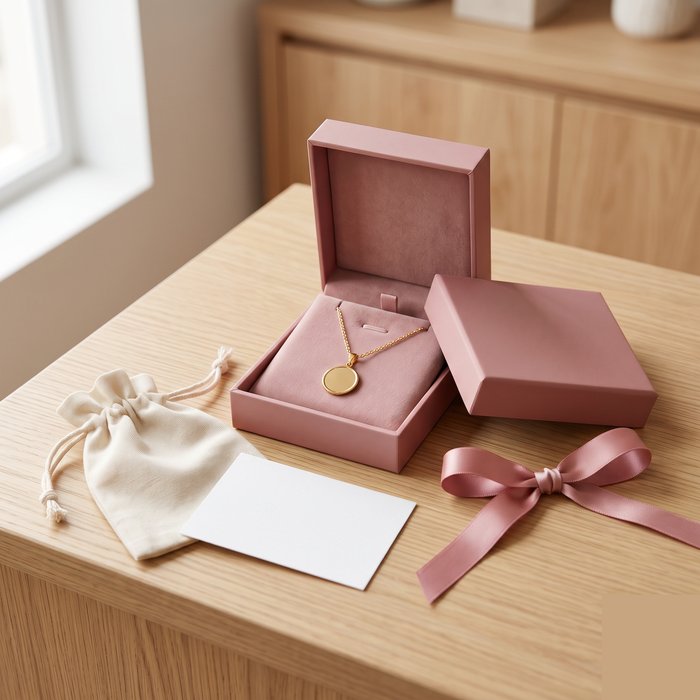
The child's drawing is on the list because it is what moves people most, and the machine does it as easily as a name: the shop photographs the paper, the engraver's software turns the stroke into a line, and the laser copies it. Choosing the right blank pieces, with the alloy and finish that withstand daily wear, and the machine with the protection a shop requires, is exactly where BCVN comes in.
Why this is an opportunity for Brazil
- The gift with no comparison on Mother's Day. The date is the strongest in Brazilian retail after Christmas, and the ordinary accessory competes on price with the shop next door. The piece with the children's names does not compete: the customer has nothing to compare it with, and pays for the name, not for the metal.
- The value is in the engraving, and the engraving is yours. The blank piece costs little at origin, and what the customer pays on top is the name, which the shop engraves. It is a margin that does not depend on finding a cheaper supplier than your competitor's.
- Simple stock, no unsold models. Half a dozen blank formats, in two or three colours, cover any order. What is left in June still works for Christmas, because it has no name written on it.
- The engraving sells itself. Done at the counter or the kiosk, in front of the customer, it is a show and proof of quality at the same time. In an online shop, it lets you engrave and ship on the same day, a lead time that anyone ordering the piece already engraved from abroad cannot offer.
- It does not end in May. After the mothers come Brazil's Valentine's Day, on 12 June, with the couple's initials and the date, Father's Day, with the steel tag, and Christmas. The machine works all year round, and each new date is just a new file on the computer.
- The calendar is tight now. With 60 to 120 days between the order and the shelf, and with Chinese New Year shutting factories from 6 February 2027, the pieces and the machine for Mother's Day have to leave China before then. The guide to planning imports from China in 2027 shows the whole year.
A technical trap, before choosing the pieces: engraving gold-plated jewellery removes the plating along the engraved line. The laser cuts through the gold layer, which is only a few microns thick, and exposes the metal underneath, almost always brass, which darkens with sweat and can irritate the skin right where the letters are. That is why the piece for engraving is chosen by its metal, not its shine: on 316L steel, even in PVD gold, what shows underneath is steel, which does not oxidise; on 925 silver, it is silver. Gold-plated jewellery is still excellent for the display, but not for taking a name.
Before importing: there are two purchases here, and each has its own rule. The piece falls under Portaria Inmetro 123/2021, a Brazilian ordinance in force since 1 April 2021, which covers costume and fine jewellery, for adults or children, sold or given away: cadmium cannot exceed 0.01% and lead cannot exceed 0.03%, by weight of the metal in each piece. There is no compulsory certification and no seal, and this is where many people get it wrong: the responsibility lies with the importer, enforcement is in the market, by Inmetro and the state Ipem institutes, and an infringement falls under the penalties of Law 9.933/1999. In practice, ask for the laboratory report for the batch, not the one in the catalogue, and confirm it in a pre-shipment inspection. The ordinance sets no limit for nickel, but it is the most common cause of contact allergy, and jewellery with the children's names is the kind that never leaves the neck: one more reason for 316L steel and 925 silver. The machine is work equipment, and NR-12, the Brazilian machinery safety standard, prohibits importing, selling and displaying machines that do not comply with it, with guards, an emergency stop and a manual in Portuguese. An open fibre engraver is usually declared by the manufacturer itself as a class 4 laser: for a shop, with customers watching, choose the enclosed model, with a lid and an interlock that switches the laser off when it is opened, and keep the protective goggles for the 1,064 nm wavelength and the fume extraction. Check the voltage (127 V or 220 V) and ask an accredited certification body for the machine's Inmetro classification in writing.
Put your own brand on it
Here, private label is more than a logo: it is what turns a blank piece, which any competitor can buy, into jewellery the customer recognises as coming from your shop.
- Your brand on the piece and the packaging (private label / OEM): the logo engraved on the back or on the clasp, the little box and the card with the shop's name, and the fabric pouch for delivery.
- Shapes, colours and finish of your choice: a medallion, heart or disc in an exclusive design, in silver, gold or rose by PVD, with the right thickness so the engraving does not mark the other side of the piece.
- The machine ready for the shop: the engraver at the right voltage, with the manual in Portuguese that NR-12 requires and fixing jigs made for your pieces, so the engraving comes out centred the first time.
Customisation usually calls for a slightly larger minimum order, and BCVN finds the right factory, negotiates the customisation, validates the sample and makes sure the product arrives exactly as you asked for it.
It is worth understanding how this works in practice before requesting the first sample: the guide on own brand in China: private label, OEM and ODM explains the difference between the three models and what each one changes in the minimum order and the lead time.
Where to buy jewellery for engraving in China
There are two different aisles, and it pays to cover both in the same order: the one for the blank pieces, which is jewellery, and the one for the machine, which is equipment.
- Yiwu Trade Fair: the permanent markets of Yiwu, open all year apart from Chinese New Year, concentrate the steel pieces for engraving, the letters, the chains, the little boxes and the counter displays, with low minimum orders.
- Shenzhen International Jewellery Fair: Shenzhen is the heart of jewellery manufacturing in China, and it is where the PVD steel and 925 silver factories that accept an exclusive design are found.
- Canton Fair, Phase 1 (machinery): the fibre laser engraver is in the machinery aisle, and it is the place to see three or four models engraving the same medallion, side by side, and compare the finish of the line.
The fairs and the Mother's Day calendar: the jewellery fairs in Shenzhen and Hong Kong return in September 2027, following the usual pattern of both, and Phase 1 of the 141st Canton Fair is expected from 15 to 19 April 2027, also following the fair's usual pattern, with no official calendar yet. For Mother's Day, both come too late. The order closes now, with samples of the pieces sent from China, a medallion engraved by the machine's factory as proof of the line, and validation done remotely. The guide to China's 2027 holidays shows what has to leave before Chinese New Year, and the China trade fair calendar 2027 shows the whole year.
The decision that is worth money here is not choosing the prettiest piece in the catalogue, because the factories all offer the same ones. It is putting together the right pair: blank pieces in a metal that withstands engraving and daily wear, with a report for the batch, and a machine a shop can keep in full view of the customer without any NR-12 problem. Whoever gets this right has, in May, the only gift in the shop that compares with nothing else, and engraves the name while the customer waits.
Frequently asked questions about importing personalised jewellery
Does personalised jewellery imported from China need Inmetro certification?
There is no compulsory certification, but there is a rule. Portaria Inmetro 123/2021, a Brazilian ordinance, limits cadmium to 0.01% and lead to 0.03%, by weight of the metal in each piece, for costume and fine jewellery for adults or children, including pieces given away as gifts. The importer is responsible for compliance, and enforcement happens in the market, by Inmetro and the state Ipem institutes. That is why it pays to ask for a laboratory report on the batch itself and to confirm it in a pre-shipment inspection. The laser engraver is a separate purchase, and falls under NR-12.
Can a name be engraved on gold-plated jewellery?
It can, but it is not the best choice. The laser cuts through the gold layer along the engraved line and exposes the metal underneath, almost always brass, which darkens with sweat and can irritate the skin right where the letters are. For engraving, the right piece is made of 316L stainless steel, in silver or PVD gold, where what shows underneath is steel, which does not oxidise, or of 925 silver.
When should the order for personalised jewellery be placed for Mother's Day in Brazil?
Mother's Day 2027 in Brazil falls on 9 May, and the time between the order in China and the shelf in Brazil is usually 60 to 120 days. In between comes Chinese New Year, on 6 February 2027, which shuts factories for two to four weeks. In practice, the blank pieces and the engraver have to be ordered in November or December 2026, or in the first days after the factories reopen. The advantage of this product is that the engraving is done in Brazil: a piece that arrives in April still becomes a personalised gift in May.