
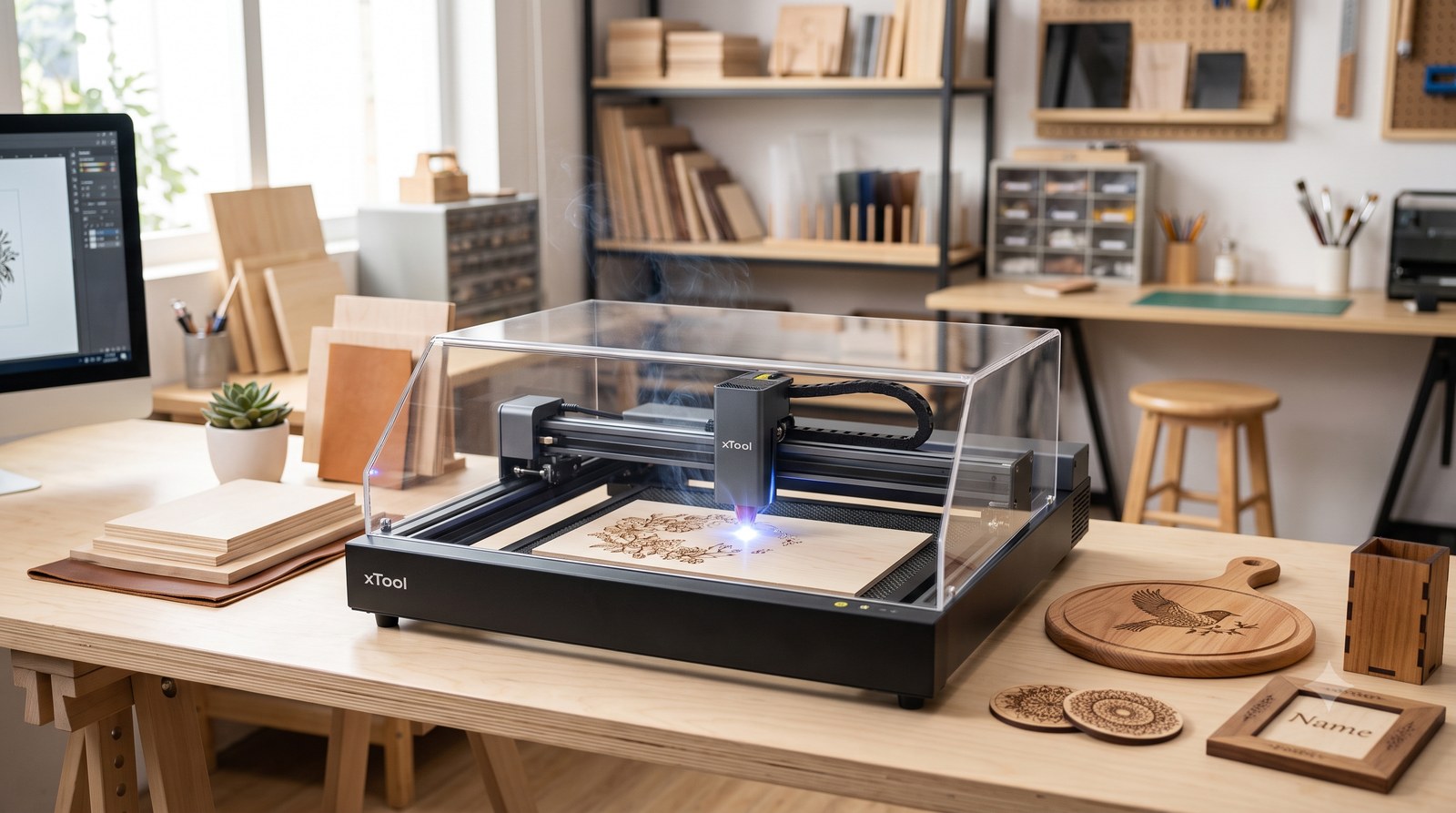
The scene has been growing in every town. Someone wants a barbecue board with a name engraved on it, an acrylic keyring with the company logo, a hundred cut-out invitations for a wedding. And there is no local print shop that will do it small and fast at a price worth paying. Except the one who profits from that demand is not the end customer: it is the entrepreneur who put a laser machine on the bench at home, and the importer who realised that machine costs, at source, a fraction of what is charged for it in Brazil.
What the desktop CNC laser machine is
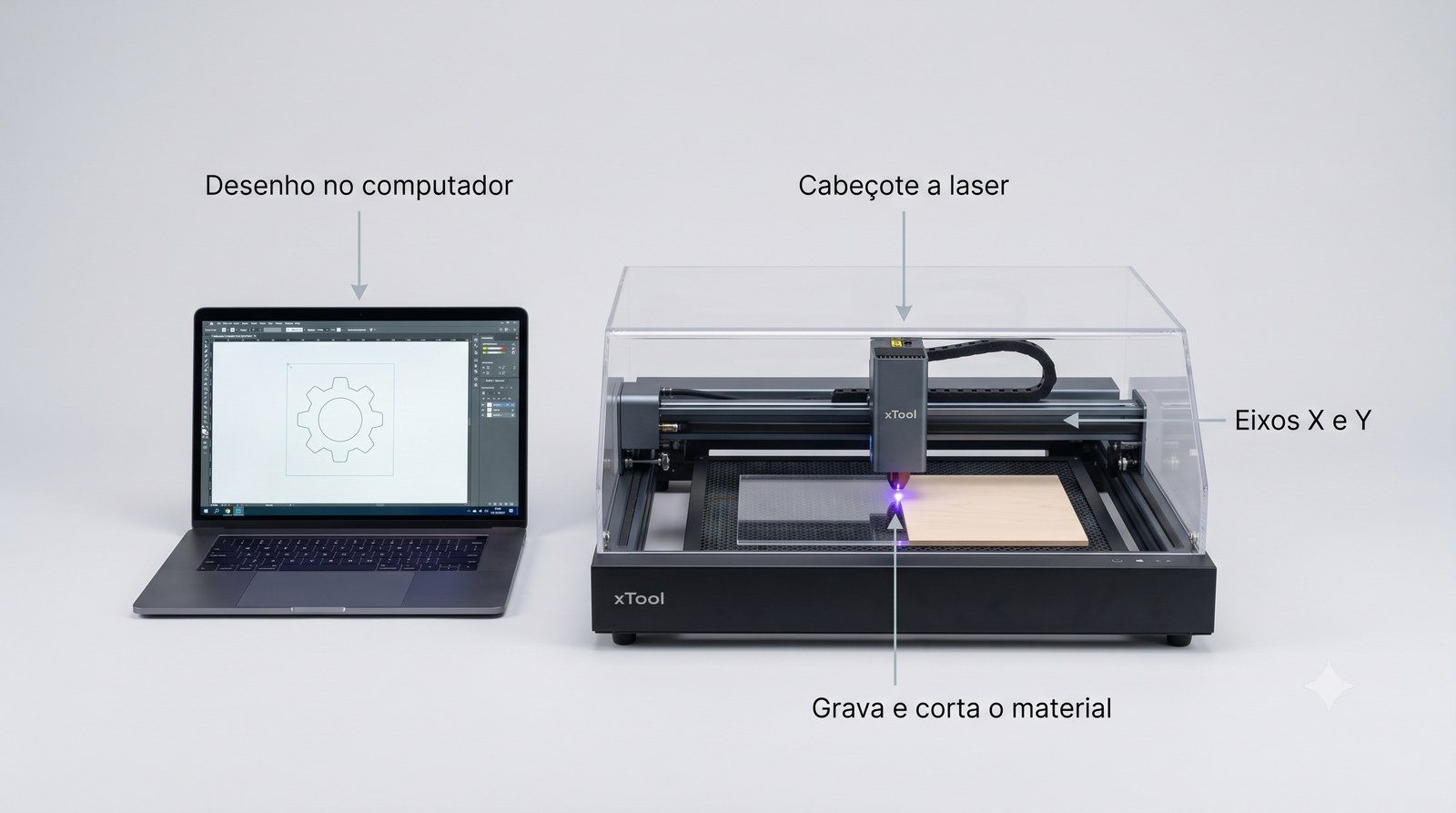
It is a compact laser engraver and cutter, driven by software (CNC). You draw or load a piece of artwork on the computer, and the machine moves the laser beam over the material, engraving or cutting with a precision of tenths of a millimetre. It engraves wood, leather, acrylic, MDF, glass and some coated metals, and cuts thin materials into any shape.
There are two main types. The diode laser is cheaper and more compact, ideal for engraving and light cutting. The CO2 laser is more powerful, cuts acrylic and MDF with room to spare and engraves glass and fabric. It is that ladder that makes the machine serve both the craftsperson who is just starting out and the small promotional goods business already selling in volume.
Why this is an opportunity for Brazil
Brazil has a giant market in personalised gifts, crafts, signage, decoration and keepsakes, and a legion of people wanting to set up their own business with little capital. The laser machine fits exactly there, and the sums work for two importer profiles at once: whoever buys to produce and whoever buys to resell the equipment.
- A machine that pays for itself: the raw material is cheap (a sheet of MDF, a sheet of acrylic) and the personalised product sells dear. It is one of those pieces of equipment where the return is counted in months of operation, not in years.
- Cheap to buy at source, resells well: the gap between the factory price in China and that of an assembled machine at Brazilian retail opens a comfortable margin, both for the equipment reseller and on the repeat-purchase consumables.
- Import timing: the machine is not seasonal, but it does have a lead time. Between manufacturing, sea freight and clearance, counting on 60 to 120 days means placing the order with room to spare before promising delivery.
- A wide and visual audience: the craft studio, the quick print shop, the promotional goods shop, the joiner, the creator selling their own brand. And it is a product that sells itself in video, which pulls online resale along.
Before importing: being electrical equipment, confirm the INMETRO requirement and the right voltage (110V or 220V). Because it emits radiation, pay attention to the laser safety class, with an enclosed cabinet or suitable protection, and to fume extraction. The quality of the laser module or tube varies a great deal between factories, and this is a case where inspecting before shipment and securing technical support avoids buying a problem instead of a machine.
Customise the specification (OEM)
Importing machinery from China is not picking the catalogue model and hoping it works out. The manufacturer adjusts the equipment to your use, and that is where having a partner at source separates whoever resells a commodity from whoever builds a serious operation.
- The right power, work area and laser type for your material: diode or CO2, a larger or smaller bed, an enclosed cabinet with extraction.
- Your brand on the equipment (private label / OEM): name, colour and software in Portuguese, to resell as a line of your own.
- After-sales and parts agreed at purchase: laser module or tube, belts, lenses and the technical support, which on a precision machine is what keeps the operation alive.
That usually calls for negotiating directly with the factory and validating a sample before the batch. BCVN finds the right manufacturer, closes the specification, tests the machine and makes sure the support really exists, and not only in the proposal.
Where to buy CNC laser machines in China
The desktop laser machine lives at the crossing of two sectors, machinery and maker technology, and it turns up at the fairs that bring the two together:
- Canton Fair, Phase 1 (Machinery and Equipment): the biggest starting point, with CNC and laser machine manufacturers side by side and the chance to see the equipment engraving on the spot.
- APPP EXPO, in Shanghai: the largest printing, advertising and maker technology fair in China, with aisles dedicated to laser, CNC and engraving. It is the sector fair that goes deeper into what the Canton Fair introduces.
- Yiwu Trade Fair: ideal for closing on consumables, accessories and the blank promotional items to engrave, at the largest small-commodities wholesale market in the world.
Next edition, Canton Fair 2026 (140th): Phase 1, with machinery and equipment, runs from 15 to 19 October 2026, at the Pazhou complex in Guangzhou. It is the chance to see the machine engrave and cut in front of you before closing the purchase, which changes everything when it comes to a production investment.
Read the complete guide to the Canton Fair 2026
The desktop laser machine is not a passing trend. It is the equipment that lowered the barrier to entry in personalisation and created, in one go, a market of people who produce and a market of people who sell machines. For the Brazilian importer, the question is not whether it is worth it, but buying the right machine, at the right power, from the manufacturer that will still be around to sell the next spare part.
Frequently asked questions about importing CNC laser machines
Do I need certification to import a CNC laser engraver?
Yes. Being electrical equipment, the laser machine normally requires INMETRO certification, and the voltage has to be confirmed (110V or 220V) for your region. Because it emits laser radiation, the safety class of the equipment also matters, with an enclosed cabinet or protective goggles. Check all of it before placing the order.
What is the difference between a diode laser and a CO2 laser?
The diode laser is cheaper and more compact, excellent for engraving wood, leather, acrylic and coated metals, and it cuts thin materials. The CO2 laser is more powerful, cuts acrylic and MDF with ease and engraves glass and fabric. The choice depends on the material and on the workload of your business.
How much does it cost to import a desktop laser machine from China?
The cost at source is a fraction of the price of the machine already assembled and resold in Brazil, which opens a margin both for whoever is going to use it and for whoever is going to resell the equipment. The figure varies with the power (from a few watts on a diode to tens of watts on a CO2), the work area and the enclosed cabinet. BCVN quotes the right machine for your material and volume.
Where can I find laser machine suppliers in China?
At the Canton Fair (Phase 1, machinery and equipment) and at the printing, advertising and maker technology fairs, such as APPP EXPO in Shanghai. The Yiwu Trade Fair helps with closing on consumables and accessories. BCVN validates the manufacturer, the technical support and the supply of parts such as the laser module or tube.