
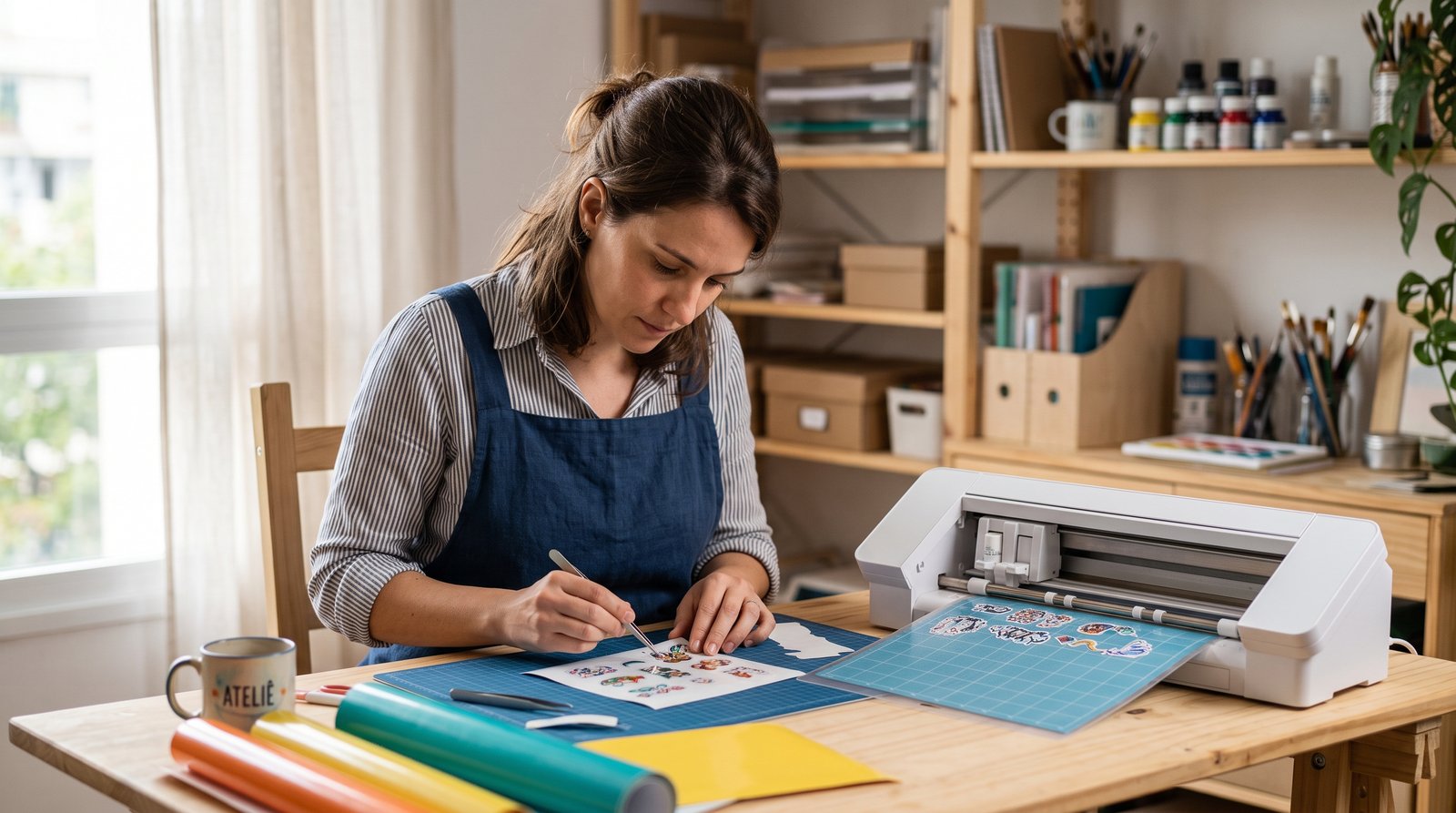
The sum is this: how many sales does it take for this machine to pay for itself? Nobody asks that when buying an air fryer. Here it is the first question, and sometimes the only one. The person on the other side has already seen someone cutting stickers on their phone, already knows what a set of personalised party favours costs and has already divided one number by the other before opening the conversation. She does not want a good-looking device, she wants one that survives the first orders. And because the answer to that question depends on one or two concrete specifications, the reseller who does not know them loses the sale to the one who does, even while charging more.
What a cutting plotter is
It is a desktop machine that drags a tiny blade over a material in sheet or roll form and cuts out the shape drawn on the computer. The blade sits loose in a holder and swivels on its own to follow the curve, like a rudder, and the machine controls two things: how much downward force it applies and how fast it travels. There is no ink, no heat, no fumes. Out of the box, plug it in and it cuts.
What it cuts is what defines the business of whoever bought it. Adhesive vinyl for mugs, bottles, walls and shop windows. Heat transfer vinyl, which goes onto a T-shirt with a heat press. Paper and card for invitations, boxes and scrapbooking. And, on the machines with more force, materials that come as a surprise: foam sheet, magnetic sheet, felt, thin leather and even a thin sheet of wood. That is why the same machine turns up in the hands of the cake decorator, the schoolteacher, the gift shop owner and the young man making motorbike decals at the back of the yard.
Models and variations
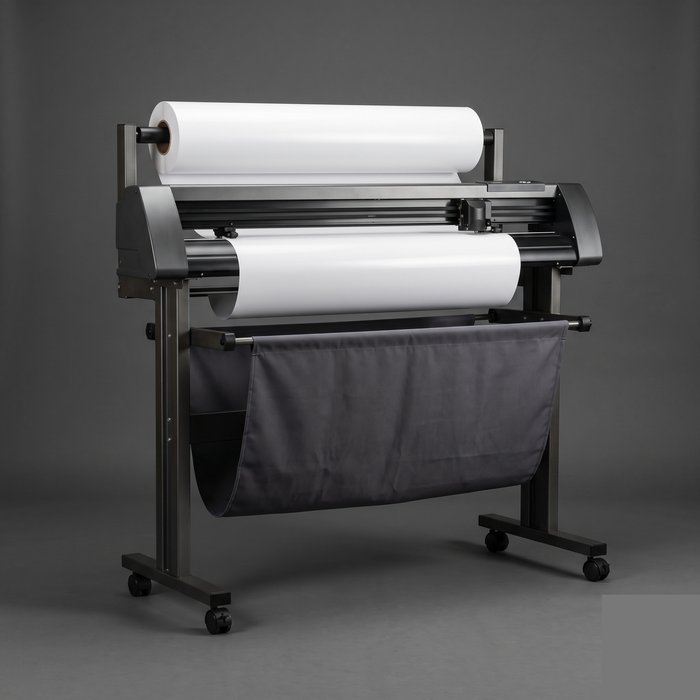
It is not a product, it is a ladder. At the fair that shows up as bands of width and of force, and each rung serves a different stage of the customer's business.
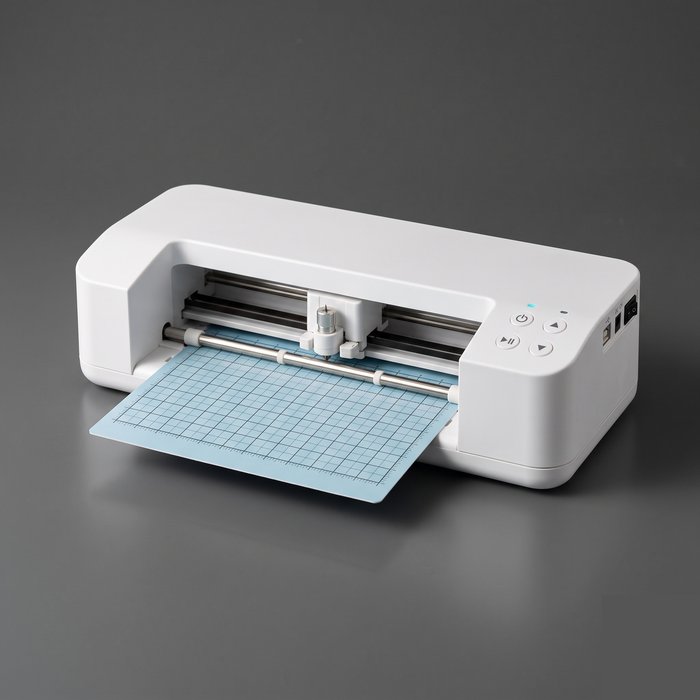
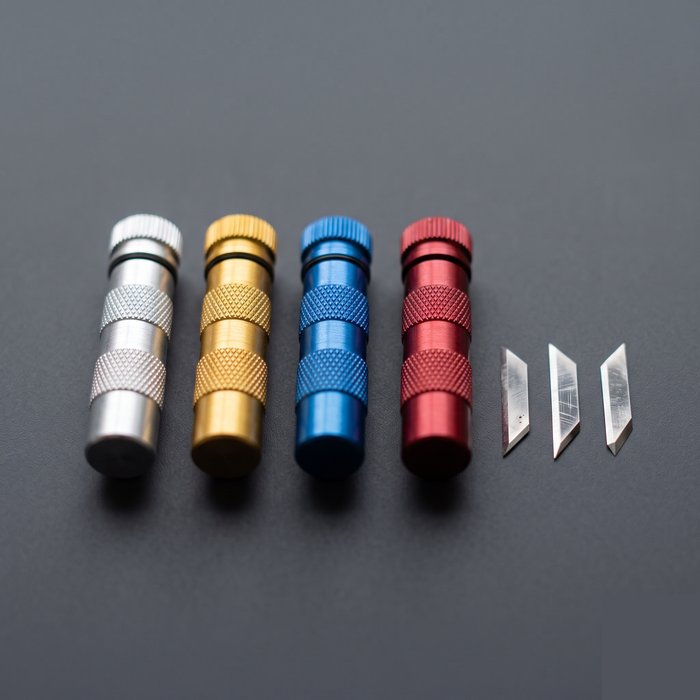
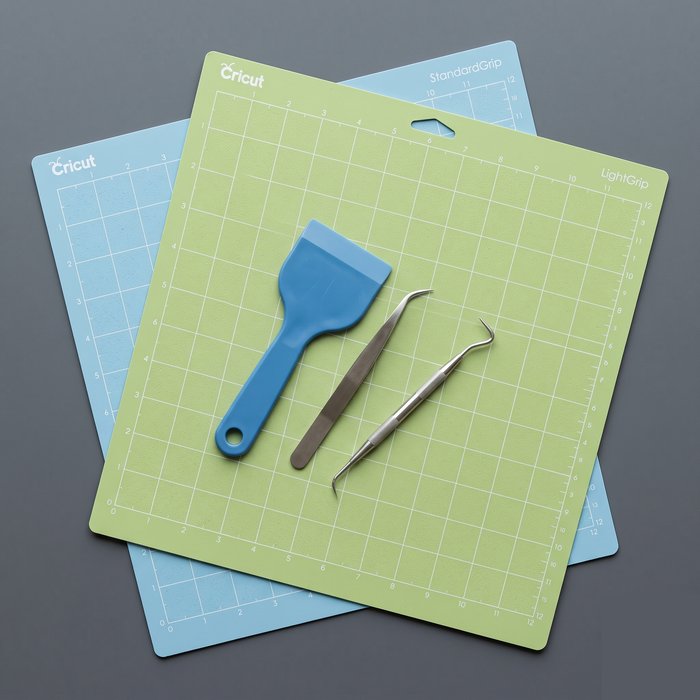
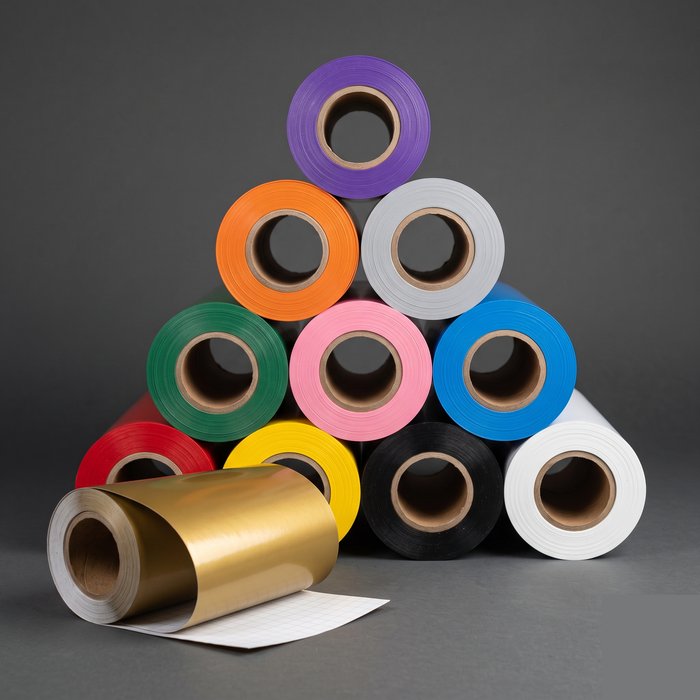
Building the right ladder, with the entry machine and the next rung already in stock, and finding the factory that keeps the whole batch identical to the approved sample, is where BCVN comes in.
The sensor that decides whether the customer will manage to sell
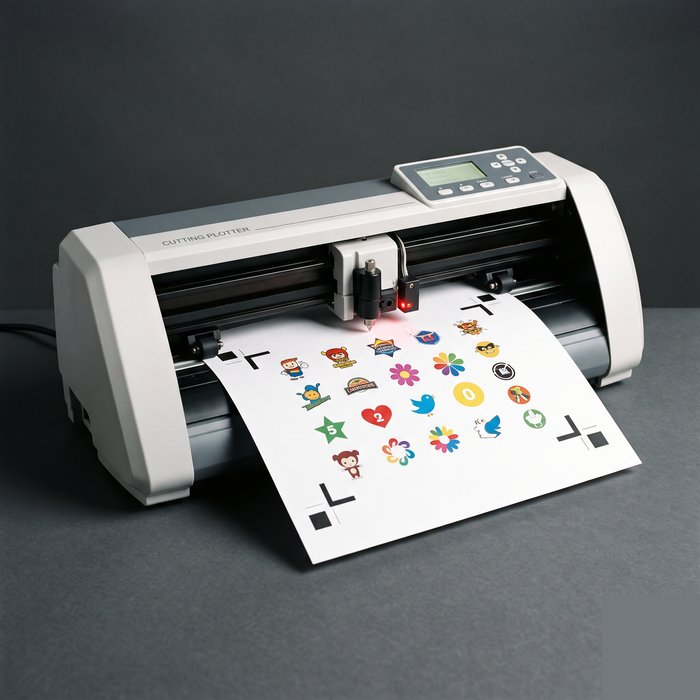
Here is the item that answers the sum from the opening, and it is small: an optical reader beside the blade carriage. Its job is to see four little black marks printed in the corners of the sheet and, from them, work out exactly where the artwork stopped after leaving the printer. Without that reader, the machine only cuts shapes it generated itself, which serves very well for letters, numbers and silhouettes in solid-colour vinyl. With it, the machine cuts around the outline of a colour image that has already been printed.
It looks like a technical detail and it is not: it is the difference between cutting decorations and producing stickers. The personalised sticker with artwork on it is the highest-margin item the customer can manufacture at home, with cheap material, no stock and sold to order. It is what makes the machine pay for itself, and that is why the model without the sensor comes back to the shop in three months, not because it broke, but because the customer discovered she cannot do the one thing that made money. For the importer, that means one more line on the data sheet requested from the factory, because the commercial description in English usually says only cutting plotter and leaves the reader out.
The second specification that decides the sale is the cutting force, measured in grams. A two-hundred-gram device cuts paper and thin vinyl and struggles with anything beyond that. In the higher bands, the same machine design starts to beat foam sheet, magnetic sheet and thin leather, which is where the customer finds the jobs nobody else in the neighbourhood does. And the third is the usable width: a machine that only takes small sheets limits the product to the size of a notebook page, while one that pulls from a roll opens the door to the shop window, the glass decal and the car banner, which is where the orders stop being one at a time.
Why this is an opportunity for Brazil
On the demand side, there is a large and quiet movement of people building a second income at home, and this is one of the few categories in which buying the equipment is the first formal step of the business. On the supply side, the Brazilian market is split in two: the imported brand with a closed ecosystem and a high price, and the generic advertised without a single useful specification, whose seller cannot say whether it has an optical sensor. The space between the two is large and almost empty.
- Timing: with a lead time of sixty to a hundred and twenty days between China and Brazil, an order closed now arrives for Christmas, which is the peak of the year in this category for two reasons at once: it is a present, and it is the month when orders for party favours explode.
- The buyer decides on return, not on price: whoever does a payback calculation accepts paying more for a machine that does more. That takes the contest out of the penny and puts it on whoever explains better, which is the ground of someone who imported knowing what they bought.
- Profit logic: the cost at source is a fraction of what Brazilian retail charges for a branded machine, and the difference in cost between the model with the sensor and the one without is small next to the difference in price the market accepts paying for the two.
- A wider audience than it looks: beyond the craftswoman, the same machine is bought by the stationery shop, the gift shop, the quick-print shop, the school, the vehicle wrapper and the small business that produces its own window signage.
- Ready-made content, and produced by the customer: the video of vinyl being weeded off the sheet is one of the most watched formats there is. The reseller does not need to produce that material, they only need somewhere to repost it.
Before importing: ask for the data sheet with the optical sensor, the cutting force in grams and the usable width stated item by item, plus a video of a contour cut made on the machine from the batch, not a catalogue clip. Confirm what languages the cutting software runs in and whether it works without a subscription, because software that demands a paid account or exists only in English turns into returns in Brazil. If there is Bluetooth or Wi-Fi on any model, it depends on ANATEL approval, with the number visible on the product or on the packaging, and it is worth learning the route in the guide to ANATEL and INMETRO approval for electronics. The external power supply is the component that comes closest to compulsory certification, so settle the tax classification of each item before shipment and schedule the pre-shipment inspection to test contour cutting on the batch, and not only on the sample.
Put your own brand on it
This category calls for own branding more than most, and for one specific reason: the customer is going to look for support, tutorials and a community, and she is going to look for them by the name written on the machine. A nameless generic builds nothing; a name of your own, with a video channel behind it, turns every buyer into a promoter.
- Your brand on the product and on the packaging, with the logo printed on the lid, engraved on the panel or applied to the box, under a private label arrangement.
- Cabinet and panel colour of your choosing, including the pale versions that look better in a photograph of a table, which is the framing this buyer publishes.
- A starter kit defined by you, with cutting mat, spare blades, spatula and the first sheets of vinyl, packed inside the same box and carrying your name.
- Packaging and manual in Portuguese, with the cutting force guide by material printed on them, ready for Brazilian retail.
Customisation usually calls for a slightly larger minimum order, and BCVN finds the right factory, negotiates the customisation, validates the sample and makes sure the product arrives exactly as you asked for it.
It is worth understanding how this works in practice before requesting the first sample: the guide on own brand in China: private label, OEM and ODM explains the difference between the three models and what each one changes in the minimum order and the lead time.
Where to buy cutting plotters in China
The machine and its consumables do not come from the same place, and that is what separates a well-planned trip from two freight bills:
- Canton Fair, Phase 1 (electronics and machinery): from 15 to 19 October, in Guangzhou. It is where the equipment makers are, and where you can compare sensor, cutting force and cutting software across dozens of suppliers in a single day.
- Yiwu Fair: from 21 to 24 October. It is the address for the consumable and the accessory, from the roll of vinyl to the cutting mat, and where you close the starter kit that goes inside the box without weighing on the container.
- Guide to importing electronics from China: what needs to be settled before closing an order for a consumer electronics product.
The order of the itinerary matters here: Canton Phase 1 (15 to 19 October, Guangzhou) closes and Yiwu (21 to 24 October) opens right afterwards, which lets you choose the machine first and only then buy the consumables that suit it, rather than the other way round. See the complete calendar of 2026 trade fairs.
Read the complete guide to the Canton Fair 2026
It is also worth looking at the desktop 3D printer, which is the other bench machine of the same buyer, and the DTF printer for garment decoration, which is the next rung for whoever started in vinyl and grew.
What makes this category different is that nobody buys the machine for the machine. They buy the possibility of the machine turning into income, and that is why it sells with an answer and not with a discount. Whoever has the answer on the tip of their tongue sells the model above; whoever does not fights over the one below with everybody else.
Frequently asked questions about importing cutting plotters
What is the optical sensor on a cutting plotter and why does it change the sale?
It is a reader that sees registration marks printed in the corners of the sheet and uses those marks to work out exactly where the artwork ended up after going through the printer. Without it, the machine only cuts shapes it generated itself, which is fine for letters, numbers and silhouettes in solid-colour vinyl. With it, the machine can cut around the outline of a colour image that has already been printed, which is the process behind any sticker with artwork on it. Since the personalised sticker is the highest-margin product the buyer can make at home, the sensor is the difference between an appliance that cuts decorations and an appliance that produces something sellable. It is the first item to confirm on the data sheet, because the factory's commercial description often leaves it out.
Does an imported cutting plotter need INMETRO certification and ANATEL approval?
It depends on what comes with the machine. The plotter itself is a desktop device powered by an external supply, and it is that supply which comes closest to the scope of compulsory certification, so the classification is checked by the tax code of each item, with the customs broker, before the order is closed. ANATEL approval, on the other hand, applies whenever there is Bluetooth or Wi-Fi, which is common on the models that connect to a phone, and in that case the approval number has to be visible on the product or on the packaging, with the marketplaces asking for that number when the listing is registered. The USB-cable-only version goes through none of this, which explains why many people begin the range with the cabled model.
What is the difference between a cutting plotter and a DTF printer?
They are complementary machines, and the same customer often ends up with both. The cutting plotter prints nothing: it drags a blade over a material in sheet or roll form and cuts the shape, whether in adhesive vinyl for mugs and walls or in heat transfer vinyl for T-shirts. The DTF printer prints the colour artwork onto a film, applies adhesive powder and produces a transfer that goes onto the T-shirt in a heat press, with no cutting at all. In practice, the plotter handles solid colour, lettering and stickers, and does it with a low initial investment; DTF handles photographic artwork in many colours and asks for one more step of structure. Resellers tend to sell the plotter first, because it is the way in, and DTF afterwards, to the same customer who has grown.