
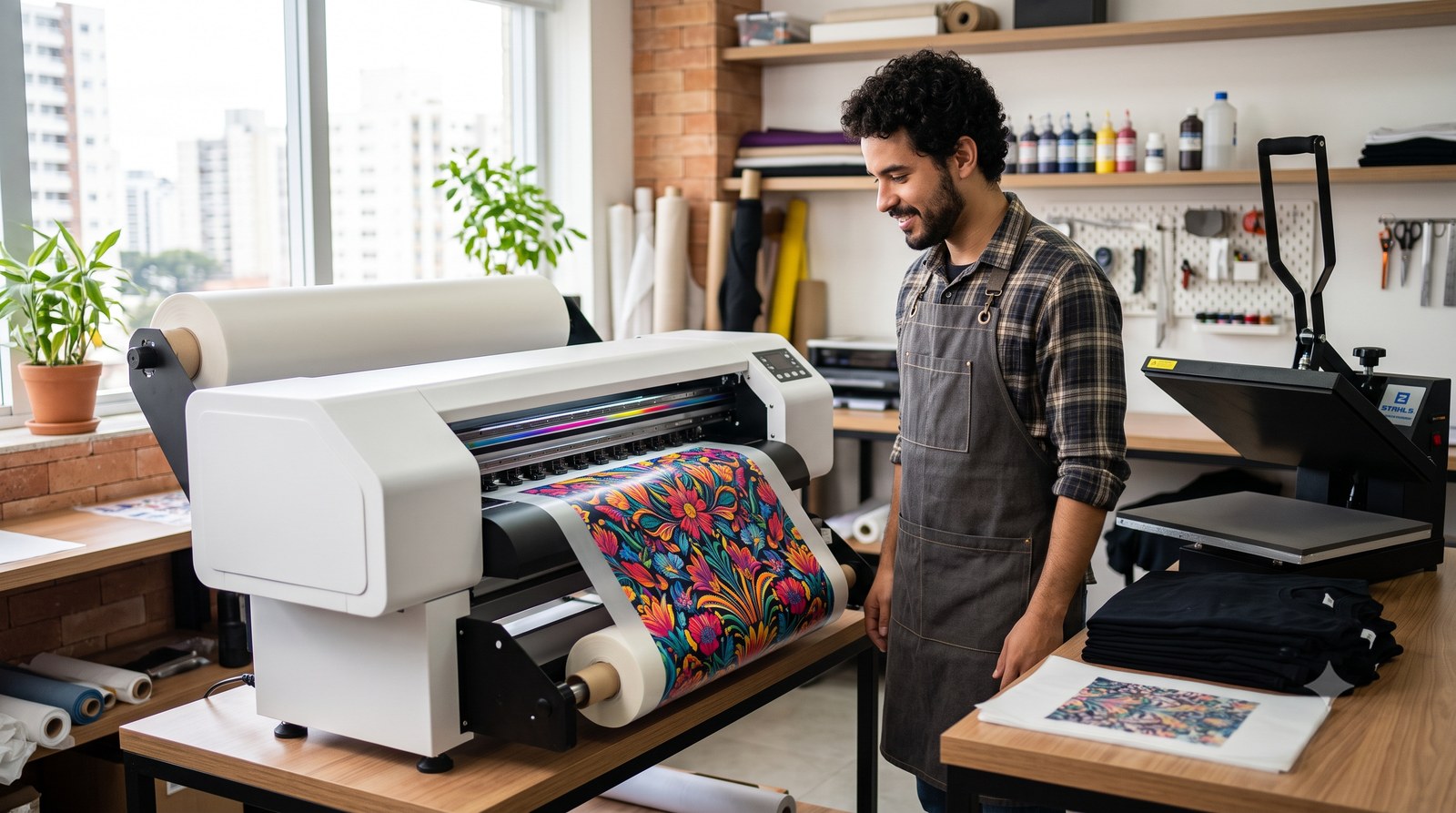
The scene repeats itself in any city in Brazil. Someone wants ten T-shirts with the artwork of their own event, or a single piece with a photo of the dog, and there is no minimum order that makes it worthwhile at a traditional print shop. Only the person who profits from that fragmented demand is not the end consumer: it is the entrepreneur who put a printing machine inside the house, and the importer who realised that this machine costs, at source, a fraction of what is charged for it assembled in Brazil.
What the DTF printer is
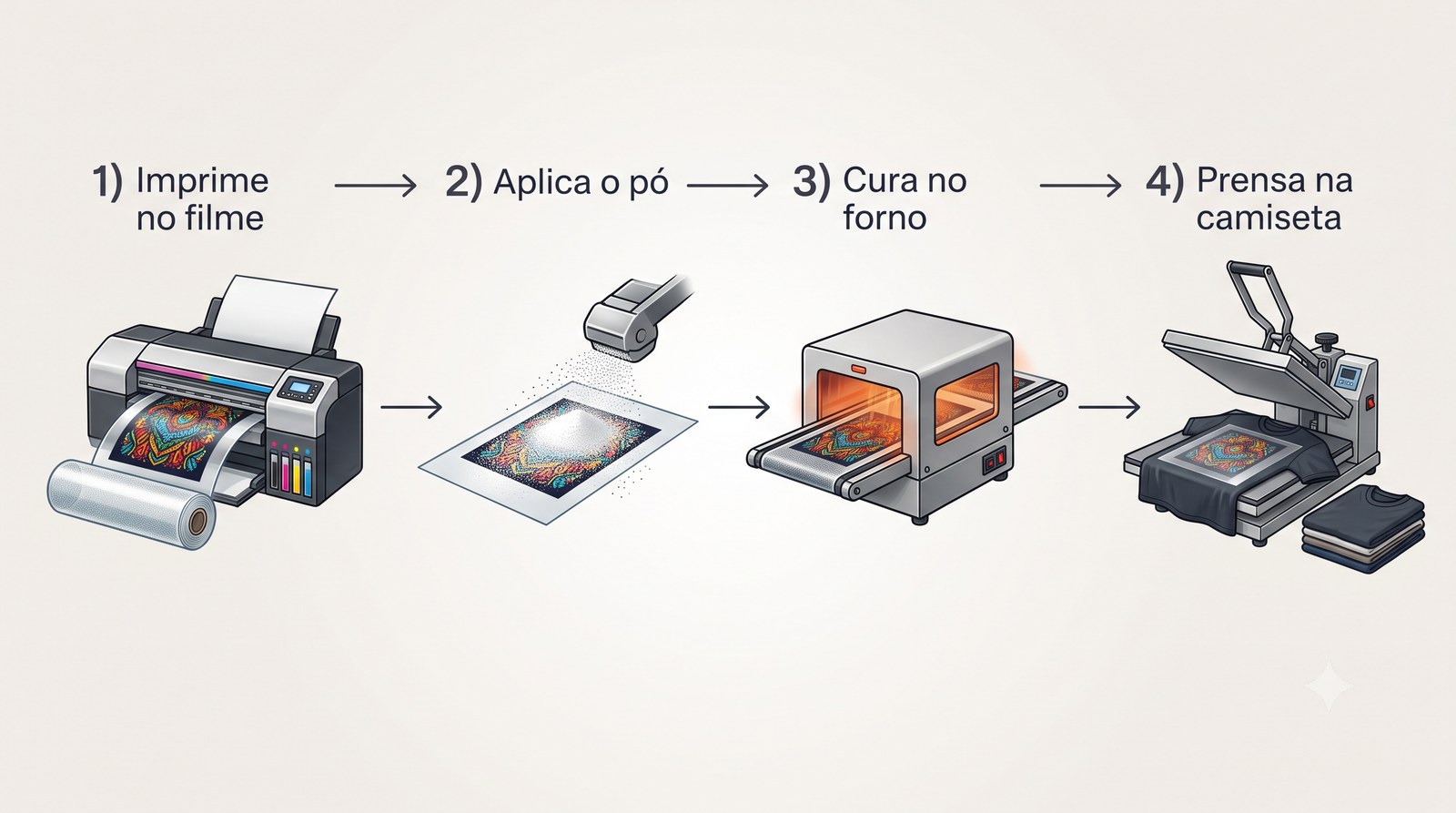
DTF stands for Direct to Film. The DTF printer prints the design in colour, plus a layer of white, onto a special plastic film. An adhesive powder is applied and cured, and the design is ready to be pressed onto almost any fabric with an ordinary heat press. It is genuine print-on-demand: one piece or a thousand, cotton, polyester or knit fabric, light or dark cloth, with nothing to cut and no pre-treatment of the garment.
They range from benchtop models, with around 30 cm of printing width, up to industrial machines of 60 cm or more with a built-in curing oven. It is that ladder of sizes that makes DTF, at the same time, the entry machine for whoever is starting out and the production equipment for whoever already sells in volume.
Why this is an opportunity for Brazil
Brazil has a huge market for personalised T-shirts, uniforms, promotional items and niche fashion, and a legion of people wanting to set up their own business with little capital. DTF fits exactly there, and the numbers add up for two importer profiles at once: whoever buys to use it and whoever buys to resell the equipment.
- A machine that pays for itself: the cost per printed piece is low and the amount charged for personalisation is high. It is one of the rare pieces of equipment where the return is counted in months of operation, not in years.
- Cheap at source, resells well: the difference between the factory price in China and that of a machine assembled in Brazilian retail opens up a comfortable margin both for the equipment reseller and for the consumables (film, powder and ink) bought again and again.
- Import timing: machinery is not seasonal, but it has a lead time. Between manufacturing, sea freight and clearance, counting on 60 to 120 days means placing the order with room to spare before promising delivery to a customer.
- A broad, recurring audience: garment workshops, quick-print shops, promotional goods stores, content creators selling their own brand. And every machine sold becomes a consumables customer for years to come.
Before importing: because it is electrical equipment, confirm the INMETRO requirement and, above all, the correct voltage (110V, 220V or three-phase) for the region where it will operate. The quality of the printhead, of the inks and of the curing system varies a great deal between factories, and this is a classic case where inspecting before shipment and securing spare parts stops you buying a problem instead of a machine.
Customise the specification (OEM)
Importing machinery from China is not a matter of taking the catalogue model and hoping it works out. The factory adjusts the equipment to your market, and that is where having a partner at source separates whoever resells a commodity from whoever builds a serious operation.
- The right voltage and configuration for Brazil: 110V, 220V or three-phase, with a suitable power supply and components.
- Your brand on the equipment (private label / OEM): name, colour and manual in Portuguese, to resell it as your own line.
- After-sales and parts agreed at the time of purchase: printhead, belts and the continuous supply of film, powder and ink.
That usually calls for direct negotiation with the factory and validation of a sample before the batch. BCVN finds the right manufacturer, settles the specification, tests the machine and makes sure the after-sales service really exists, and not only in the proposal.
Where to buy a DTF printer in China
The DTF printer sits at the crossing of two sectors, printing machinery and visual communication, and it appears at the fairs that bring the two together:
- Canton Fair, Phase 1 (Machinery and Equipment): the biggest starting point, with industrial machinery manufacturers side by side and the chance to see the equipment running.
- APPP EXPO, in Shanghai: the largest printing, garment printing and visual communication fair in China, with aisles dedicated to DTF, sublimation and presses. It is the sector fair that goes deeper into what the Canton Fair presents.
- Yiwu Trade Fair: ideal for closing the repeat-purchase consumables (film, powder and ink) and accessories at the largest small-commodities wholesale market in the world.
Next edition, Canton Fair 2026 (140th): Phase 1, with machinery and equipment, runs from 15 to 19 October 2026, at the Pazhou Complex in Guangzhou. It is the chance to see the machine print in front of you before closing the purchase, which changes everything when it comes to a production investment.
Read the complete guide to the Canton Fair 2026
The DTF printer is not a bet on a passing trend. It is the machine that lowered the entry barrier of garment printing and created, in one go, a market of people who operate and a market of people who sell equipment. For the Brazilian importer, the question is not whether it is worth it, but how to buy the right machine, in the right voltage, from the manufacturer that will still be around to sell the next spare part.
Frequently asked questions about importing DTF printers
Do I need certification to import a DTF printer?
Yes. Because it is electrical equipment, the DTF printer normally requires INMETRO certification, and you need to confirm the voltage (110V, 220V or three-phase) for your region. Also check the invoice and the correct tariff classification before placing the order.
What is the difference between DTF, DTG and cut vinyl?
DTF prints the design onto a film and transfers it to almost any fabric and colour, with no cutting and no pre-treatment of the garment. Vinyl requires cutting and is limited in detail. DTG prints straight onto the garment, but usually calls for pre-treatment and works best on light cotton. DTF is the most versatile for printing on demand.
How much does it cost to import a DTF printer from China?
The cost at source is a fraction of the price of the machine already assembled and resold in Brazil, which opens up margin both for whoever is going to use it and for whoever is going to resell the equipment. The price varies with the printing width (desktop models of 30 cm up to industrial ones of 60 cm or more) and with whether the curing oven is built in or separate. BCVN quotes the right machine for your volume.
Where can I find DTF printer suppliers in China?
At the Canton Fair (Phase 1, machinery and equipment) and at the printing and visual communication fairs, such as APPP EXPO in Shanghai. The Yiwu Trade Fair helps to consolidate consumables such as film, powder and inks. BCVN validates the manufacturer, the after-sales service and the supply of parts.