This guide is the second pillar of our culture series, alongside guanxi, mianzi and the dinner table. That one is about reading the room; this one is about the ground. They are different things and both decide trips: you can be excellent in a meeting and still lose half a day because you could not pay for a taxi.
This is not a cost guide, which already exists in what a business trip to China costs, nor an itinerary, which is in a 10 day itinerary for importers. It is the operating manual: what to settle before flying, what can only be settled there, and what changes your relationship with the country once understood.
The country where everything runs through an app
Start with this idea, because everything that follows derives from it. In little more than a decade, China skipped whole stages the West is still working through: it went from cash straight to payment by phone, without passing through a card culture, and then stacked practically every everyday service on top of that payment.
The result is that two apps, WeChat and Alipay, stopped being apps and became infrastructure. Inside them you pay the restaurant bill, buy a train ticket, hail a car, order food, read the menu, open the metro gate, message the supplier and sign the contract. They are not superapps as a marketing line: they are the operating system of civil life.
For the visitor that has a consequence which is not obvious. The friction is not in any particular task, it is in access. Once inside the system, everything becomes easy in an almost embarrassing way. Outside it, trivial tasks turn into small negotiations.
The line to remember: in China the barrier is not the language, it is the sign-up. Language is solved with a phone camera. Sign-up is solved before you fly, or it is not solved at all.
Paying: cash has left the stage
The first surprise on arrival is realising that almost nobody uses notes. Market trader, taxi driver, cheap restaurant, street vendor: they all point at a square barcode and wait for you to point your phone back.
Cash is still legal tender, and the country has an explicit rule against refusing it. But the practical reality is different: many places have no change, because they have not taken a banknote in years. Paying in cash works, and it works slowly, with awkwardness on both sides.
What works today. Both Alipay and WeChat now accept an international card linked to a visitor's account, with no Chinese bank required. You install the app, verify your identity with your passport, link the card and start paying like a local. There are limits per transaction and per period, and a threshold above which a fee applies. Those numbers change, and they change without notice, so treat whatever you read anywhere as an approximation and confirm inside the app itself before you travel.
What usually goes wrong, and it is always the same thing: leaving the setup until after landing. Verification may want a code sent by the bank, a confirmation call, a photographed document, and none of that is pleasant to do with your bank at home closed, on the other side of the world, in an airport.
The mistake that costs you the first night: arriving with no payment set up, no working SIM and no local cash. It is the combination that leaves somebody stranded in the lobby. Set the app up at home, test it with a small purchase as soon as you arrive, and carry a few small notes as a reserve, not as the main plan.
A compliance note is worth making, and it cuts both ways. Paying a supplier is not done through a consumer app or in cash: import payment has its own channel, contract, invoice and banking trail, and the subject is covered in paying Chinese suppliers. Mixing the two is creating a tax problem to be solved later.
Connecting: what works and what disappears
The second surprise is opening your phone and finding that half your working tools do not respond. The Chinese internet is filtered, and the filtering reaches much of the Western search, e-mail, messaging, mapping and social services. It is not a leisure detail: for anyone working with attachments, calendars and messages, it is the whole operation.
The options, in order of simplicity:
- International roaming on your Brazilian SIM. It is the simplest solution and the one that tends to work best, because the traffic leaves through your home carrier rather than the local internet. It costs more and carries no guarantee, but it handles the day to day with no configuration.
- A local SIM or eSIM. Cheap and fast for data, and subject to the same filtering as the Chinese internet. It serves very well for maps, transport and payment, which are local services.
- Hotel Wi-Fi. It works, with the same filtering, and often asks for a phone number to release access.
On network workarounds, the honest guidance is this: they are unstable, they get better and worse without notice, and local legislation on the subject is not a matter worth improvising on. If your work depends on one specific channel, solve it with roaming and agree it beforehand.
The point almost nobody thinks about: agree the channel with home before you travel. If your team talks to you through an app that does not work there, define the substitute the day before, not on day one with a meeting booked. With the Chinese supplier the channel is always WeChat, and it must be installed, verified and with the contacts added before you fly.
Getting around: high-speed rail, metro and ride-hailing
Here comes the part that impresses most, because Chinese transport infrastructure is better than almost anything the visitor knows.
High-speed rail. It is the standard means of transport for medium distances, and on many legs it beats flying comfortably, because the station sits in the city centre and demands no airport-style margin. The ticket is bought with your passport number, which is what identifies you at the gate. Arrive early: the station screens you at the entrance, it is large, and the gate closes a few minutes before departure. No exceptions, no appeal.
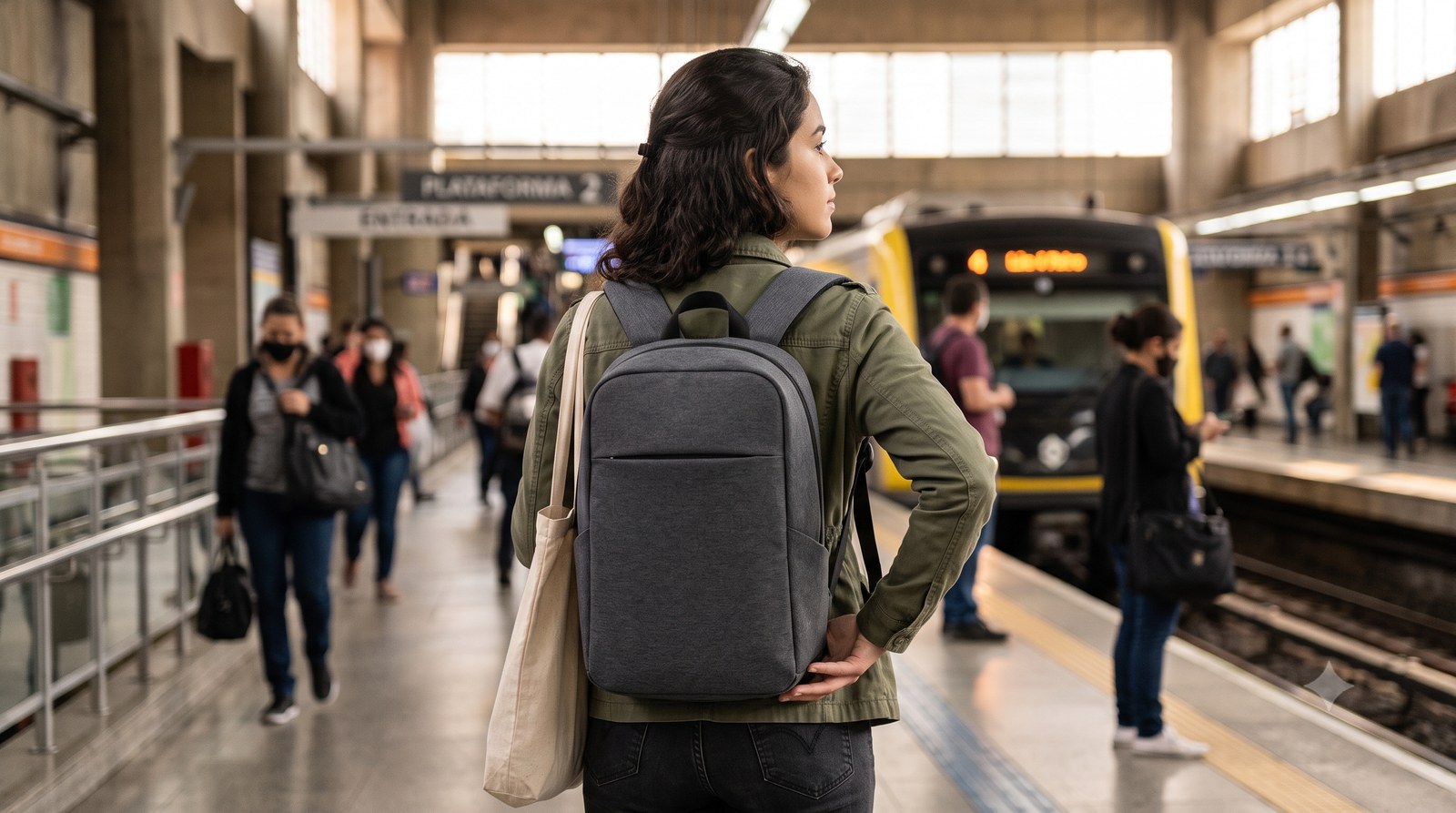
Metro. Present in practically every large city, signed in Latin characters as well, with bag screening at the entrance to every station. The gate opens with a code in the payment app, and in the big cities it is almost always the fastest way through the traffic.
Ride-hailing. It works very well, it is cheap, and it solves the address problem, because you do not have to say anything to anybody. The detail that catches foreigners out: the driver usually calls to confirm the pick-up point, in Mandarin, and not answering means a cancelled ride. Agree an obvious spot in advance, prefer the hotel entrance, and keep the address in characters on your screen.
Taxis. They still exist and they are useful, with one golden rule: carry the destination written in characters. The hotel card in your pocket remains the most useful object of the trip, and the cheapest.
A mistake of scale that wrecks itineraries: China looks compact on a map and it is not. Guangzhou to Shenzhen is short and runs by train several times a day. Guangzhou to Yiwu, or to Shanghai, is a crossing of the country. Building an agenda without checking real travel times is the commonest way to lose a whole day of meetings.
Eating: the Chinese food you do not know
Here is the most enjoyable misunderstanding to clear up. What is called Chinese food in Brazil is a distant adaptation of a single regional cuisine, the Cantonese, filtered through decades of neighbourhood restaurants. China has several regional cuisines as different from one another as Portuguese food is from Hungarian.
In simplified terms, and without exhausting the subject:
| Area | What it is like | Where you will find it |
|---|---|---|
| Cantonese | Mild, steamed, focused on the fresh ingredient, dim sum at breakfast | Guangzhou, Shenzhen, Hong Kong and the whole south |
| Sichuanese | Hot and numbing at the same time, because of the Sichuan peppercorn | Chengdu and Chongqing, and restaurants across the country |
| Hunanese | Dry heat and saltier, without the numbness of the Sichuanese | Changsha and the south-centre |
| Northern | Wheat instead of rice: hand-pulled noodles, steamed bread, filled pastries | Beijing, Xi'an, Shandong and the north-east |
| Eastern | Faintly sweet, dark sauces, river fish | Shanghai, Hangzhou, Suzhou and the Yiwu region |
| North-western | Lamb, cumin, skewers, flatbread, Muslim halal cooking | Xinjiang, and houses scattered through every large city |
Three practical notes that spare you discomfort. First: hot tea and hot water are the default, and iced water is not a local habit, which explains the vacuum flask everybody carries. Second: lunch is early, around midday, and so is dinner, often before seven. Third: dietary restrictions need to be written in characters on your phone, because explaining an allergy by gesture does not work and the risk is real.
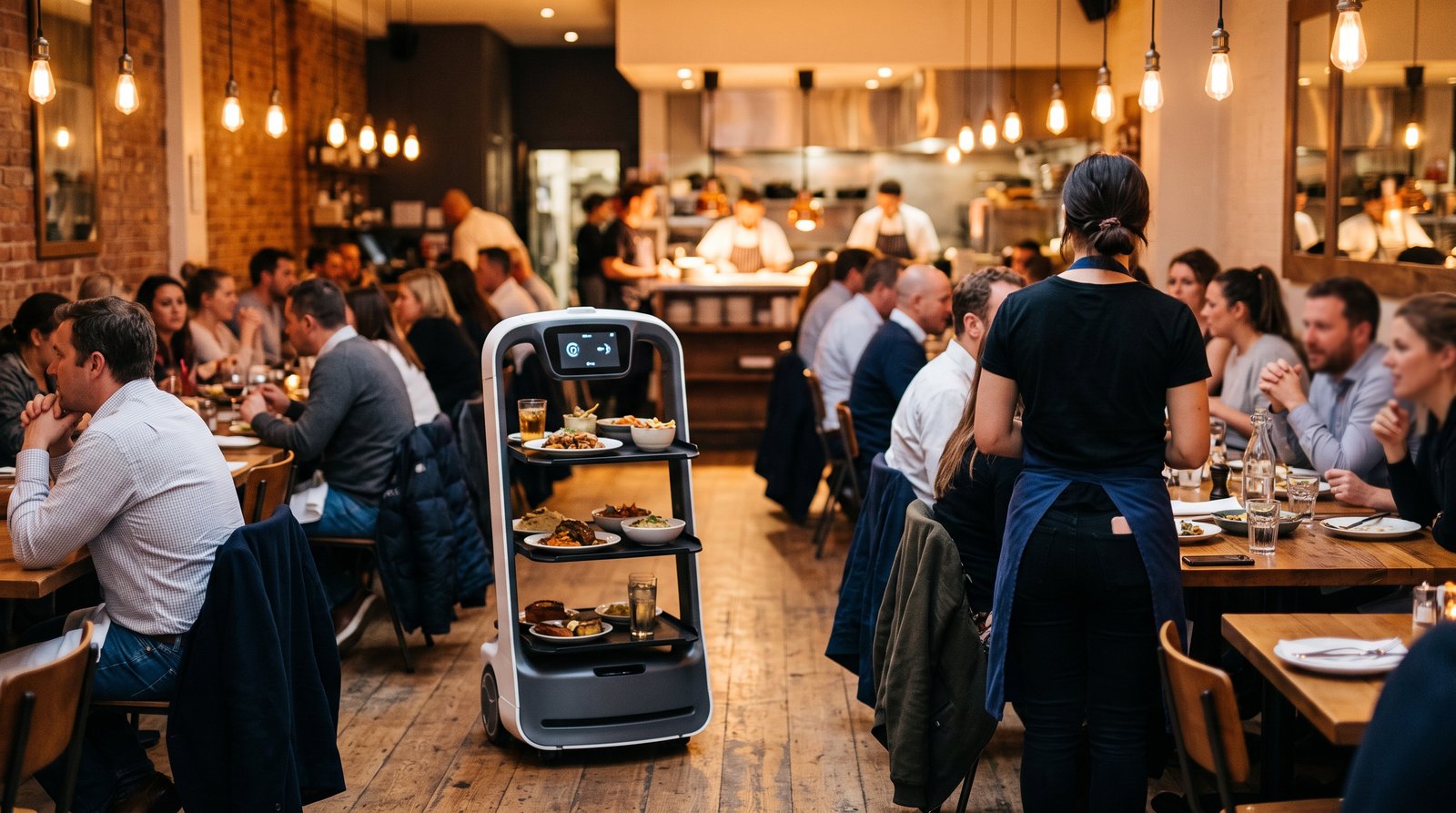
And an observation that tends to surprise: in recent years it has become common to see robots carrying dishes to the table in restaurant chains, especially inland and in mid-sized cities. It is not a technology showcase, it is an answer to labour cost, and the logic behind it is in the guide to service robotics.
When the table is a business table
A working dinner in China is not the same social event as a working dinner in Brazil, and choosing the restaurant is a message that will be read. The grammar of it, who sits where, who pays, who toasts first and what the polite refusal means, is set out in full in guanxi, mianzi and the dinner table, and there is no sense repeating it here.
What belongs in this guide is the operational side: book ahead in a big city, confirm on the day, and do not treat the dinner as an appendix to the meeting. It is usually where the meeting actually happens. If you need vocabulary for the table and for bargaining, the guide to Mandarin phrases for negotiating carries the essentials with pronunciation.
Daily life: hotel, plug socket, map and clock
A handful of small details which, added up, decide whether the week is comfortable or irritating.
- Hotel. Not every property is licensed to take foreign guests, and registering the foreigner is a formality the hotel completes at check-in. Book somewhere that already receives international visitors, and avoid discovering the restriction at the front desk, at night.
- Plug socket and voltage. The mains run at 220 volts and the sockets do not take the Brazilian plug. Bring a universal adapter, and more than one, because the hotel rarely lends them.
- Maps. Western maps do not work well there, and it is not only blocking: the street, metro and business data live in the local maps, integrated with the transport and payment apps. Use the map the country uses.
- Time. The entire country runs on a single time zone, which makes the day start and end at different hours depending on the longitude. And the difference from Brazil is about half a day, so the useful window for talking to home is short and needs to be agreed.
- Water. Tap water is not drunk. The flask of hot water that sits in every hotel room, every train and every office is the local solution, and it works.
- Toilets. In simpler public places the squat pan is still common, and paper is not always provided. Tissues in your pocket solve the whole problem.
- Calendar. Travelling on top of a national holiday is the most expensive planning mistake there is, because transport and hotels sell out and the factories stop. The 2027 dates are in the guide to public holidays in China.
On entry to the country, visa rules and what has changed for Brazilians, the subject has its own updated guide in the visa for China. Always confirm the rules in force before buying a ticket, because this is a point that changes often.
What no app can solve
There comes a point where survival competence ends and something else begins. It is worth being frank about where that line sits, because it tends to be discovered late.
On your own, with a phone, you can move around, eat well, arrive on time and pay the bill. That is a lot, and it is enough for a holiday. What an app cannot solve is everything that depends on reading context and on continuity.
An automatic translator returns words, not intent, and much of Chinese commercial communication lives in the intent. It does not notice that the answer was a polite no, it does not know the question embarrassed somebody in front of their boss, and it does not suggest you back off. Nor does it call the factory the next day, check whether the sample that arrived is the one agreed, or turn up unannounced on the production line.
There is also the silent cost of improvising: time. A week of agenda built by somebody who knows the ground yields three or four appointments a day; the same week built from afar yields one, plus badly calculated journeys. The difference does not appear on the travel bill, it appears in what the trip produced, and it is what we discuss in the account of a trip with support on the ground.
That is why our recommendation is always the same and is quite specific: handle the survival layer on your own, which is easy and which this guide covers, and do not try to handle the commercial layer on your own, which is where the money sits. Those with permanent people in China book the agenda with whoever decides, negotiate in Mandarin, visit the factory behind the stall and close with a pre-shipment inspection. If you are putting the trip together, planning your import for 2027 shows in which months it pays off most.
Frequently asked questions about daily life in China
Can I get around China with just a credit card and cash?
You can, but you live in a country parallel to the one everybody around you is using. International cards are accepted in big hotels, airport shops and little else. Cash is still legal tender and nobody may refuse it, except that many places simply have no change, because they have not seen a banknote in years. What works is settling app payment before you fly and carrying cash only as a fallback.
Will my WhatsApp and my Gmail work in China?
On a local connection, no. A good share of Western messaging, e-mail, search and social services is not reachable from the Chinese internet, and that includes tools you probably use for work. International roaming on your Brazilian SIM usually travels outside that filtering and is the simplest and steadiest solution, though there is no guarantee. Agree the channel with home before you travel, rather than discovering this on day one.
How do you buy a high-speed train ticket in China?
Through the railway's official app or an agency, always with your passport number, which is what identifies the ticket. Foreigners board by showing the passport at the gate, and many stations no longer issue paper tickets. Arrive early, because the station screens bags at the entrance and the gates close a few minutes before departure. On legs such as Guangzhou to Shenzhen, the train beats every alternative.
Do I need Mandarin to get around on my own?
To get around, no. To sort things out, yes. With a camera translator on your phone and the address written in characters, you move between hotel, restaurant and metro without much drama. The trouble starts when something departs from the plan: a driver calling to confirm, a charge that does not add up, an order that needs explaining. Outside airports and international hotels, English is the exception, not the rule.
Is real Chinese food anything like the Chinese food back home?
Hardly at all. What is known as Chinese food in Brazil is a distant adaptation of Cantonese cooking, and China has several regional cuisines as different from one another as Italian food is from German. Cantonese is mild and steamed, Sichuanese is spicy and numbing, the north runs on wheat and noodles, the east is faintly sweet. Knowing this is not trivia: choosing the right restaurant is a message, and at a business dinner that message gets read.
What do I settle before flying and what can wait until I land?
Before flying: entry into the country, app payment with the card already linked and tested, the communication channel with home, a hotel that takes foreign guests and the addresses in characters. The rest gets settled there: a local SIM if you need one, train tickets, urban transport and restaurants. The practical rule is simple: anything depending on registration, verification or a bank, settle while your home time zone is still working for you.
BCVN — Brasil China Viagens e Negócios has connected Brazilian companies to the best suppliers in China and Asia since 2008. Find out about our services in commercial intermediation, quality inspection, factory audits and guided business trips to China's main trade fairs.
What you see on the street, in the Showcase
Categories that are part of Chinese daily life and became resale products in Brazil. See more in the China Showcase.