
The scene repeats in any gym, any bus queue, any office desk: someone digging through their bag, their coat pocket, the wrong kitchen drawer, looking for the earbuds case. Wireless earbuds got good and cheap too fast, but the case remains the weak link in the story: small, with no colour that draws attention, easy to forget anywhere except in the ear itself. For resellers, that becomes a recurring headache: a good share of wireless earbuds' after-sales isn't about the sound, it's about the customer who lost the case and wants to buy everything again.
What a Shenzhen factory solved wasn't the earbud. It was the case.
What the smartwatch with built-in earbuds is
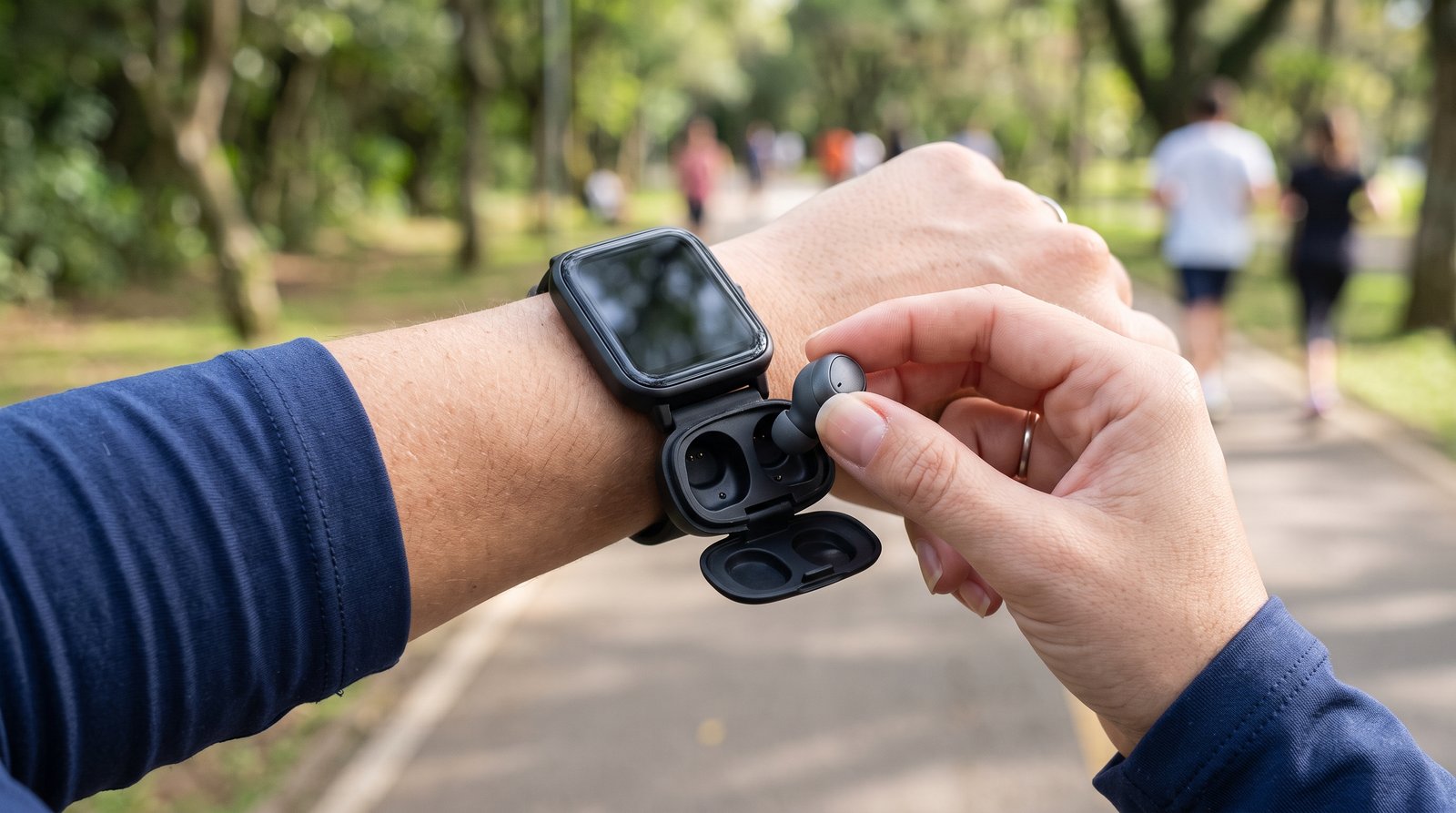
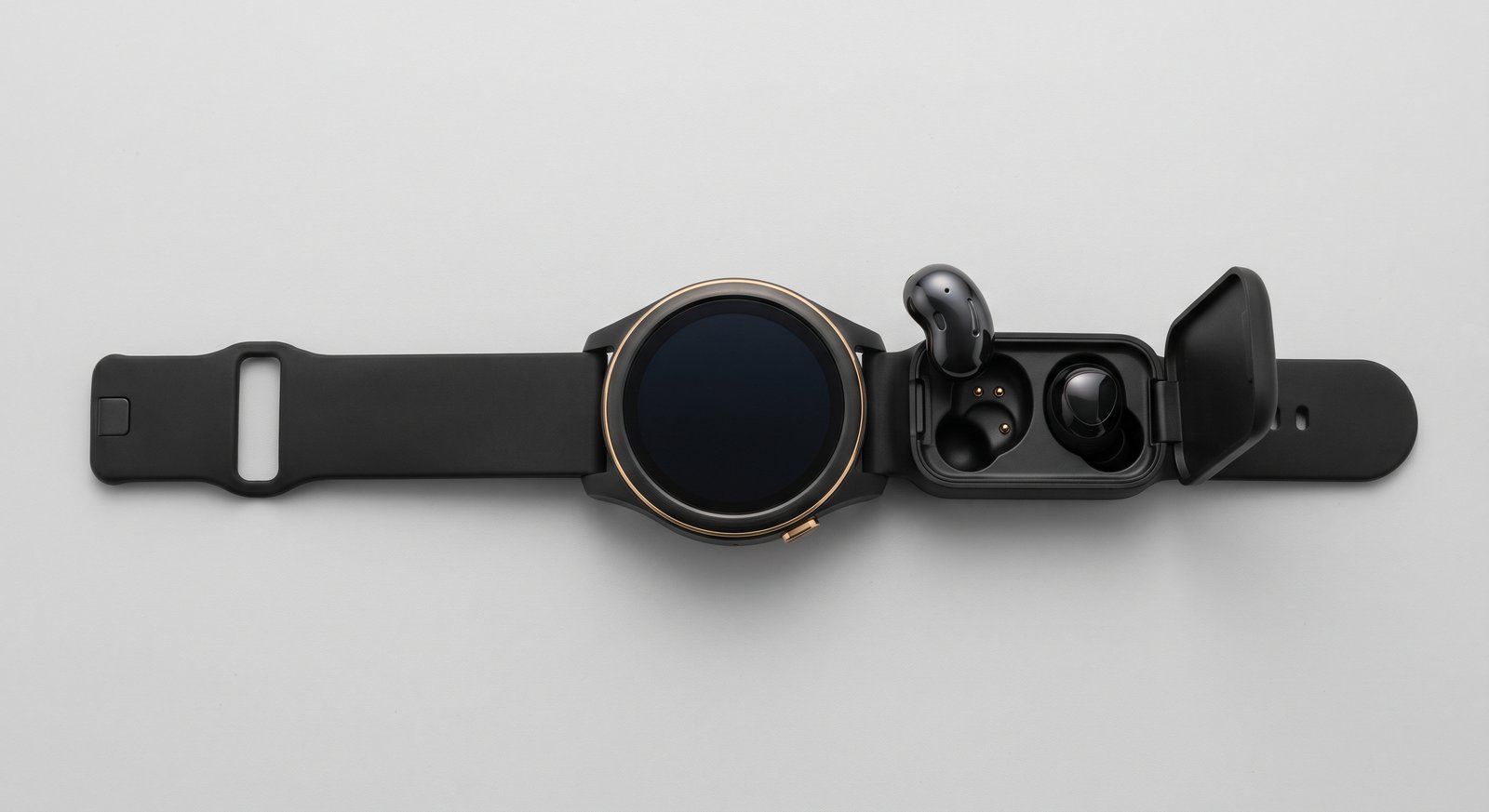
From the outside it's a smartwatch like any other: touch display, silicone strap, step and heart-rate sensors. The difference lives in the strap itself, in a small compartment closed by a magnetic latch, which opens with light pressure and reveals two tiny earbuds, one docked on each side. Pull both out to use them; snap them back in and they recharge on their own, drawing power from the same battery that already runs the watch.
The detail that sets this apart from a kit sold together is that the watch and the earbuds are two independent radios, each with its own Bluetooth pairing. The watch talks to the phone's health app the usual way; the earbuds, as soon as they leave the compartment, pair on their own with any Bluetooth-capable device, exactly like a standalone TWS earbud. Neither depends on the other to work, and that independence is what makes the product more than the sum of its two parts.
The watch's battery, bigger than any standalone earbud's, works like a portable charger hidden in plain sight: it tops up the earbud in a few minutes of docking, enough to cover a workout, a meeting or an entire bus ride without the customer thinking about carrying anything else. Whoever leaves home to run leaves with just their wrist: no case hanging in the shorts pocket, no risk of dropping it on the gym floor.
This isn't the smartwatch sold next to the wireless earbuds on the same shelf. It's a third product, with its own spec sheet and its own audience: whoever today buys one just so they don't lose the other.
Why this is an opportunity for Brazil
The Vitrine's wearables cluster had just one item, the watch sold on its own. This find doesn't repeat the watch or the earbuds: it opens a third drawer in the same category, without fighting on price with either of the first two. The map of industrial clusters explains why it's precisely in Shenzhen, and nowhere else, that this kind of combination is born first: it's where the chain of miniaturised electronic components already serves phones, earbuds and watches at once, and where a factory can test crossing all three without the cost spiking.
- Solves reseller's complaint number one for wireless earbuds. A lost case is the biggest cause of after-sales contact in the category, and a product where the case is the customer's own wrist reduces that friction before it even happens.
- Sells to whoever already owns both products separately. The customer who owns a smartwatch and a pair of TWS earbuds is exactly the easiest buyer to convince to swap both for one, because they've already felt the problem the product solves.
- Two products' ticket, one body's cost. The perceived value is the sum of the watch and the earbuds, but the factory shares battery, casing and part of the electronics between the two, which supports a better margin than selling the two pieces separately.
- A short-video category. A watch that "gives birth" to an earbud from inside its own strap is exactly the kind of image that's already made for the thirty-second video, with no script or complex editing needed.
- Evergreen, with no dependence on season. It serves the gym crowd all year round and works well as a birthday or year-end gift, which can absorb the 60-to-120-day lead time between China and Brazil without turning into dead stock.
Before importing: these are two radios in a single body, and the ANATEL certification needs to cover both: the watch's Bluetooth module and the earbuds' Bluetooth module, tested and certified within the same report, not as a separate accessory. Ask the supplier for the exact model's certification number, with both radios listed; a certificate that covers only the watch leaves the earbuds uncovered, and that's the kind of gap that shows up in enforcement, not in the sample. Battery and charger fall under Portaria Inmetro 148/2022, like any consumer electronics with a rechargeable lithium battery. Factory-to-factory variation shows up in the health sensors and in how stable the two radios pair at the same time, and this is a product where inspecting before shipping avoids a whole batch of earbuds that won't hold the connection.
Put your own brand on it
It's a product that sits on the customer's wrist all day, face up, and that's why private label pays off fast here.
- Your brand on the product and the packaging (private label / OEM): logo engraved on the dial or on the compartment lid, and a box designed to show the watch already with the earbud on display.
- Strap colour and watch finish of your choice, with the earbud compartment available in sport and fashion lines.
- Packaging and manual in Portuguese, with the two radios' pairing explained step by step, which cuts the after-sales question before it turns into a complaint.
Customisation usually calls for a slightly larger minimum order, and BCVN finds the right factory, negotiates the customisation, validates the sample and makes sure the product arrives exactly as you asked for it.
It is worth understanding how this works in practice before requesting the first sample: the guide on own brand in China: private label, OEM and ODM explains the difference between the three models and what each one changes in the minimum order and the lead time.
Where to buy the smartwatch with built-in earbuds in China
It's a consumer electronics product, and the right corridor is the same one that serves phones, earbuds and watches sold separately.
- Canton Fair, Phase 1 (electronics): brings watch and audio manufacturers together in the same complex, which makes it easy to compare how the two radios pair side by side, with the product in hand.
- Hong Kong Electronics Fair: concentrates the higher-finish lines, with factories already used to organising a certification report for products with more than one radio.
- Yiwu Market: serves the accessories around it, spare straps, cases and chargers, with a low minimum order.
Autumn 2026 Canton Fair (140th): Phase 1 runs from 15 to 19 October 2026, in Guangzhou, and it is the phase for this product. The Hong Kong Electronics Fair opens earlier, from 13 to 16 October, and the Yiwu Market later, from 21 to 24 October, so all three fit into the same trip. The next Canton Fair, the 141st, is expected in April 2027, going by the fair's usual pattern and with no official calendar yet: the Canton Fair 2027 guide has the expected dates.
Read the complete guide to the Canton Fair 2026
The business decision here isn't choosing between selling the watch or the earbuds. It's realising that the customer who today buys both separately, and grows wary every time they open the drawer looking for the case, is asking for a way to stop losing pieces. Whoever enters this category early sells the solution to the problem, not one more gadget on the pile.
Frequently asked questions about importing a smartwatch with built-in earbuds
Does the watch with built-in earbuds work with any phone?
It does, because both radios use the same Bluetooth protocol that any standalone earphone or watch already uses, on both Android and iOS. The watch pairs with the phone's health app the usual way, and the earbuds, once they come out of the compartment, pair on their own with any Bluetooth-capable device, exactly like a standalone TWS earbud. Neither depends on the other to work, and that independence is what makes the product more than the sum of its two parts. The one practical difference is that, on first setup, the customer does two pairings instead of one, and the Portuguese manual needs to make that clear, because it's where most after-sales questions start: assuming the earbuds are already connected just because the watch is.
Do I need certification to import this smartwatch with built-in earbuds?
You do, twice over. There are two independent Bluetooth radios in a single body, the watch's and the earbuds', and ANATEL certification needs to cover both within the same test report, under the manufacturer's exact model, not the generic product line. A certificate that only tested the watch leaves the earbuds uncovered, even though both ship in the same box. Battery and charger are also covered by Portaria Inmetro 148/2022, like any consumer electronics with a rechargeable lithium battery. Ask for the complete report, with both radios named, before closing the order.
How many times can the earbuds recharge using just the watch's battery?
It will vary factory to factory, but the logic is always the same: the watch's battery is bigger than any standalone earbud's, and it acts as an energy reserve for the earbud whenever it's docked. That usually gives several full earbud recharges from a single watch charge, enough to cover a whole day away from home without the customer thinking about carrying a charger. Confirm the exact number with the supplier in writing, because it's the figure that varies most between factories and the one most compared in product reviews.