

The scene is familiar to anyone with young children and parents far away. The grandchild does something funny, someone takes a photo and posts it in the family group. The siblings reply with stickers, and the grandmother, for whom the photo was taken, does not see it, because she does not open the group, because her phone is full or because nobody showed her how to zoom in. On Sunday, someone remembers to show her the photo on the small screen, standing in the kitchen.
This week's find takes the grandmother out of the problem. The photo leaves the phone of whoever took it and appears by itself on a screen in her living room, without her having to do anything. The end customer gets it in two seconds and buys it as a gift. What interests the importer is something else: it is a gift with high perceived value, which a group of siblings buys together and which fits exactly into the strongest retail date after Christmas.
What a Wi-Fi digital photo frame is
On the outside, it is a photo frame: a frame with a screen, almost always 10 inches, standing on a chest of drawers or hanging on the wall. Inside, it is a small computer with a touchscreen, 16 or 32 GB of internal memory and a card slot, which shows photos in sequence. What sets it apart from the digital photo frames of fifteen years ago, which depended on someone copying photos onto a memory card, is Wi-Fi.
It works like this: the device is connected to the home network once, during setup, and generates a code. Each family member installs an app on their phone, enters that code and starts sending photos and short videos, which appear on the frame's screen within seconds. The most common app on these devices is called Frameo, and it comes pre-installed at the factory. The person receiving needs no account, no password and no phone: just a socket.
The Chinese side of the product is the usual one in consumer electronics: the screen, the board and the assembly come from the same Shenzhen supply chain that makes entry-level tablets. That is why the product became cheap enough to be a gift, and also why hundreds of factories offer the same device in different frames. The guide Shenzhen from the inside explains how this chain works and why the factory is rarely where the sales office is.
Models and variations
At the fair, the device is almost always the same inside, and what changes is what the customer sees: the screen size, the frame and the box. These three things are where the range is built, separating the entry-level gift from the window-display gift.
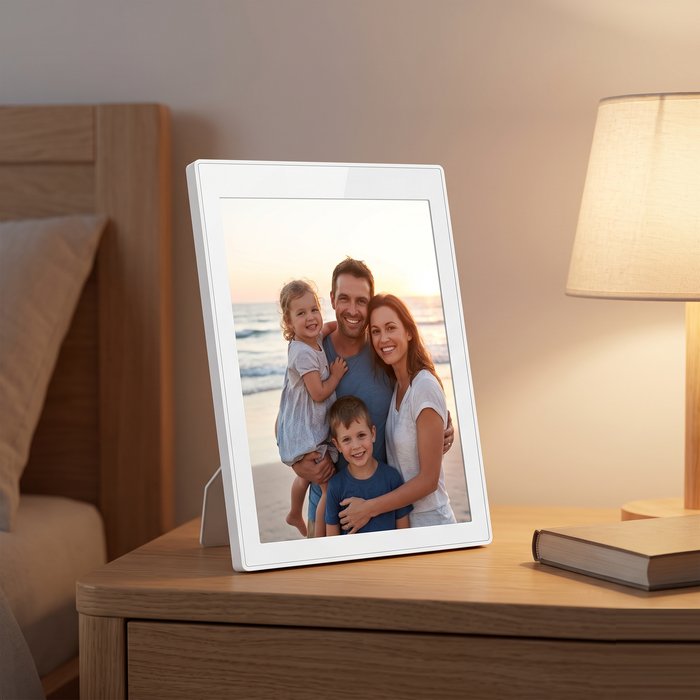
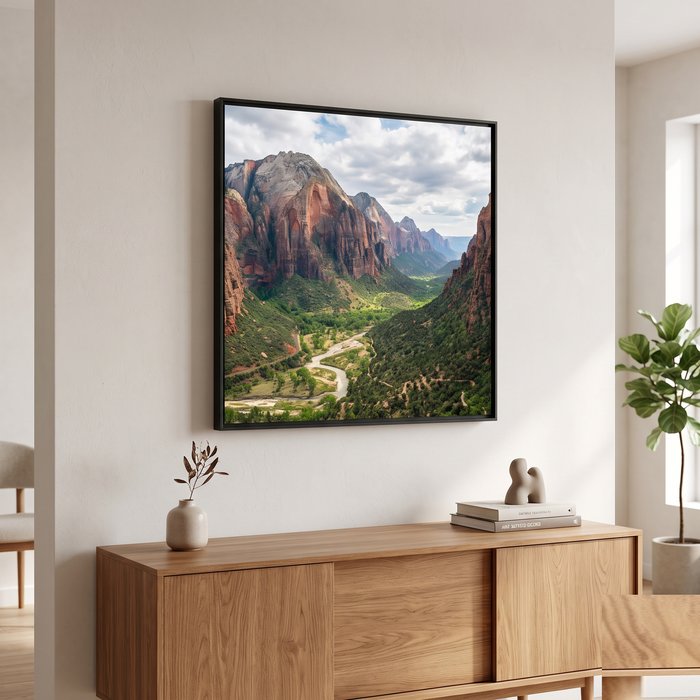
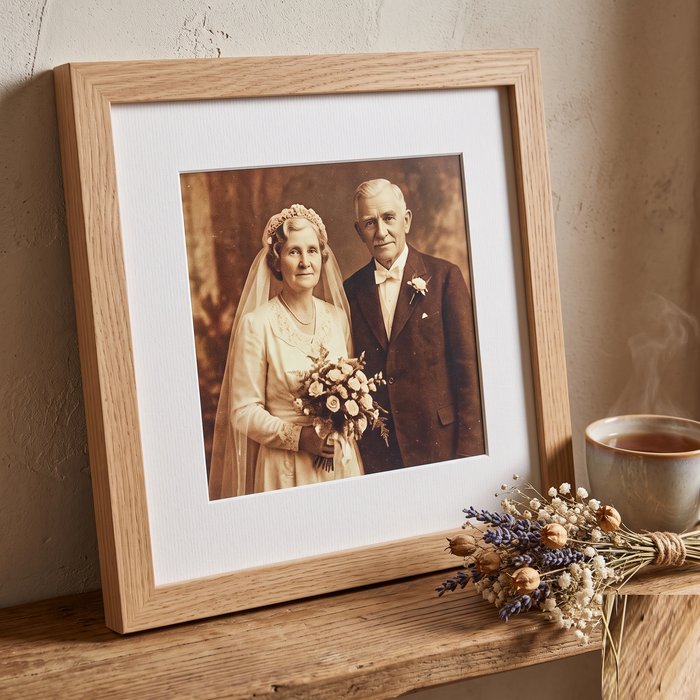
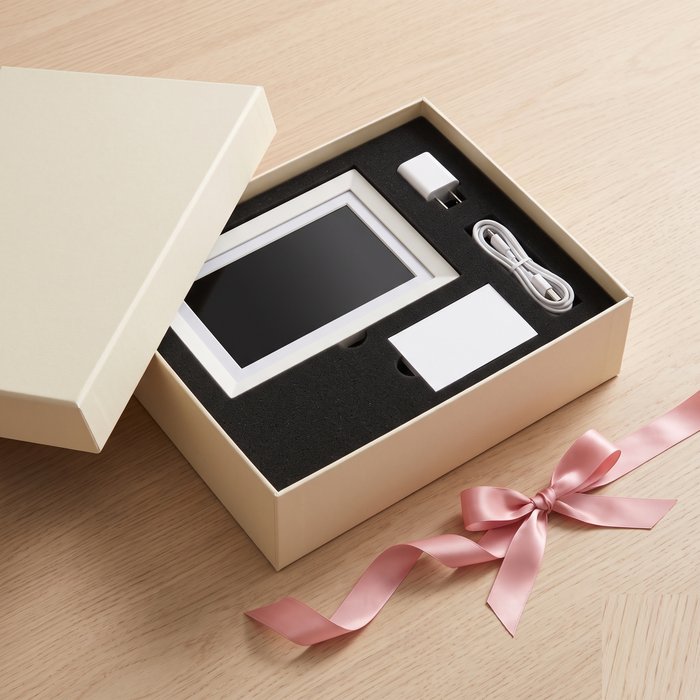
The box is on the list on purpose. This is a product bought to give, and gift buyers look at the packaging before the spec sheet. Choosing the right size, frame and box for the shop's customers, among factories that make all three, is exactly where BCVN comes in.
Why this is an opportunity for Brazil
- Mother's Day is Brazil's strongest retail date after Christmas, and this is a gift made for it. It is not another electronic gadget fought over on specs: it is an object with a story that is easy to tell at the counter and in the ad, the grandchild who appears in grandma's living room.
- High perceived value, entry-level electronics cost at source. Customers compare the frame with other gifts, not with a tablet, and so accept a price the spec sheet alone would not justify. It is often a purchase siblings split, which raises the average ticket.
- It does not end on Sunday. With every new photo, the gift is remembered again, and the giver tends to come back to buy another for the mother-in-law or the other grandmother. After Mother's Day come Grandparents' Day in Brazil, in July, and Christmas, the second season for the same product.
- In Brazil, the category is still up for grabs. Abroad, the product is already a category of its own in the big stores. In Brazil it is still little known, and what appears usually comes unbranded. Whoever arrives first with a box in Portuguese, a simple manual and their own brand takes the space.
- The calendar is what separates those who sell from those who arrive late. With 60 to 120 days between order and shelf, and Chinese New Year stopping factories from 6 February 2027, the Mother's Day container closes now. The guide to planning imports from China in 2027 shows the whole year.
One sales-pitch trap before closing the order: screen resolution is not what sells this product. Factories all advertise the same numbers, and gift buyers do not read them. What holds the price is the frame, the box and a setup that works first time, because the gift that will not connect on Sunday morning comes back to the shop on Monday.
Before importing: the digital photo frame transmits over Wi-Fi, and every product that uses radio frequency needs Anatel certification (homologação) to be sold in Brazil, under the regulation in Resolution 715 of 2019. The certification covers the exact model that goes in the box, with laboratory tests and a certificate issued by a body designated by Anatel. Many factories reply with the certificate for the Wi-Fi module inside the device: do not accept only that, ask for the number of the finished model and check it on Anatel's system before paying for production. The guide to Anatel and Inmetro certification of electronics from China shows the way. Without certification, the shipment can be held and marketplaces take the listing down. The device comes with a plug-in power adapter, which must have the Brazilian standard plug, and how the adapter is classified by Inmetro should be confirmed in writing by an accredited certification body. There are two more points that are not regulations but become complaints: most models only connect to 2.4 GHz networks, and modern routers usually show the 5 GHz one first; and photos pass through the app's servers, so it is worth asking the factory whether it is authorised to install the app it advertises and whether the app has a Portuguese version.
Put your own brand on it
Gifts are the category where an own brand pays off most, because customers do not compare numbers: they compare boxes. A branded frame with an attractive box and a Portuguese manual sells next to a generic import at a price well above it.
- Your brand on the product and packaging (private label / OEM): a discreet logo on the frame or base, and a rigid gift box designed for shop windows and gift wrapping.
- Frame, colour and finish of your choice: white, black, light or dark wood, and the frame with a mount that looks like a traditional photo frame.
- Packaging and manual in Portuguese, with setup in three steps and the 2.4 GHz network warning right in the first one, which is what prevents the Monday return.
Customisation usually calls for a slightly larger minimum order, and BCVN finds the right factory, negotiates the customisation, validates the sample and makes sure the product arrives exactly as you asked for it.
It is worth understanding how this works in practice before requesting the first sample: the guide on own brand in China: private label, OEM and ODM explains the difference between the three models and what each one changes in the minimum order and the lead time.
Where to buy digital photo frames in China
Digital photo frame factories are concentrated in Shenzhen and the neighbouring cities of the Pearl River Delta, next to the tablet and screen makers. That is where you compare the same board in different frames and decide what goes into the range.
- Canton Fair, Phase 1 (consumer electronics): the main aisle, and the place to set ten frames side by side and run the test that matters: connect each one to Wi-Fi and send a photo from a phone.
- Hong Kong Electronics Fair: where the higher-end frames appear, along with factories that supply European and American brands, almost always with certification already organised.
- Yiwu Fair: not where you buy the device, but where the gift box, the ribbon and the counter display that complete the sale are found, with low minimum orders.
2026 fairs and the Mother's Day calendar: Phase 1 of the autumn Canton Fair runs until 19 October 2026, in Guangzhou. The next is the spring 2027 edition (the 141st), with Phase 1 expected on 15 to 19 April going by the fair's usual pattern, still without an official calendar, and the spring Hong Kong Electronics Fair expected on 13 to 16 April. For Mother's Day, however, April is too late: the spring fair buys for Christmas. The Mother's Day order closes now, with samples sent from China and validation done remotely. The guide to China's 2027 public holidays shows what has to ship before Chinese New Year, and the China trade fair calendar 2027 shows the whole year.
The decision that makes money here is not the screen, because the factories all offer the same one. It is getting the gift and the calendar right: the frame the shop's customer would choose for their mother, the box that sells itself in the window, a certification that does not hold the shipment at the port and an order that leaves China before the factories stop. Whoever gets this right has the May gift on the shelf in April. Whoever waits for the April fair sells the same product, but at Christmas.
Frequently asked questions about importing digital photo frames
Does a Wi-Fi digital photo frame need Anatel certification?
Yes. Every product that transmits by radio, and Wi-Fi is radio, needs Anatel certification (homologação) to be sold in Brazil, under the regulation in Resolution 715 of 2019. The certification covers the exact model that goes in the box, with laboratory tests and a certificate issued by a body designated by Anatel. Do not accept only the certificate for the Wi-Fi module inside the device: ask for the number of the finished model and check it on Anatel's system before paying for production. Without it, the goods may be held at customs and the listing is taken down on marketplaces.
How do photos reach the digital photo frame?
Through the phone of whoever sends them. The frame connects to the home Wi-Fi once, generates a code, and each family member installs an app, enters the code and starts sending photos and short videos, which appear on the screen by themselves. The most common app on these devices is called Frameo. Most models only work on a 2.4 GHz network, and this is the most frequent reason for returns: modern routers advertise the 5 GHz network, and the device cannot find it. The box and the Portuguese manual must explain this in the very first step.
When should the order be placed to sell digital photo frames for Mother's Day?
Mother's Day 2027 falls on 9 May in Brazil, and the time between ordering in China and reaching the shelf in Brazil is usually 60 to 120 days. In between comes Chinese New Year, on 6 February 2027, which stops factories for two to four weeks. In practice, the order has to close in November or December 2026, or in the first days after factories reopen. Anyone who waits for the April fair is buying for Christmas, not for mothers.