
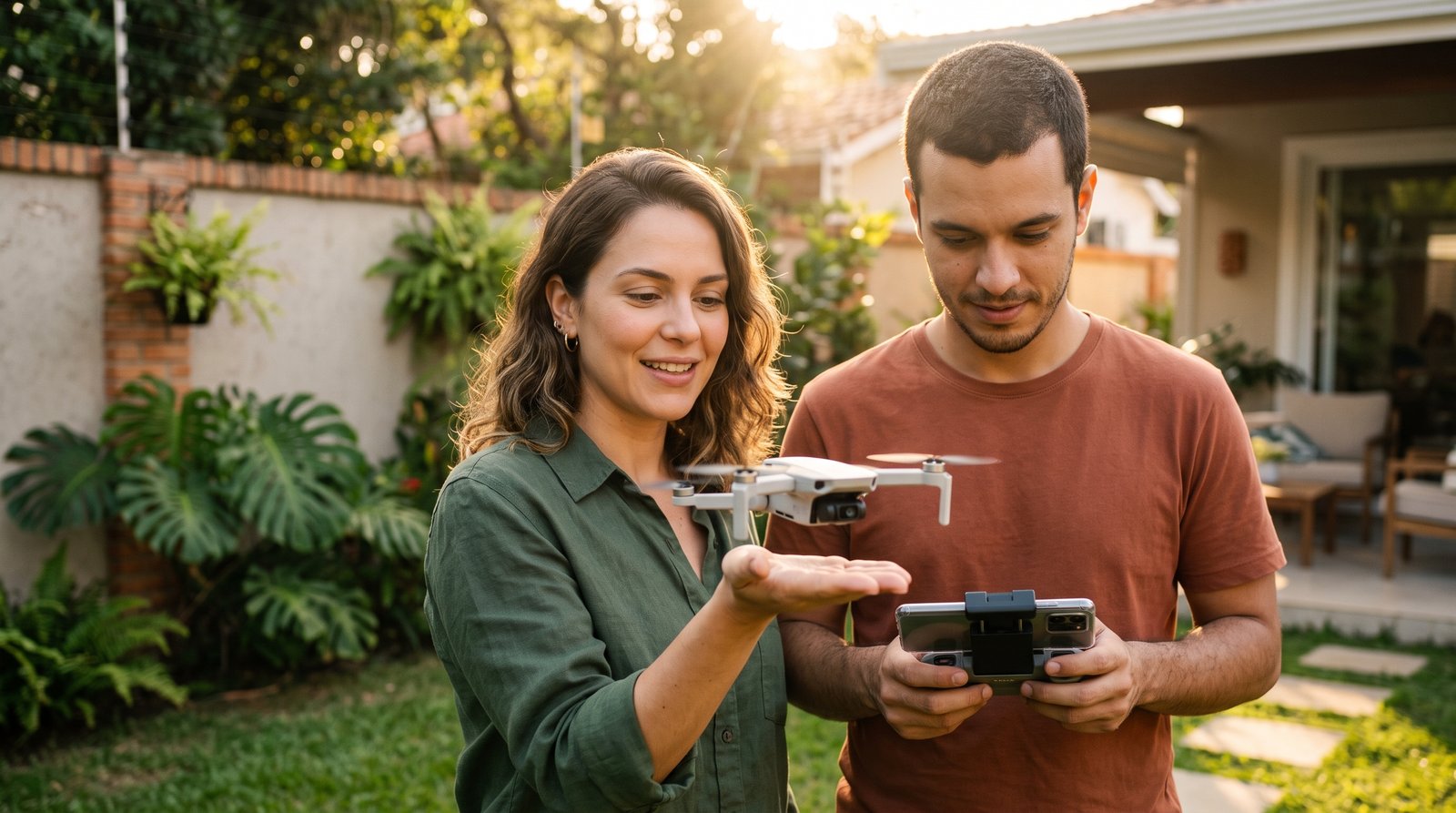
Anyone who watches a mini drone lift off for the first time, in a shop or in a friend's video, asks the same question: how much does it cost? It is an impulse purchase dressed as a gift, and it works because the product explains itself: it rises, films and returns to the hand. The end customer only enters here as bait. Who decides whether this drone reaches the shelf is the retailer who picks the model, and that is who discovers, at import time, that a drone is a product where the paperwork weighs more than the price.
What a consumer mini drone is
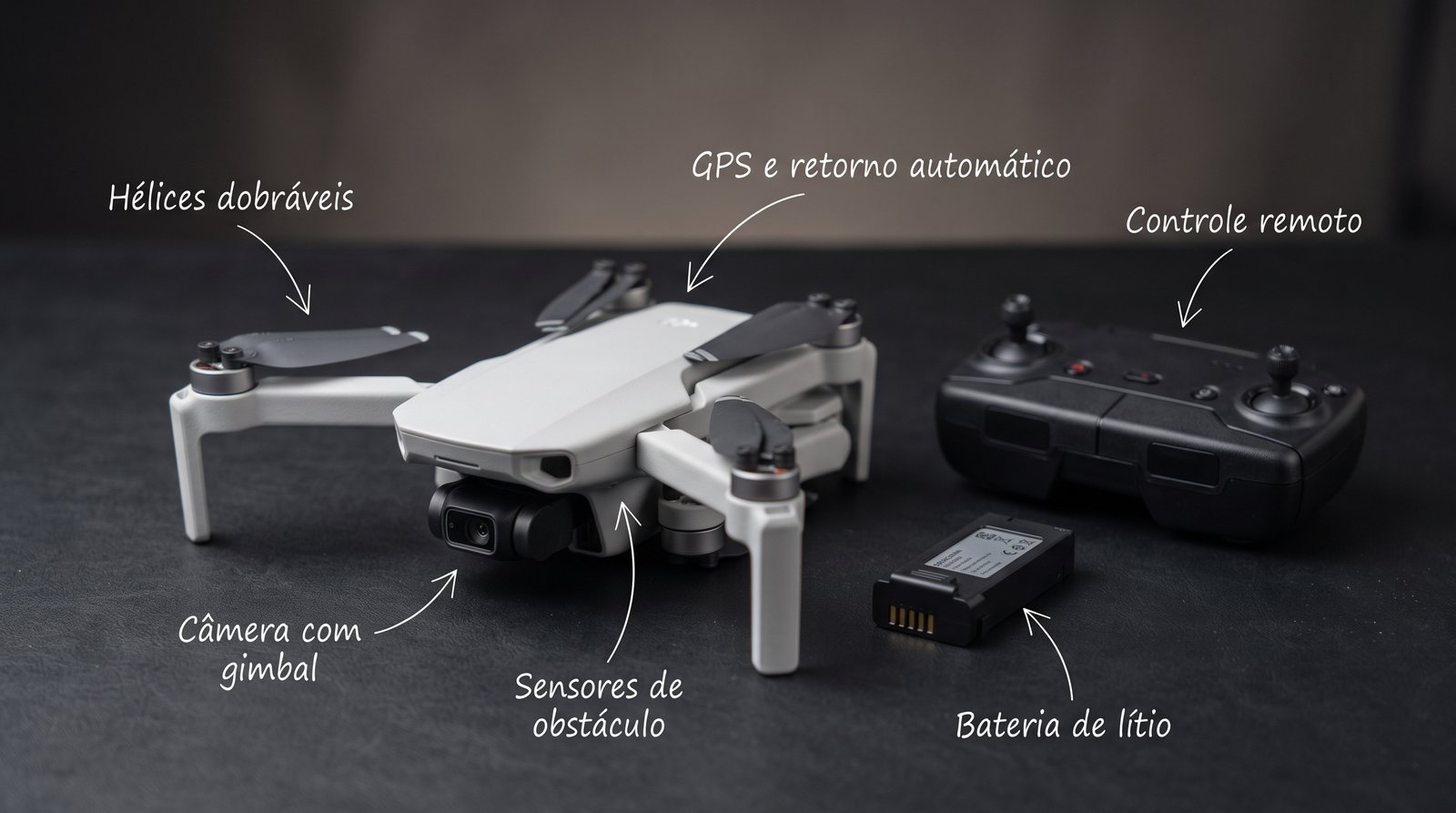
It is the mini drone, a foldable quadcopter that fits in the palm of a hand and, in the lightest models, stays under 250 grams. It carries a stabilised camera (a two- or three-axis gimbal on the best ones), folding propellers, a rechargeable lithium battery with around 20 to 30 minutes of flight, a remote controller or phone control and, from the entry models upward, GPS with automatic return to the starting point and sensors to avoid obstacles. The customer sees an expensive toy that shoots cinematic footage. The retailer sees a high-ticket item that fits in a small box, barely takes up stock space and sells on gift dates.
There is also the FPV family, in which the pilot flies with goggles that show the camera image in real time, a hobby and racing audience that buys parts and batteries all year round. It is a different conversation, more technical, and this find covers the camera mini drone for gifts and for beginners. Nor is it the agricultural spraying drone, which is a work machine, sold to farmers, with other rules and another buying cycle. Here the buyer is the electronics and gift retailer.
Why this is an opportunity for Brazil
The drone stopped being a professional's object. According to the press, ANAC's register of unmanned aircraft passed 133,000 in February 2026 and reached about 160,000 in June, and that count only reaches what exceeds 250 grams. The drone that fits in the palm of a hand is left out of the count, which means the real market is bigger than the number.
- Timing: the drone sells all year, but it is a gift, and gift dates pull orders. With a lead time of 60 to 120 days, an order closed now arrives, in the best case, for the end of the year, and the Anatel certificate is what decides whether that deadline is met. The sample and the certificate can be sorted out now, and the Canton Fair and the October Hong Kong fair are only days away.
- Profit logic: low cost at origin and good resale, with the margin living in the kit: the drone with two or three extra batteries and the carrying bag, and in repurchases of batteries and propellers. Whoever breaks a propeller comes back to the shop.
- Broad audience: gift buyers, beginners, people who film trips, events and properties, electronics and gift shops, online resellers.
- Ready-made content: the flight is the video. The overhead shot, filmed by the product itself, sells without any production.
Before importing, the wall is triple: a drone is the product where the rule comes not from one agency but from three, and each one looks after something different. What follows was checked on 3 October 2026, in the press and on specialist sites, and not in the official text of each rule: confirm each item with the agency before closing the order.
- Anatel, the door that blocks the sale. According to the press, drones and controllers with a radio-frequency transmitter need Anatel homologation to be sold and used in Brazil. The drone falls into category II, where homologation can be issued by declaration of conformity, and a foreign certification accepted by Anatel can replace part of the tests. It was also reported that the homologation fee was waived. Enforcement is real: in an operation on 26 May 2025, in six states and with 33 inspectors, Anatel seized non-compliant drones sold on Mercado Livre, Amazon and Shopee, and in Santa Catarina 466 of the 926 drones on Mercado Livre were non-compliant. Anatel itself spoke of about 15,000 drone homologations in 2024. In practice: ask the factory and the customs broker for the Anatel certificate of the exact model before the order.
- ANAC, the rule for whoever flies. The framework changed in 2026: RBAC 100, approved by ANAC Resolution 805 of 15 June 2026, replaced RBAC-E 94 and organises operations into Open, Specific and Certified categories, with a 120-metre height limit and visual-line-of-sight flight in the Open category, and there is a specific rule for drones up to 250 grams. Registration, insurance and minimum age to fly belong to the operator, not the retailer, and since the rule is new, the customer should consult ANAC's text. Whoever sells explains this in the shop and avoids the customer who feels misled.
- DECEA, the airspace. The new edition of ICA 100-40, through DECEA Ordinance 2094/DNOR8 of 18 March 2026, has applied since 1 July 2026: every flight now requires prior authorisation in SARPAS, including those of drones under 250 grams, and the press mentions a minimum distance of 30 metres from people. It is what knocks down the sales argument “it's light, it flies anywhere”, and whoever films answers for what they film.
Two practical points remain. The lithium battery is regulated cargo in air transport, and whoever ships it should ask the freight agent before the order; Inmetro Ordinance 148/2022, which some people cite for batteries, covers household appliances and does not apply, and Inmetro certification for drone batteries was not confirmed. China concentrates lithium production, as the guide why China sets the price of solar, batteries and the electric car shows. And the tax classification: the drone has its own subheadings in 88.06 since Gecex Resolution 272/2021, but the exact rate and classification are confirmed with the customs broker, in the TEC and the TIPI. Finally, inspect the lot before shipment, with a flight and battery test: the catalogue photo does not fly.
Customise the mini drone with your brand
Importing from China is not just reselling a generic product. The factory can put your brand on the drone, the controller and the box, and assemble the kit your way. That is how a house brand is built, with more margin and less price competition, which is valuable on a product the customer compares on marketplaces.
- Your brand on the drone, the controller and the packaging (private label / OEM): engraved or printed logo.
- Colour and kit composition of your choice: extra batteries, carrying bag, spare propellers.
- Packaging and manual in Portuguese, with the flight rules explained for the Brazilian customer.
On a homologated product, the brand enters the process from the start: define the logo and the model name before requesting the certificate, and ask the customs broker whether changing the name or the kit requires a new process. BCVN finds the right factory, negotiates the customisation and validates the sample before the order.
It is worth understanding how this works in practice before requesting the first sample: the guide on own brand in China: private label, OEM and ODM explains the difference between the three models and what each one changes in the minimum order and the lead time.
Where to buy a mini drone in China
Consumer drones come out of electronics factories, and the map of China's industrial clusters shows where each category is born. At the fairs, the product appears in two places:
- Canton Fair, Phase 1 (Electronics, Machinery and Vehicles): the April 2026 edition opened the first zone dedicated to consumer and agricultural drones, among nine new zones, according to the organiser's release. Check with the organiser whether the zone returns in October.
- Global Sources Consumer Electronics, in Hong Kong: a consumer electronics fair at AsiaWorld-Expo, with the 2026 edition announced for 11 to 14 October, a date to confirm with the organiser.
Autumn 2026 Canton Fair (140th): Phase 1 takes place from 15 to 19 October 2026, at the Pazhou complex in Guangzhou, which puts the Hong Kong fair and the Guangzhou fair in the same travel week. For those planning next year, the guide plan your import from China in 2027 brings together fairs, the Chinese New Year stoppage and deadlines, and the Canton Fair 2027 guide gives the expected dates.
Read the complete guide to the Canton Fair 2026
The mini drone is the product where the shop window deceives: what the customer sees is a toy, and what the retailer buys is radio and aviation equipment. Whoever understands this before going to the factory picks the right model, asks for the certificate early and sells without fear of the enforcement that has already reached the marketplaces.
Frequently asked questions about importing a mini drone
Do I need Anatel homologation to import a mini drone?
You do. According to the specialist press, drones and controllers with a radio-frequency transmitter need Anatel homologation to be sold and used in Brazil, and Anatel has been seizing non-compliant drones on marketplaces. Ask the factory and the customs broker for the certificate of the exact model before the order, and check the rules in Anatel's own text.
Can a mini drone under 250 grams fly without authorisation?
Not any more, according to the press: since 1 July 2026, the new edition of DECEA's ICA 100-40 requires prior authorisation in SARPAS for every flight, including drones under 250 grams. Check the rule in force with DECEA and explain it to the customer at the point of sale.
What changed in ANAC's rules for drones in 2026?
ANAC approved RBAC 100, through Resolution 805 of 15 June 2026, which replaced RBAC-E 94 and organises operations into Open, Specific and Certified categories. Whoever flies is responsible for registration and for the operation, so the retailer should point the customer to ANAC's text.
Where can I find mini drone suppliers in China?
At the Canton Fair, whose April 2026 edition opened the first zone dedicated to consumer drones, and at Global Sources Consumer Electronics, in Hong Kong, from 11 to 14 October 2026. BCVN vets the supplier, the sample and the Anatel certificate before the order. The dates given are for the 2026 season; the next Canton Fair, the 141st, is expected in April 2027.