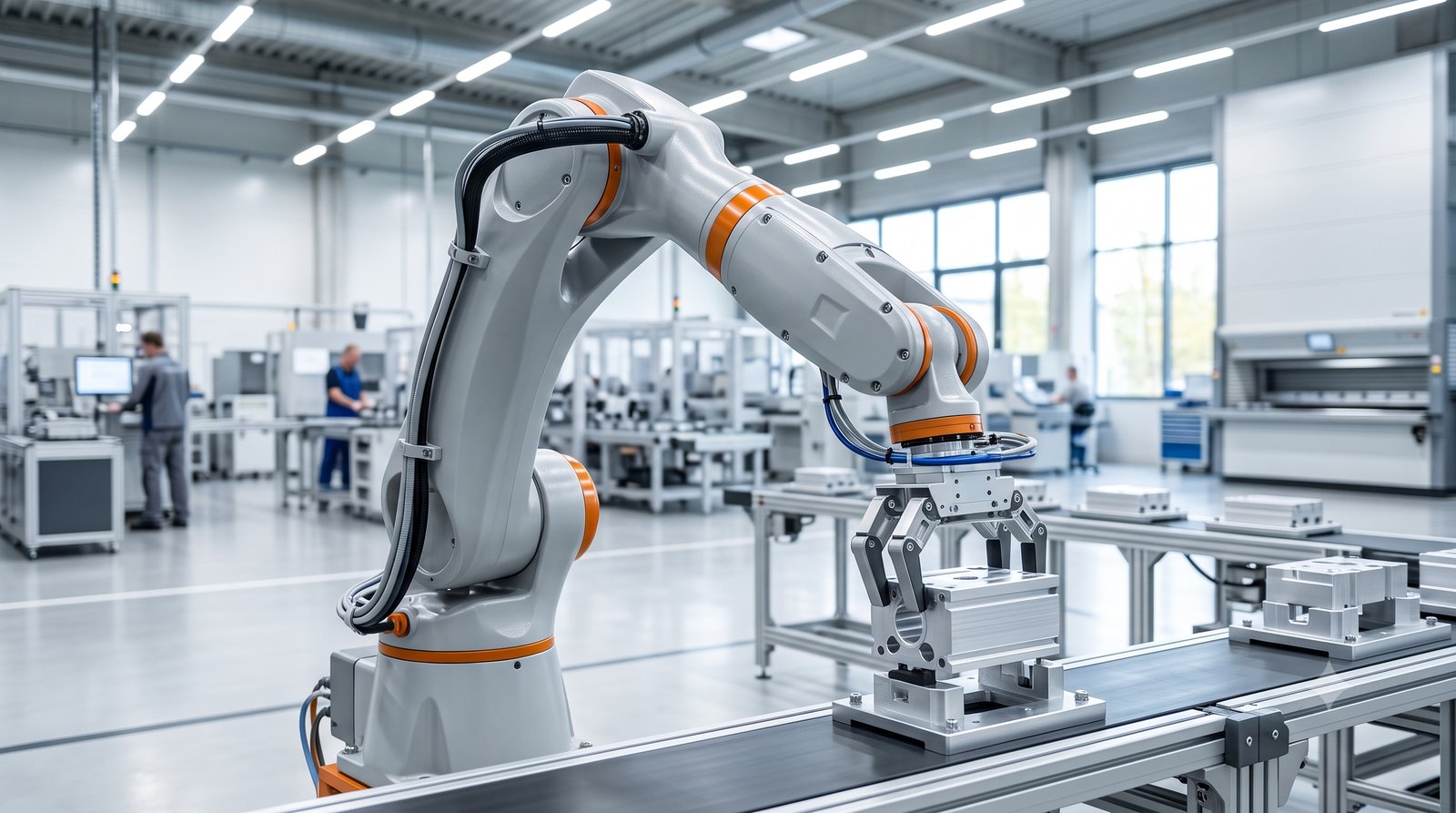
China builds more industrial equipment than any other country. CNC lathes, injection moulding machines, packaging lines, compressors, textile machinery, agricultural equipment: practically any category leaves there for a fraction of what the European or American equivalent would cost. For Brazilian industry that changes the arithmetic of an entire project, and the opportunity is real.
What misleads people is that the easy part looks like the important part. Picking the machine out of a catalogue takes an afternoon. Getting that machine to Brazil legally, on the right mains frequency, with the guarding the inspectorate demands and with spare parts still available two years from now is another problem altogether, and it is the one that decides whether the equipment goes into production or becomes an expensive asset sitting idle in the yard. If you are after the script for finding a supplier and hitting buy, this is not it: industrial equipment is not about where to click, it is about what has to be settled before the machine ships.
The three bars that fall on the importer, not on the factory
Industrial equipment does not face a single regulatory bar, it faces three. And none of them is the Chinese manufacturer's responsibility: all three fall on the CNPJ that imported the goods.
Compulsory certification for the regulated families: portable power tools, general-purpose compressors, inverters, photovoltaic panels. Without the mark the product cannot be sold in Brazil, and the problem surfaces at customs.
A machine that does not require INMETRO still has to meet the Brazilian occupational safety standards. NR-12 covers guarding, emergency stops and technical documentation; NR-13 covers boilers and pressure vessels. The inspectorate shuts down equipment that is already installed.
The manufacturer delivers what was ordered and their involvement ends at customs. The one answerable before INMETRO, the labour inspectorate and the Receita is the importer. A certificate on the supplier's letterhead does not transfer that.
Here is the most expensive confusion in the sector: CE, CCC and ISO do not count as Brazilian conformity. CE is a European mark, CCC is China's own compulsory certification and ISO is a management system, not a product certification. A machine can carry all three and still be non-compliant here. To see which families fall under compulsory certification, the guide to products that require INMETRO is worth reading.
The question that settles the order: before discussing price, the question is "will this machine be operated by a worker and does it run on mains electricity?". The answer decides whether you will be dealing with INMETRO, with NR-12 or with both, and neither is sorted out once the goods have arrived. Bringing it into line in Brazil costs several times what specifying it at origin would have.
Who can import, and why the NCM code decides the cost
Importing equipment is not personal shopping on a larger scale. It is a company operation and it takes two things from the outset: a CNPJ with a compatible line of business and clearance on RADAR Siscomex, the registration that authorises international trade. Without them there is no proper capital goods import.
Once who imports is settled, in comes the heaviest factor in the cost: the NCM, the eight-digit code that classifies the machine and determines the taxes it attracts. Industrial equipment is where classification varies most, because the same machine changes code according to its function, capacity and drive, and the rates change with it. Picking the cheapest code without technical grounds is an invitation to reclassification, a demand for the difference and a fine, with the goods held while that gets resolved. The guide to NCM and tariff classification explains why this is the mistake the Receita charges most dearly for.
Add the exchange rate, heavy-cargo freight, insurance and the taxes levied on the customs value, and it becomes clear that the proforma price is only the start of the sum. To build the real cost, see what it costs to import from China and the guide to freight from China to Brazil. Equipment that exceeds container dimensions moves under a special transport arrangement, with costs worked out case by case and a timeline of its own.
60 Hz: the electrical detail that turns a new machine into a loss
This is the most overlooked risk in the category and the most expensive to discover late. The Chinese grid runs at 50 Hz, the Brazilian one at 60 Hz. A motor designed for 50 Hz turns roughly 20% faster on 60 Hz: it runs hotter, loses service life and changes the speed of every production process that depends on it.
| Parameter | China | Brazil | Impact |
|---|---|---|---|
| Single-phase | 220V | 127V or 220V | Depends on the plant's actual supply |
| Three-phase | 380V | 220V or 380V | Compatible in many cases |
| Frequency | 50 Hz | 60 Hz | Affects motor speed and life |
| Plugs | Type A/I | ABNT NBR 14136 | Always different from the origin standard |
The factory's export standard is their standard, not yours. When the specification is not locked into the order and checked with the motor turning under load before shipment, the correction happens in Brazil, with motor rewinding and component swaps, and it eats a meaningful slice of the equipment's own value. It is a problem no document can fix: no certificate reveals the real frequency of the machine inside the container. Only the test does.
The mistakes that turn equipment into a loss
A machine is not a batch of goods: it is a single, expensive item, and each of these mistakes compromises the whole investment.
1. Accepting the export standard instead of locking the specification
Frequency, voltage, plug standard, the language of the control panel and the manual. The factory delivers its own standard when the order does not say otherwise, and adjusting it in Brazil costs far more than specifying it at origin would have.
2. Leaving NR-12 out of the order
The machine arrives, it is installed, the labour inspectorate shuts it down. Retrofitting guarding, signage and technical documentation in Brazil is expensive work, and the line sits idle while it happens.
3. Trusting the declared capacity
The catalogue promises a volume per hour, the machine delivers considerably less. The gap dismantles the production plan that justified the purchase, and it only shows up in a load test, never in the paperwork.
4. Not knowing whether you are buying from a factory or a middleman
With capital goods, a reseller subcontracts production, stretches the lead time and disappears when a fault appears. The difference is invisible during negotiation and glaring on the day the machine stops.
5. Buying without securing spare parts
Months after installation, a wear part breaks. If it was not dealt with in the order, between having the part made and shipping it the line sits idle for weeks.
6. Under-invoicing or misclassifying
Equipment carries a high value, and high value is what the Receita checks most. Declaring below the real figure or picking a convenient NCM code brings a hold, an assessed value and a fine, with storage running while the case drags on.
The common denominator is that all six are settled at origin, before shipment, and none of them can be fixed once the machine is on its way. For the full picture of what holds goods at customs, see the mistakes that get your shipment held by the Receita.
What you cannot settle from a distance
There is plenty of content teaching you to import machinery on your own, and it almost always stops at the point where the business really begins. Because the stages that decide the outcome are not the ones you do in front of a computer, with photos and a catalogue. They are these:
- Knowing whether the factory is a factory. A real factory has a production line, component stock, a quality control area and people working. A middleman has an office and a catalogue. With capital goods, the difference shows in the lead time, the price and who answers when the machine stops.
- Watching the load test. The machine running, under real load, with capacity, temperature and consumption measured, before the final payment goes out. It is the only moment when the declared capacity is either confirmed or disproved, and it depends on somebody being there.
- Checking NR-12 on the factory floor. Guarding fitted, emergency stop in place, technical documentation complete. That is verified by looking at the assembled equipment, not by reading the supplier's data sheet.
- Seeing the electrical specification honoured. Specifying 60 Hz is easy. Confirming that the machine inside the container is the one that was specified is another matter, and it is the one nobody does from a distance.
- Negotiating what comes after the sale. A wear-parts kit, a warranty with clear conditions for claiming, technical support and commissioning. These are won with presence, language and track record, and the distant buyer almost never gets them.
None of those stages fits into a tutorial, because none of them can be done remotely. This is where a partner at origin stops being a luxury and becomes what separates the machine that produces from the machine that disappoints. A single quality inspection before shipment pays for that care many times over.
The sum that rarely shows up: the cheapness of importing on your own ignores the cost of the mistake. A non-compliant machine, on the wrong frequency or with no spare parts, is not a discount, it is tied-up capital plus the production it should have been delivering. The partner does not make the operation more expensive, they remove the risk that stalls the investment.
The cost that only shows up in year two
With consumer goods, after-sales is a detail. With industrial equipment it is half the decision, and it is the item the first-time importer discovers late. The machine that breaks down in Brazil has its manufacturer 18,000 km away, in an opposite time zone and in a language that is not yours.
Three things decide that scenario, and all three are set before the order: whether there is a stock of wear parts travelling with the equipment, whether the warranty has written conditions for claiming, including who pays the freight on a faulty part, and whether there is real technical support for installation and diagnosis. A supplier that has already exported to Brazil usually has all three answers ready, and that is what separates the good supplier from the cheap one.
The point is that none of this is negotiated after the problem happens. It is negotiated beforehand, with somebody who knows what to ask for, and it is exactly the kind of conversation that distance and language make impossible. Anyone who treats after-sales as a matter for the future buys the equipment twice.
Where to see the machine running before you buy
The best way to choose equipment is not from a catalogue, it is by watching the machine turn and talking to whoever builds it. Two fronts concentrate the sector:
The machinery, electronics and vehicles phase of China's largest general trade fair, in Guangzhou. It brings together makers of machine tools, packaging equipment, power tools and agricultural machinery in one complex. See the guide to Canton Fair Phase 1.
Every vertical has its own dedicated fair in China, with specialist manufacturers and the equipment demonstrated in operation. Fitting one of them into the same trip as the Canton Fair multiplies the reach of the visit. See the 2026 China trade fair calendar.
Being at the fair lets you see the equipment in operation, compare dozens of manufacturers in hours and tell those who produce from those who merely resell, all before committing a single cent. It is also where you negotiate customisation and own-brand production with people who have the power to decide: see the guide to own brand, private label and OEM. Between the arm bolted to the bench and the machine that moves down the corridor on its own there is a boundary that changes the whole business, and it is set out in the guide to service robotics.
Frequently asked questions about importing industrial equipment from China
Does industrial equipment imported from China need INMETRO certification?
It depends on the product family. Portable power tools, general-purpose compressors, inverters and photovoltaic panels are subject to compulsory certification. Heavy machinery such as lathes, presses and injection moulding machines usually falls outside INMETRO, but it does not fall outside the rules: it has to meet NR-12, on machinery and equipment safety, while boilers and pressure vessels answer to NR-13. In every case it is the Brazilian importer who is answerable for conformity, not the Chinese manufacturer.
Is the Chinese manufacturer's CE or CCC certificate valid in Brazil?
No. CE is a European mark, CCC is China's own compulsory certification and ISO is a management system, not a product certification. None of them replaces INMETRO certification or conformity with the Brazilian Normas Regulamentadoras. A machine can carry all three marks and still be non-compliant here, whether at customs or in a labour inspection once it is installed.
What voltage and frequency do machines built in China use?
The Chinese standard is 220V single-phase and 380V three-phase, at 50 Hz. Brazil runs at 60 Hz, with 127V or 220V single-phase and 220V or 380V three-phase. The frequency gap is the one that does the damage: a 50 Hz motor turns roughly 20% faster on 60 Hz, runs hot and loses service life. And the real frequency does not show up reliably on any document, only a load test on the motor before shipment confirms what was actually built.
Can anyone import machinery from China?
To import properly you need a CNPJ with a compatible line of business and clearance on RADAR Siscomex, the registration that authorises a company to trade internationally. Capital goods are a company operation: beyond the sums involved, it is the importing CNPJ that answers for the equipment's conformity before INMETRO, the labour inspectorate and the Receita. That is why BCVN serves industry, distributors and retailers, not the purchase of a single unit by a private individual.
How do you import industrial equipment from China without surprises?
By settling at origin what Brazil will demand at destination: locking the electrical specification and attending the load test before shipment, requiring NR-12 conformity in the build itself, classifying the right NCM code, declaring the real value and dealing with spare parts, warranty and support inside the order. That is precisely the part you cannot do from a distance, with photos and a catalogue. BCVN validates the factory, attends the test, inspects the equipment and runs the import in conformity.
Trade fair products in the China Showcase
Real finds from the fairs this guide covers, each with the cost and resale logic behind it. See more in the China Showcase.