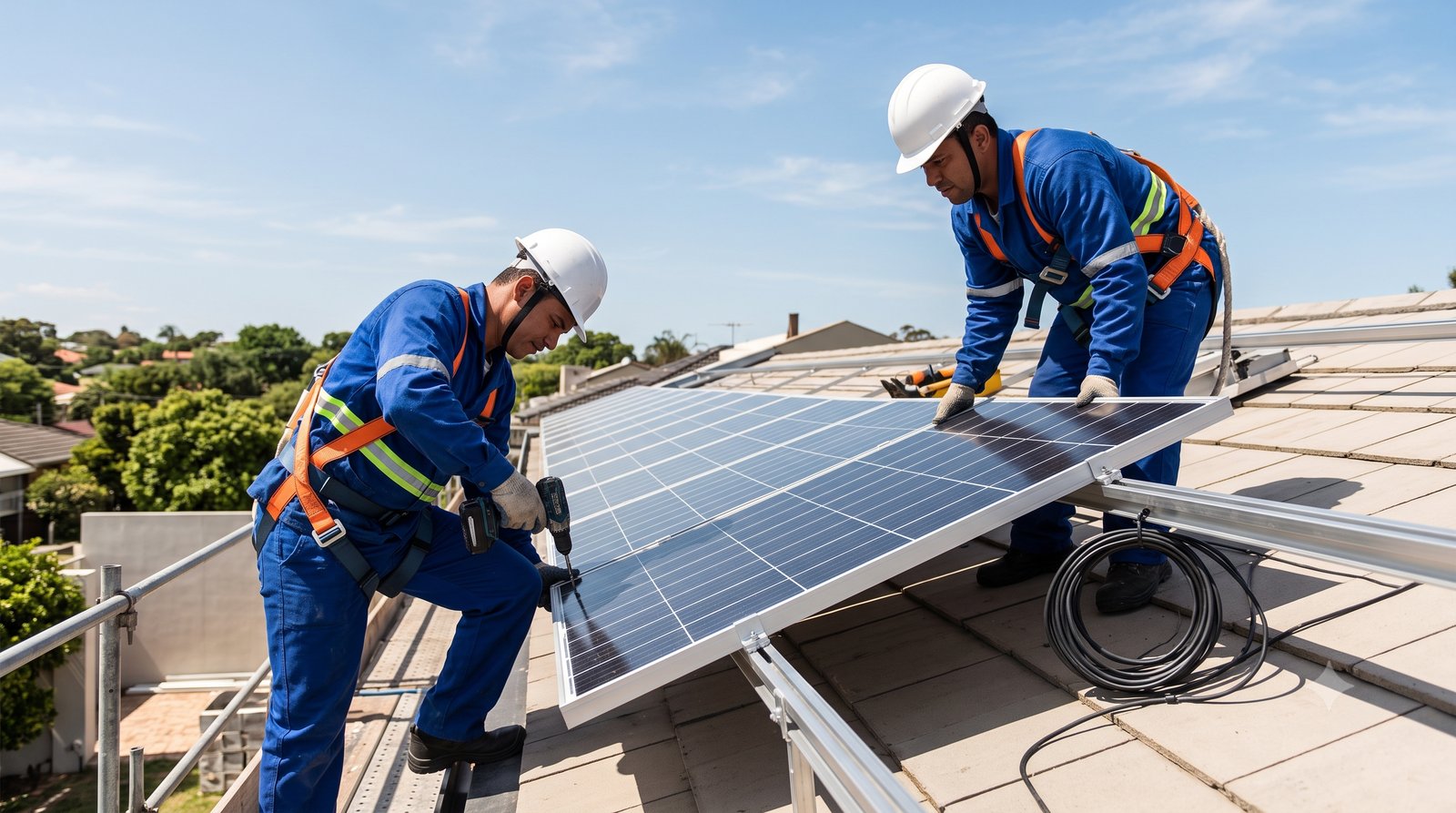
The Brazilian distributed generation market has not stopped growing in recent years, and every new roof means a whole kit being bought: modules, inverter, mounting structure, cabling, string box. Almost all of it comes from China, at a production scale no other country matches. For the installer, the distributor and the reseller, the difference between buying on the home market and buying at source changes the margin on every project of the year.
What misleads is the commodity look. A module looks like a module, an inverter looks like an inverter, and the spreadsheet only shows the price per watt. But in this vertical the product is not the equipment: it is the energy it will generate over 25 years, and that is what was sold to the end customer. When what arrives delivers less than the label says, nobody notices on installation day. It shows up on the customer’s electricity bill months later, when the promised saving fails to appear and the phone that rings is yours. If what you want is a step by step guide to finding a supplier and clicking buy, this is not it.
Without INMETRO registration, there is no system
This is the fundamental difference between solar energy and any other imported category. In almost every product, compliance is a legal requirement enforced afterwards, at inspection. In photovoltaics it is a commercial gate enforced beforehand: the utility asks for the certificate in the grid connection request, and without it the system is not approved. The equipment can be installed, aligned and spotless on the roof, and still be an investment that generates no credit at all.
Generation, conditioning and storage equipment in a photovoltaic system is under compulsory certification, in a regime tightened by Ordinance 140/2022 and later adjusted by 515/2023. The requirements vary with the power rating, and the bands change over time.
It is not enough for the brand to be registered. It is the exact model, at the exact power rating, that has to be listed. Swapping the model for an "equivalent" after the order is the shortest route to discovering the problem with the cargo already in the country.
An inverter with Wi-Fi or Bluetooth for monitoring, which today is almost every inverter, also needs ANATEL approval. It is a second yardstick that goes unnoticed until customs clearance.
Worth insisting: a CE or CCC certificate replaces none of this. CE is a European marking and CCC is China’s own compulsory certification. The equipment can hold both and still be useless for a system approved here. To understand how the two yardsticks that come up most in this vertical work, see the guides on products that require INMETRO and on ANATEL and INMETRO approval for electronics. Residential storage is one of ten categories that matured at the same time, listed in the guide to the technologies reaching the shelf in 2027.
The question that decides the order: before discussing price per watt, the question is "is this specific model, at this specific power rating, registered?". The answer does not come from the factory’s salesperson, it comes from checking the register. Finding this out after shipment means cargo held, project delayed and an end customer waiting for a saving that was sold with a date attached.
The power the label promises and the roof delivers
This is the costliest risk in the category, and the hardest to see from a distance. The module is sold at a nominal power, 550 W for example, and part of the market consistently delivers less than that. The industry named the problem fake power, and it was frequent enough for INMETRO itself to tighten the power requirements in 2023.
The effect is treacherous because it does not show up as a fault. Nothing burns out, nothing stops, nothing throws an error. The system simply generates less than the sizing predicted, every day, for the next 25 years. Whoever sold the project calculated the return on generation that will not happen, and the one who answers for that to the end customer is the installer, not the factory on the other side of the world.
There is a concrete way to check, and it is not in the catalogue: the flash test report. Every module is measured as it comes off the line, and the report gives the measured power tied to the serial number. What separates those who buy well from those who buy cheap is demanding that report for the batch and checking the serial numbers against what actually shipped, instead of accepting a generic document that could be from any production run. It is the kind of check that a pre-shipment inspection settles and an exchange of messages does not.
The 25 year warranty is worth whatever the manufacturer is worth
No other imported category sells such a long promise. And two things that tend to be advertised together have to be separated: the product warranty, against manufacturing defects, which is usually much shorter, and the performance warranty, which promises a minimum percentage of power over decades.
The awkward detail is that neither of them triggers itself. For them to be worth anything, the manufacturer has to exist fifteen years from now, has to answer, and has to agree to pay. The Chinese solar sector is large, competitive and volatile: factories appear, merge and disappear often. Choosing a supplier here is less a question of price per watt and more a bet on who will still be standing when the promise falls due.
In practice, three questions define the risk, and all three are answered before the order: how long the factory has been producing, whether it has exported to Brazil on a recurring basis, and who answers for the warranty on this side. A solid supplier has all three answers ready and in writing. One who answers evasively is telling you exactly what you need to know.
The mistakes that turn a solar kit into a loss
1. Buying on price per watt and only then checking the registration The right order is the reverse. Confirming the registration of the exact model is the first filter, because it rules out half the quotes before any negotiation, and avoids discovering the problem with the cargo in the country.
2. Accepting a generic flash test report A report that does not tie measured power to a serial number proves nothing about the batch that shipped. It is the easiest document to ask for and the easiest to forget.
3. Ignoring ANATEL on the inverter Practically every inverter today has Wi-Fi for monitoring, and that puts it under a second approval. It is a requirement people remember only when it is already holding up clearance.
4. Underestimating transport damage Modules crack on the inside. The microcrack is invisible to the naked eye, does not break the glass and still reduces that panel’s output forever. Packaging, palletising and stowage are not a logistics detail in this category, they are part of the specification.
5. Treating taxation as a fixed number The tax burden on photovoltaic equipment has changed more than once in recent years, and the rate has to be confirmed on the date of the order, not copied from an old spreadsheet. Add classification to that: the same family changes code depending on the item. See NCM and tariff classification and the mistakes that get cargo held.
What cannot be settled from a distance
There is plenty of content teaching you to import a solar kit on your own, and it tends to stop exactly where the risk begins. The steps that decide the outcome are not the ones done in front of a computer, with a catalogue and a spreadsheet. They are these:
- Knowing who actually manufactures. In this chain there are many companies that merely assemble or resell under their own brand. A factory with cells, lamination and testing on its own line is another matter, and the difference shows in batch consistency and in who honours the warranty.
- Checking the flash test against the cargo. Not the document that arrives by email: the batch report, with the serial numbers matching the modules being palletised.
- Seeing the packaging before closing. Palletising, reinforced corners, how it is stowed in the container. It decides how many modules arrive with microcracks, and it is a negotiation won by being there.
- Confirming the registration of the model, not the brand. Registration is by model and power rating. Accepting a swap for an "equivalent" at production time is the mistake that blocks approval later.
- Settling who answers for the warranty in Brazil. In writing, with the conditions for claiming and the deadline. It is the most important item of all and the easiest to leave for later.
None of these steps fits in a tutorial, because none of them is done remotely. This is where a partner at source stops being a comfort and becomes the difference between the project that generates what was forecast and the one that generates excuses for 25 years.
The sum that rarely appears: the cheapness of importing alone ignores the cost of a system that is not approved or that generates less than was sold. The first is capital sitting idle; the second is reputation, because whoever installed it answers to the end customer every month. The partner does not make the operation dearer, it removes the risk that gets paid in long instalments.
The cost the module hides
Modules are heavy, fragile and bulky, which makes logistics a large part of the bill and not a detail at the end. The container calculation changes with the palletising, and the difference between good stowage and improvised stowage shows in how many panels arrive intact.
To build the real cost, beyond the proforma value, it is worth seeing what it costs to import from China and the guide to freight from China to Brazil. Anyone without their own import structure can operate through a third party importer, and anyone working with recurring volume should look at drawback where it applies. Before any of those steps, though, it is worth understanding how to check whether the supplier is reliable, because in this vertical the supplier is the warranty.
Where to see the sector before buying
Choosing a solar supplier improves a great deal when you see the line, the sample and the track record up close. Two fronts concentrate the sector in China, and they sit at different points in the calendar:
The electronics, machinery and energy phase of China’s largest general trade fair, in Guangzhou. It is the hot window of the year for anyone wanting to compare module, inverter and accessory manufacturers in the same complex. See the guide to Canton Fair Phase 1.
The sector fair for photovoltaics and storage, in Shanghai, ran from 3 to 5 June 2026 at the NECC. Anyone wanting the sector in depth starts planning for the 2027 edition, with the date to be confirmed by the organiser. See the China trade fair calendar 2026.
In practice, anyone who needs to settle a supplier within this cycle works with the October Canton Fair and uses the following year’s SNEC to go deeper and renegotiate. Being at the fair lets you compare dozens of manufacturers in hours, separate those who produce from those who only resell, and discuss the warranty with someone who has the power to decide, including own brand, private label and OEM, which in solar applies above all to mounting, cable and accessories.
The neighbouring guides are also worth reading: electronics, for the ANATEL yardstick, and industrial equipment, for anyone who also brings in machinery. And if the question is why module prices move the way they do, who sets the price of solar, batteries and electric cars explains the rung of the chain where the decision is made.
Frequently asked questions about importing solar energy from China
Do solar panels and inverters imported from China need INMETRO certification?
Yes. Generation, conditioning and storage equipment in a photovoltaic system is under compulsory INMETRO certification, a regime tightened by Ordinance 140/2022 and later adjusted by Ordinance 515/2023. The requirements vary with the power rating and the bands change over time, so the classification has to be confirmed on the date of the order. In practice the decisive point is commercial: the utility asks for the certificate in the grid connection request, and equipment outside the register blocks approval of the system.
What is fake power in a solar panel?
It is a module that delivers less power than the label declares. The panel is sold as 550 W, for example, and consistently produces below that, which reduces the output of the whole system and destroys the return calculation presented to the end customer. The problem was frequent enough for INMETRO itself to tighten the power requirements in 2023. It cannot be detected from a photo or a catalogue: it is detected by comparing the batch flash test report with what actually shipped.
Is the 25 year warranty on a Chinese solar panel valid in Brazil?
It is worth whatever the manufacturer is worth 25 years from now, and two warranties have to be separated: the product warranty, against manufacturing defects, which is usually much shorter, and the performance warranty, which promises a minimum percentage of power over decades. Neither triggers itself: somebody has to exist, answer and pay. That is why the choice of manufacturer weighs more in this vertical than in any other, and why the conversation about who answers for the warranty happens before the order, not after the problem.
Who can import solar energy equipment from China?
To import on a regular basis you need a CNPJ with a compatible activity and RADAR Siscomex authorisation. It is the importing CNPJ that answers for the conformity of the equipment before INMETRO and the Receita, and it is that name that stays attached to the installed system for the next 25 years. That is why BCVN serves installers, distributors and resellers working at volume, and not the purchase of a single kit by an individual.
How do I import solar energy from China without the risk of the system not being approved?
By confirming the registration of the exact model before the order, not of the line or the brand in general, because registration is per model. Then by demanding the batch flash test report and checking the serial numbers against what ships, verifying the ANATEL approval of any inverter with wireless communication, defining the NCM code on a technical basis and settling in writing who answers for the warranty in Brazil. None of that is done from a catalogue, and it is exactly where BCVN comes in.
Trade fair products in the China Showcase
Real finds from the fairs this guide covers, with the cost and resale logic of each one. See more in the China Showcase.