
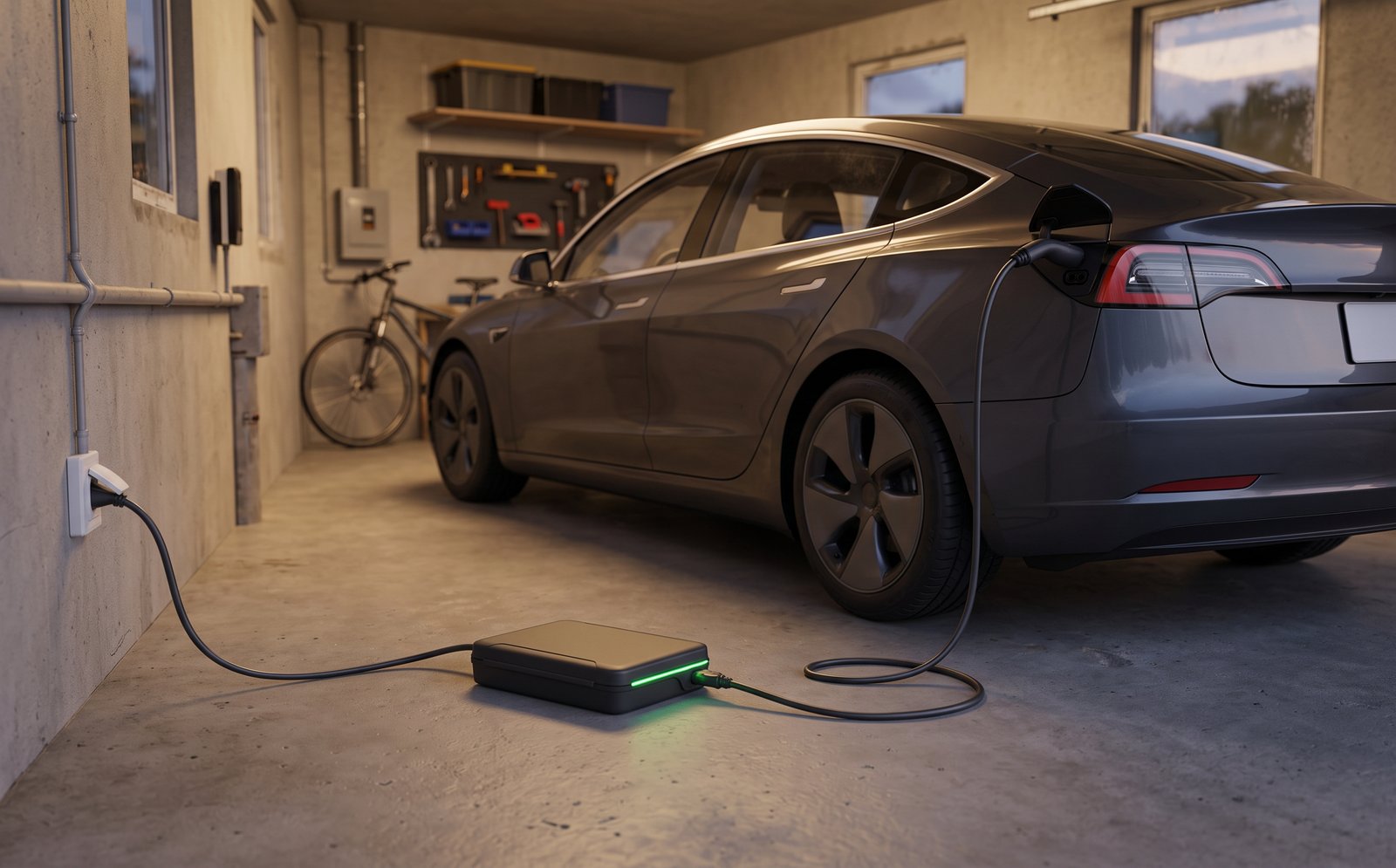
There's a profile of electric car owner that advertising doesn't show. The one who lives in an apartment and didn't get, or didn't want to fight for, condo approval to install a charging point in their spot. The one who leases the car by subscription and isn't going to do construction work on a property that isn't theirs. The one who changes cars every two or three years and doesn't want to tie a fixed wall investment to a vehicle they're going to sell. For this buyer, who is already a large group and growing along with Brazil's electric fleet, the fixed charging station isn't the answer. It's the wrong question.
What is a portable EV charger
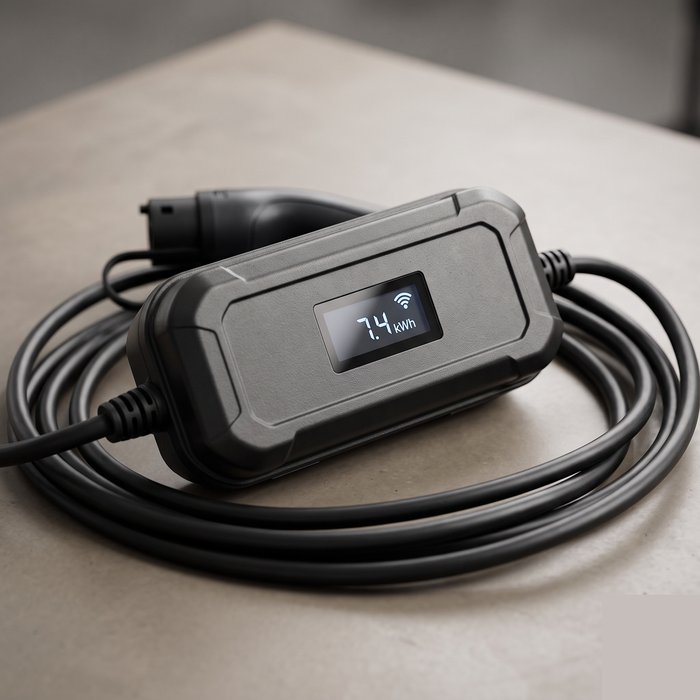
From the outside it's a thick cable with a box in the middle, about the size of a laptop case. On one end, the plug that goes into the wall outlet. On the other, the connector that fits the car. The box in the middle, which the industry calls the in-cable control box, is the real charger: it measures current, controls charging, detects leakage and stops everything in case of a fault, things a common outlet does not do on its own. The car only accepts current after that box authorizes it, cell by cell, and it's this dialogue between the box and the car that makes the difference between charging safely from a common outlet and forcing an installation that wasn't built for that.
Most models have a selector, physical or through an app, to adjust the output current: usually between 6 and 16 amps, sometimes up to 32. It's this adjustment that lets the same product serve both a common 10-amp outlet and a 20-amp point already designed for the car, and it's the detail that separates the product that adapts to the existing installation from one that requires a new one.
Models and variations
On the fair floor the product splits into formats that solve different problems, and the factory that only shows one of them is showing half its catalog.
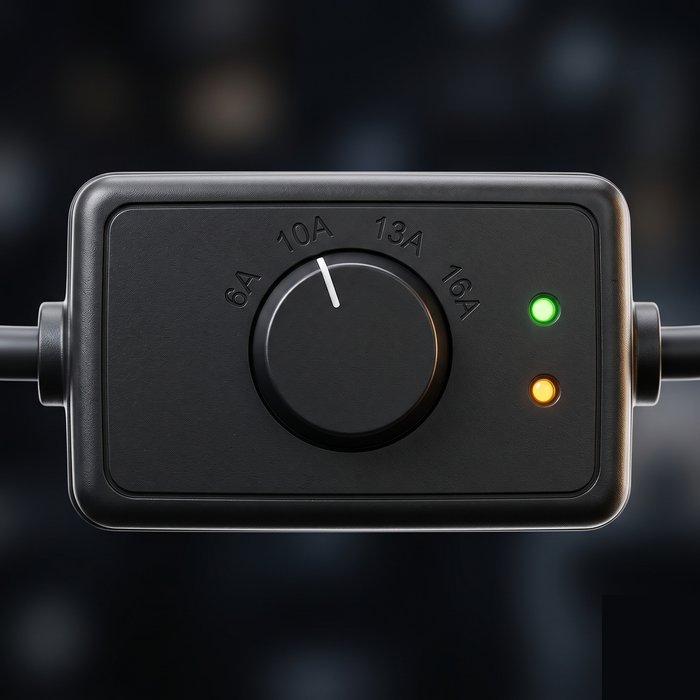
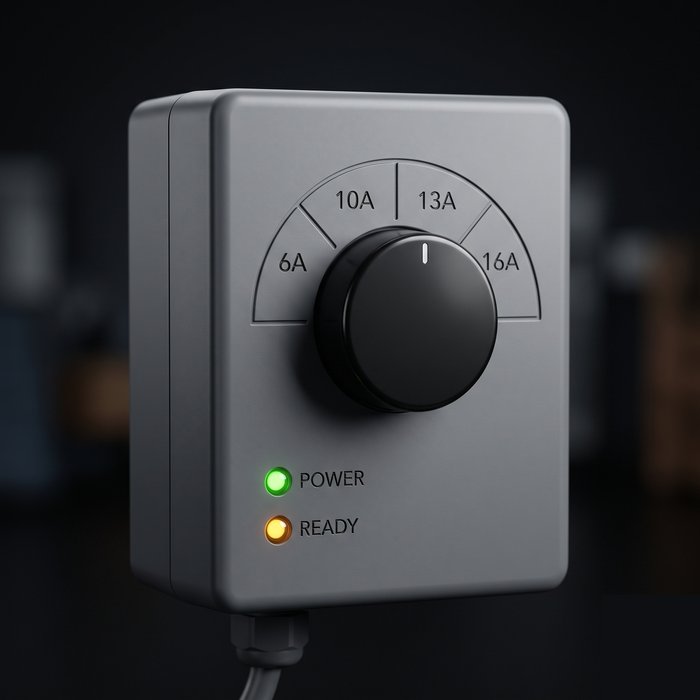
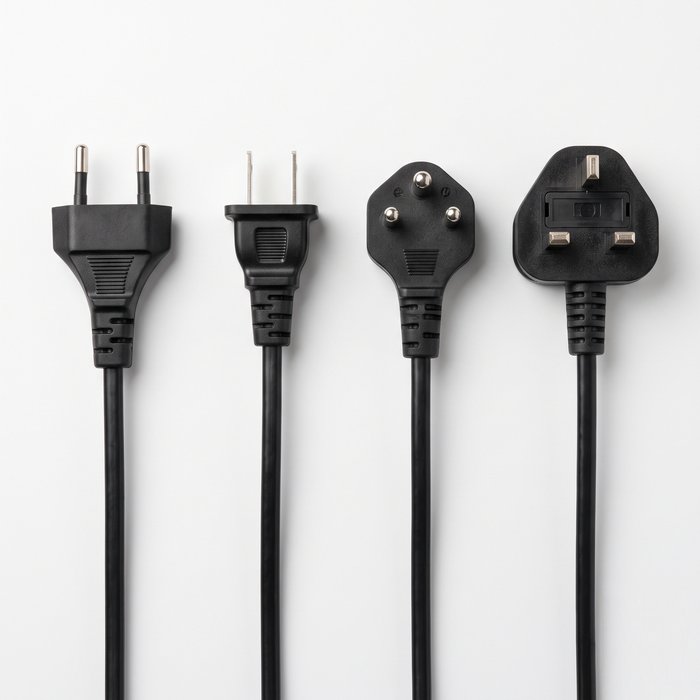
Choosing between these four is not a matter of taste, it's a matter of who the product is going to sell to: the travel case for whoever already has a fixed charger and wants a backup, the simple-selector one for the first-time buyer, and the one with a display for whoever pays the condo's electricity bill and needs to prove how much they spent. Understanding this segmentation before closing the container is where BCVN comes in.
Why this is an opportunity for Brazil
Brazil's electric fleet is growing faster than residential charging infrastructure, and the gap between the two is exactly the space where this product sells. The chain that sustains that growth, on the battery and car side, is described in the guide on solar, battery and electric car, which serves as the backdrop for any find in this cluster.
- Solves the buyer the fixed station doesn't reach. Apartment without condo approval, subscription rental, shared garage: none of these cases accept construction work, and all of them accept a product you can take with you.
- Sells before and after the fixed installation. Whoever just bought the car uses this product in the first month, while sorting out the permanent installation, and whoever already has a wall charger buys a second one, for trips or to leave at their parents' house.
- Accessory ticket, electronics life cycle. It's a product that gets decided on and bought quickly, similar in buying journey to a car phone charger, just in a much higher price bracket.
- Evergreen category, with no seasonality to hold up the order. The electric fleet grows all year round, and the 60-to-120-day lead time between China and Brazil doesn't clash with any specific buying window.
- Sets itself apart by being the opposite of what's already in the catalog. The fixed charging station sells infrastructure, electrical design and installation: it's for whoever has their own wall and wants to settle it once and for all. This one sells exactly not needing any of the three. They are two different buyers, and whoever has both products in the catalog covers the entire EV owner's journey.
Before importing: today there is no compulsory INMETRO certification for this type of charger. Ordinance 148/2022 expressly excludes the conductive electric vehicle charger from its scope, and the product follows the ABNT NBR IEC 61851 technical standard on a voluntary basis. INMETRO opened studies in 2026 for its own technical regulation for electric vehicle charging, with conclusion expected by December 2026, and this could change the picture. The absence of a compulsory requirement is not the absence of care: confirm in writing that the connector on the car's side is Type 2 (Mennekes, ABNT NBR IEC 62196), the official standard in Brazil, because much of Chinese production leaves the factory with the GB/T connector, from China's domestic market, which does not fit. Also confirm the dual voltage, from 100 to 240V, and that the control box has built-in ground-fault protection, because the Brazilian outlet alone does not guarantee that. And remember NBR 5410: continuous load for more than three hours, exactly the case of a car charging overnight, has to run at no more than 80% of the circuit breaker's current, so the charger's current setting needs to respect the existing installation, not the other way around. If the model has Wi-Fi or an app, ANATEL approves the radio part.
Put your own brand on it
It's a product the customer carries visibly, pulling it out of the trunk in front of whoever's at the charging point or the neighboring building's garage, and that works as a showcase for whoever builds a private label in this category.
- Your brand on the product and the case (private label / OEM): logo on the control box and the carrying case, which is the most exposed part of the set.
- Cable color, box finish and kit composition of your choice, including the plug kit that comes with the product.
- Packaging and manual in Portuguese, with the warning about current and dedicated circuit explained clearly, which is what keeps a tripped breaker from turning into a complaint.
Customisation usually calls for a slightly larger minimum order, and BCVN finds the right factory, negotiates the customisation, validates the sample and makes sure the product arrives exactly as you asked for it.
It is worth understanding how this works in practice before requesting the first sample: the guide on own brand in China: private label, OEM and ODM explains the difference between the three models and what each one changes in the minimum order and the lead time.
Where to buy a portable EV charger in China
The product sits in the same chain of automotive and electronic components that also produces the battery and the fixed station, so the purchase fits well into a single trip.
- Canton Fair, Phase 1 (electronics, machinery and vehicles): brings together charger manufacturers, automotive component makers and electric vehicle makers in the same complex, which makes it easy to compare the charger against the car it's going to serve.
- Hong Kong Electronics Fair: concentrates higher-finish factories, with lines already built for export and organized certification.
Next edition, Canton Fair 2026 (140th): Phase 1 runs from October 15 to 19, 2026, in Guangzhou. The Hong Kong Electronics Fair opens earlier, from October 13 to 16, and the two fit into the same trip.
Read the complete guide to the Canton Fair 2026
The decision that separates whoever sells well in this category from whoever ends up with a return is not the power printed on the box, it's the right connector, the confirmed dual voltage and a control box that genuinely protects the installation the customer already has at home. Whoever gets these three points right sells to the buyer the fixed station will never reach.
Frequently asked questions about importing a portable EV charger
Does a portable EV charger need an electrical installation?
Not in the sense of construction work or a new electrical project, which is exactly what separates this product from the fixed charging station. It plugs into a common outlet that already exists. What needs attention is different: the outlet has to withstand a continuous load for hours, and Brazil's NBR 5410 standard requires a circuit used that way continuously to run at no more than 80% of the breaker's rated current. An outlet on a circuit shared with other appliances, or an undersized breaker, is what makes the charger trip or overheat the point, not the product itself.
Does this charger work with any electric car sold in Brazil?
Only if the connector on the car's side is Type 2, also called Mennekes, which is the standard officially adopted in Brazil under ABNT NBR IEC 62196 and the only one automakers install here. The detail that trips people up is that much of Chinese manufacturing is built for China's own domestic market, which uses the GB/T connector, physically different and incompatible. Closing the order without confirming the Type 2 connector in writing is the costliest mistake in this category. Also confirm the voltage: the product needs to accept both ranges used in Brazil, between 100 and 240 volts, because a unit built only for 220V stalls on a 127V installation.
Does this charger need INMETRO certification?
Today, there is no compulsory INMETRO certification for conductive EV chargers: Ordinance 148/2022 expressly excludes this equipment from its scope, and it follows the ABNT NBR IEC 61851 technical standard on a voluntary basis. INMETRO opened studies in 2026 for a specific metrological technical regulation for EV charging, with conclusion expected by December 2026, and compliance rules change by ordinance. The absence of a compulsory requirement does not replace technical care: confirming the connector, the dual voltage and the built-in ground-fault protection in the control box is still what decides whether the product is safe, seal or no seal.