
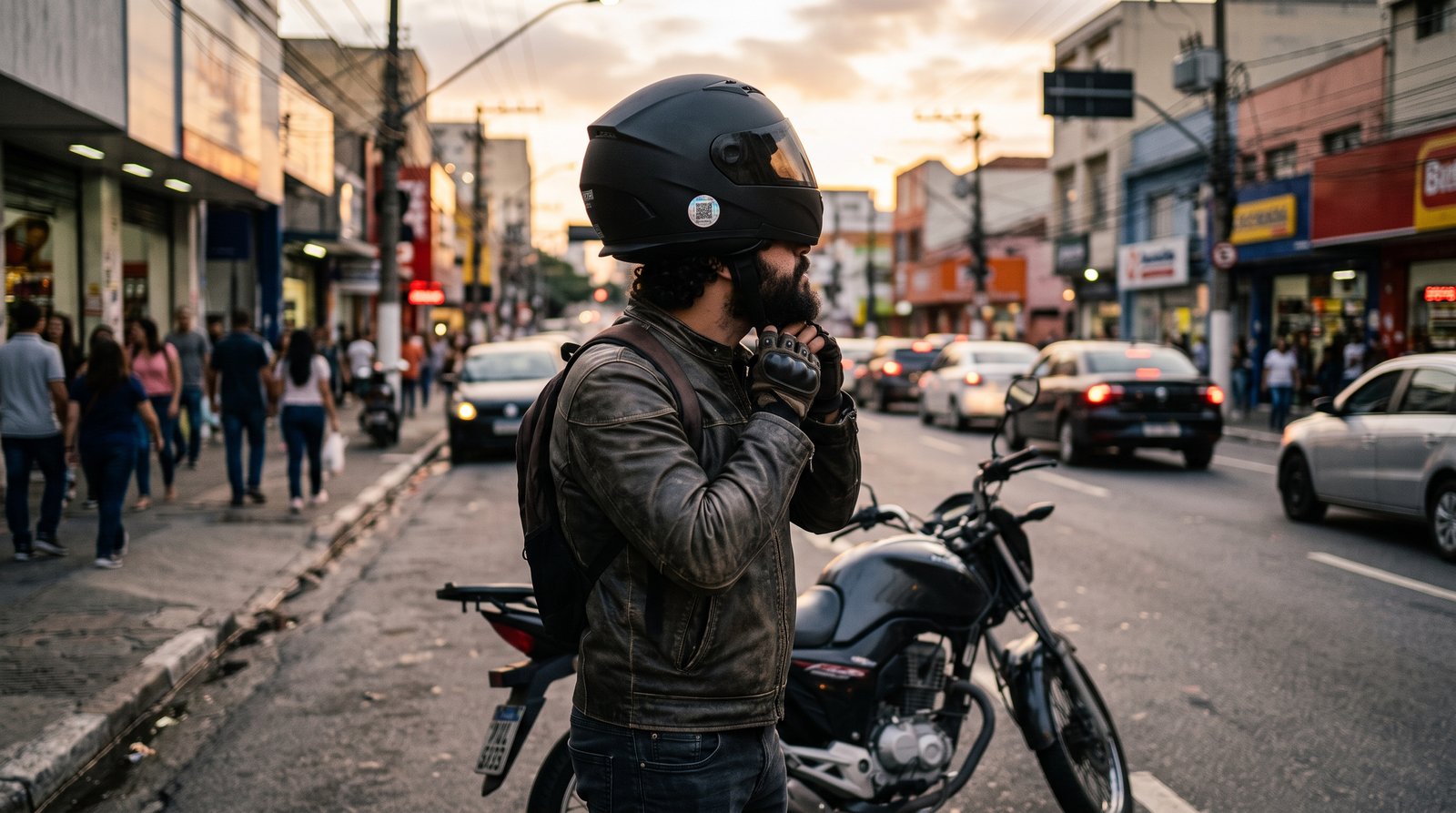
The helmet is the safety equipment that the Brazilian Traffic Code requires on every motorcycle ride, which is why it is the item that moves most in any accessories shop: on Mercado Livre, close to half of the motorcycle accessories on offer are helmets. The buyer is the delivery rider replacing a worn shell, the motorcycle taxi rider, the person who has just bought a first bike. The shopkeeper knows helmets sell. What almost nobody knows is that, for an importer, it is the product in the category where the paperwork comes before the factory.
What a certified motorcycle helmet is
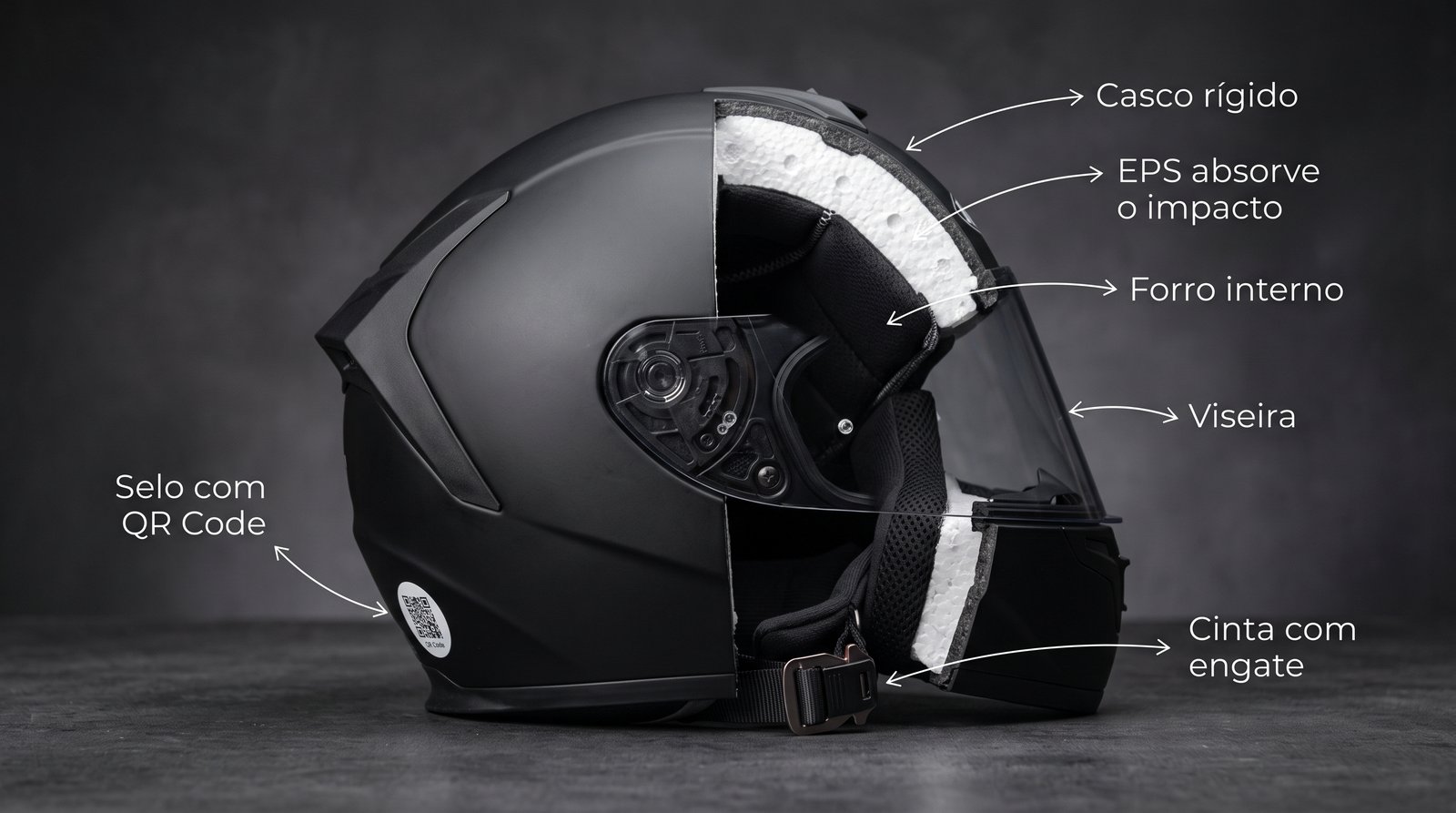
It is the motorcycle helmet that meets ABNT NBR 7471, the Brazilian performance standard for helmets for motorcyclists and similar vehicles, and was certified under Inmetro's rules: a rigid shell, an impact-absorbing layer of expanded polystyrene (EPS), a liner, a retention system with strap and buckle and, on closed models, the visor. Portaria Inmetro 231/2021 covers full-face, open-face, modular and hybrid helmets. What separates the certified product from the "identical" helmet on the next shelf is on the back of the shell: the conformity identification seal, a 30 mm circle with a QR code.
From July 2026, only helmets with the new seal can be sold. It is produced exclusively by the Brazilian Mint (Casa da Moeda do Brasil), with optically variable ink, an element visible only under ultraviolet light and a unique code per unit, linked to Inmetro's database. The customer points a phone and the screen says whether that helmet exists and whose it is. It was made to end counterfeit helmets, and it changed the game for importers: the product is no longer just the shell with a visor, it is the shell plus the code.
Why this is an opportunity for Brazil
The motorcycle fleet grows every month, and the helmet is the first item a rider replaces. The new rule changed the supply, and whoever restocks the shelf now needs the right product.
- Timing: motorcycle registrations grew 12.37% from January to July 2026, at 1.37 million units, and Fenabrave's forecast for the year is 2.4 million. The seal transition ended on 30 June, and shops that lived off old stock are now restocking. With a lead time of 60 to 120 days, whoever starts the certification process now, before production, arrives in time for the restocking at the start of the year.
- Profit logic: low cost at origin and good resale, but with a calculation that is not that of an ordinary product. Certification and the seal are a cost per model, and what dilutes that cost is volume. Importing many models in small quantities is the way to lose margin. The strategy is the opposite of the variety shop: few models, with volume, and the question to ask the certification body is what counts as a new model and what counts as a variation.
- Broad audience: app-based delivery riders, motorcycle taxi riders, urban motorcyclists, accessories shops, workshops and delivery fleets.
- Ready-made content: "scan the seal before you buy" is a short video that explains itself, and the comparison between the original helmet and the counterfeit makes content without production.
Before importing, the whole rule: the motorcycle helmet is under compulsory certification in Brazil. Under Portaria Inmetro 231/2021, it cannot be manufactured, imported, distributed or sold without going through the certification mechanism, with ABNT NBR 7471 as the test reference. What this changes for the importer comes down to four points, checked on 1 October 2026:
- Foreign certification does not count. Inmetro states in writing, in its official FAQ, that it does not recognise any foreign certification: an American DOT or European ECE helmet does not replace the Brazilian process. A supplier showing an ECE in the catalogue has not solved your problem, only proved it knows how to make helmets.
- Certification comes from an accredited certification body (OCP), and the certificate is valid for the approved models and families. The manufacturer or the importer applies. The model has to be decided before the batch, because what is certified is the design, and any change to the shell, visor or buckle must go back for assessment.
- The seal is new and has a single supplier. Portaria Inmetro 314/2025, of 29 May 2025, replaced the printed seal with the digital 30 mm seal with a QR code, made exclusively by the Brazilian Mint (Casa da Moeda do Brasil). The transition ended on 30 June 2026, and since 1 July only helmets with the new seal can be sold.
- Traceability is the importer's. The same ordinance requires the manufacturer and the importer to keep documented records by serial number, batch, manufacturing date, model and the unique code of each seal. If a helmet comes back with a problem, the code points to the batch and to whoever brought it in.
It is a rule that changes by ordinance, and three instruments are in play here: 231/2021, 314/2025 and NBR 7471. Ask an accredited OCP for the classification of the exact model and the length of the process before placing the order, and inspect the batch before shipment: EPS thickness below the design is invisible in a photo, and it is precisely what the impact test catches.
Customise the helmet with your brand
Importing from China is not just reselling a generic product. The factory can put your brand on the helmet and the packaging, and customise the product your way. That is how a private brand is built, with more margin and less price competition, which is powerful in a category where the customer now checks the origin before paying.
- Your brand on the shell and the box (private label / OEM): logo and exclusive packaging.
- Colours, graphics and visor type to your choice, within what the certified model allows.
- Packaging and manual in Portuguese, with usage and care information.
On a certified product, the brand enters the process from the start: define the logo, the model name and the colours before applying for the certificate, and ask the certification body what happens if something changes later. BCVN finds the right factory, negotiates the customisation and validates the sample before the order.
It is worth understanding how this works in practice before requesting the first sample: the guide on own brand in China: private label, OEM and ODM explains the difference between the three models and what each one changes in the minimum order and the lead time.
Where to buy motorcycle helmets in China
Helmets mostly come from factories that make motorcycle parts and accessories, and the sector's fairs are more specific than the general ones:
- Canton Fair, Phase 1 (Vehicles and Auto Parts): the hall for vehicles, motorcycles and accessories, in the same complex as the electronics and the machinery.
- CIMAMotor, in Chongqing: the country's international motorcycle fair, with more than a thousand exhibitors in the 2026 edition, held on 19 to 22 September. The next one should fall in September 2027, with the date to be confirmed.
- China Motorcycle Parts Fair, in Guangzhou: a motorcycle parts and accessories fair, with the autumn 2026 edition expected on 10 to 12 November, a date to be confirmed with the organiser.
Autumn 2026 Canton Fair (140th): Phase 1 takes place on 15 to 19 October 2026, at the Pazhou complex in Guangzhou. For anyone already planning the April 2027 edition, the Canton Fair 2027 guide gives the expected dates, and the China trade fair calendar 2027 shows the whole year. To understand where each hub makes what, see the map of China's industrial clusters.
Read the complete Canton Fair 2026 guide
The helmet is the product in the category where the rule stopped being a footnote: it became the sales argument itself, because the customer checks the seal before paying. Whoever understands the certificate's path before going to the factory negotiates the batch better, and does not risk ending up with a container of helmets the law will not let them sell.
Frequently asked questions about importing motorcycle helmets
Do I need Inmetro certification to import motorcycle helmets?
Yes. A motorcycle helmet is under compulsory certification through Portaria Inmetro 231/2021, with ABNT NBR 7471 as the test standard, and it cannot be imported or sold without it. Since 1 July 2026, selling also requires the digital seal with a QR code from Portaria 314/2025. Confirm the model's classification with an accredited certification body before placing the order.
Can a helmet with ECE or DOT certification be sold in Brazil?
Not as a substitute for Brazilian certification. Inmetro states that it does not recognise any foreign certification, and every helmet sold on the domestic market must be certified under the Brazilian ordinance. A supplier's ECE or DOT is a good sign that the factory knows how to make helmets, but it does not replace the process in Brazil.
What changed with the digital seal with a QR code?
The printed seal became a 30 mm seal with a QR code, a unique code per unit and security features, produced exclusively by the Brazilian Mint (Casa da Moeda do Brasil). Since 1 July 2026 only helmets with the new seal can be sold, and manufacturers and importers must keep a record of the serial number, batch, manufacturing date, model and code of each seal.
Where can I find motorcycle helmet suppliers in China?
At the Canton Fair (Phase 1, vehicles and auto parts), at CIMAMotor in Chongqing, and at the China Motorcycle Parts Fair in Guangzhou. BCVN validates the supplier, guides the certification path with an accredited body and can inspect the batch before shipment.