
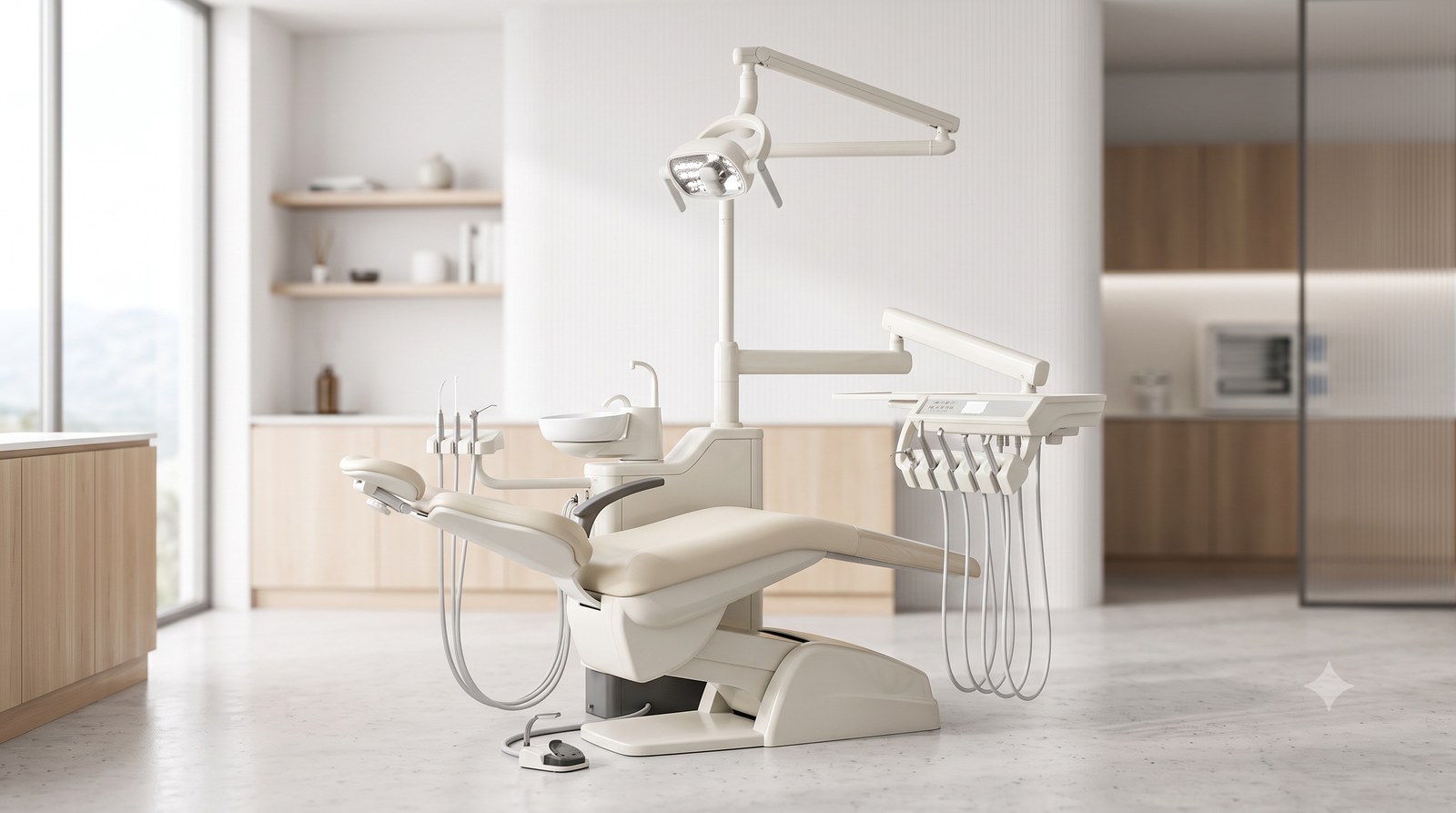
The scene is familiar to any dentist who has set up a practice: the quotation for the unit comes in high, and a good part of the price is the margin that piled up along a queue of sales reps before the chair reached the surgery. Whoever really profits from the change is not only the person sitting the patient down: it is the dealer who discovered that China makes the same unit for far less, and the dentist who realised it is possible to import with compliance instead of paying the nationalised price.
What the dental chair (dental unit) is
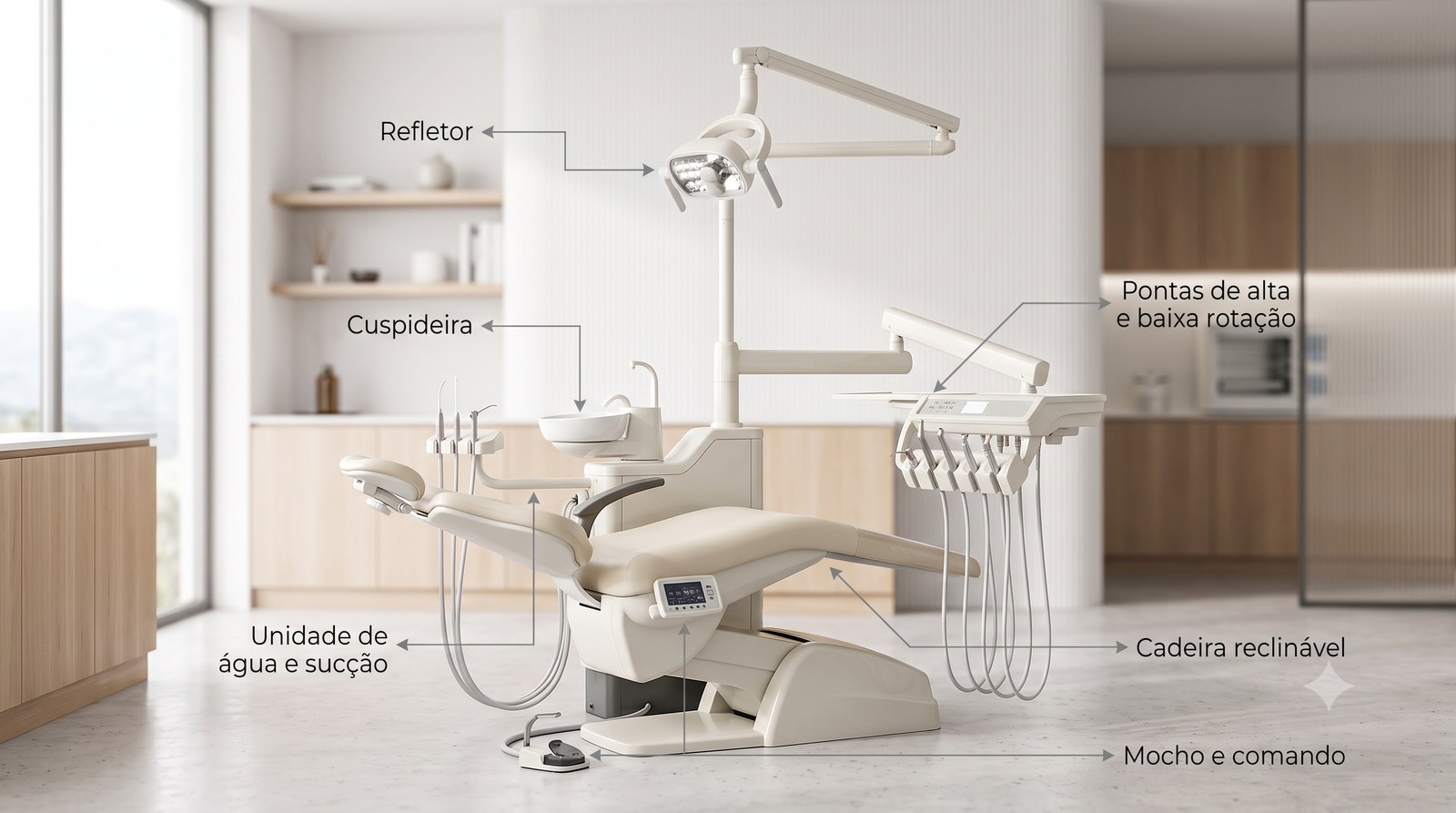
The dental unit is the complete set-up of the practice: the patient's reclining chair, the operating light, the spittoon, the water and suction unit, the operator's stool and the arm with the high-speed and low-speed handpieces, three-way syringe and control panel. It is the practice's central machine, in daily and intensive use, and for that reason an ROI purchase, not an impulse one.
It is a piece of equipment with a high ticket and a high perceived value, in which the buyer is a professional who invests for a return. That changes everything in reselling: it is not sold on impulse, it is sold on trust, compliance and after-sales. Whoever imports well delivers all three.
Why this is an opportunity for Brazil
The dental chair brings together what makes the health track the most valuable one: a high ticket, a professional customer and a real need for a partner. The audience is the dentist opening or refurbishing a practice and the regional dental equipment dealer, and the opportunity lies in the difference between the cost at source and the nationalised price.
- High ticket, full margin: a single unit has a high resale value, and the difference between the source and the already nationalised price opens up room both for the dealer and for the dentist buying for themselves.
- A customer who buys on ROI: the dentist invests in order to produce, so they value quality, warranty and service support above the lowest price, which rewards whoever imports seriously.
- Compliance as a barrier and as value: the ANVISA requirement keeps the amateur away and protects the margin of whoever does it properly.
- Import timing: equipment is not an impulse purchase at the factory. Between the order, sea freight and release, counting on 60 to 120 days means closing now to have the unit in the following season.
Before importing: the unit is a medical device and requires regularisation with ANVISA, as well as electrical safety and Brazilian voltage (60 Hz). Confirm the requirement before closing the order and arrange the quality inspection before shipment to test the operation, the suction and the finish of the batch.
Customise the specification (OEM)
Importing a dental unit is not taking the catalogue model and hoping for the best. The factory adjusts the equipment to your audience and puts your brand on it, and that is where having a partner at source separates whoever resells a commodity from whoever builds a dental equipment line with a margin.
- The right configuration and voltage: type of chair, suction system, handpieces and control panel sized for the use, at your market's 110V or 220V, at 60 Hz.
- After-sales and parts agreed at the purchase: handpieces, motors, upholstery and the technical service, which on a piece of equipment in daily use is what sustains the resale and the reputation.
- Your brand and finish (private label / OEM): upholstery colour, logo and manual in Portuguese.
That calls for direct negotiation with the factory, sample validation and taking the compliance forward. BCVN finds the right manufacturer, closes the specification, tests the equipment and guarantees the after-sales genuinely exists, and not only in the quotation.
Where to buy dental chairs in China
The dental unit appears at the sector fairs of dentistry and medical equipment:
- DenTech (dental fair): the dental sector fair, where the unit manufacturers show the complete lines.
- CMEF (medical equipment): the largest medical equipment fair in Asia, with a dentistry section.
- Canton Fair, Phase 3 (Medical Products): where dentistry appears alongside the rest of the health and consumer universe.
Next edition, 2026: DenTech China is expected in October, in Shanghai (confirm the exact date of the edition), falling at the peak of the Chinese fairs. It can be combined with the Canton Fair in a single season.
Read the complete guide to the Canton Fair 2026
The dental chair is not the easiest bet in the Showcase, and that is precisely why it is the most valuable. The compliance barrier that keeps the unwary buyer away is the same one that protects the margin of whoever does it properly. For the importer, the question is not whether the dentist wants it, it is bringing in the right unit, from the manufacturer that supplies the documentation, with ANVISA under way and the after-sales that sustains every day in the surgery.
Frequently asked questions about importing dental chairs
Is it worth importing dental chairs from China?
China concentrates the world's manufacturing of dental units, in clusters such as Foshan, with a cost at source far below that of the product already nationalised. It is an ROI purchase, with a high ticket, a good margin for the dealer and a real saving for the dentist equipping their own practice, provided compliance and after-sales are taken care of.
Can I import just one dental chair?
BCVN works with importing for resale and for companies, not with the sale of a single loose unit to an end consumer. Chinese manufacturers operate by minimum order quantity (MOQ) and freight and customs clearance only pay off at volume. To equip a single practice there may be a route, but it is a B2B import operation, with compliance and logistics, and that is what BCVN structures, not an over-the-counter sale.
Does a dental chair imported from China need ANVISA registration?
Yes. The dental unit is a medical device and requires regularisation with ANVISA to be marketed and used in Brazil, as well as meeting the electrical safety standards and the Brazilian voltage (60 Hz). It is the central requirement and it has to be mapped out before the purchase. BCVN validates the manufacturer and the technical documentation.
Where to find dental chair suppliers in China?
At dental fairs such as DenTech (Shanghai), at CMEF (medical equipment) and at the Canton Fair Phase 3 (medical products). BCVN identifies the right manufacturer, separates the factory from the trading company and negotiates the specification, the after-sales and the parts.