
At China's energy fairs, storage has stopped being the corner of the hall. At the April 2026 Canton Fair, the new-energy hall was packed with foreign buyers, and the hybrid inverter became the central product for anyone selling solar. In Brazil, the market estimate is to reach about 1 GWh of installed batteries in 2026, which is still little compared with the country's potential. The importer who supplies the integrator holds the position of whoever delivers the product that is missing from the catalogue.
What a residential lithium battery and a hybrid inverter are
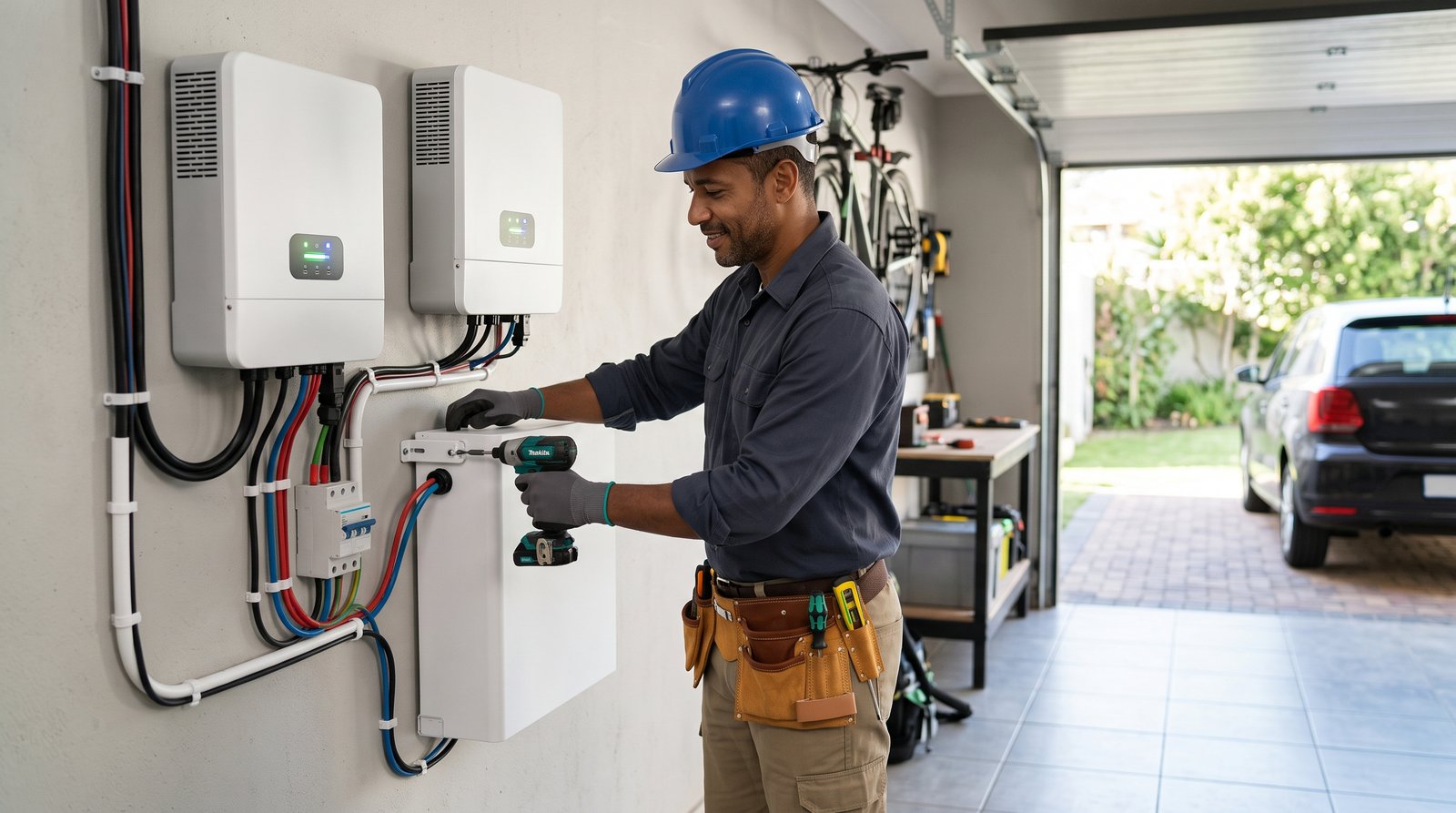
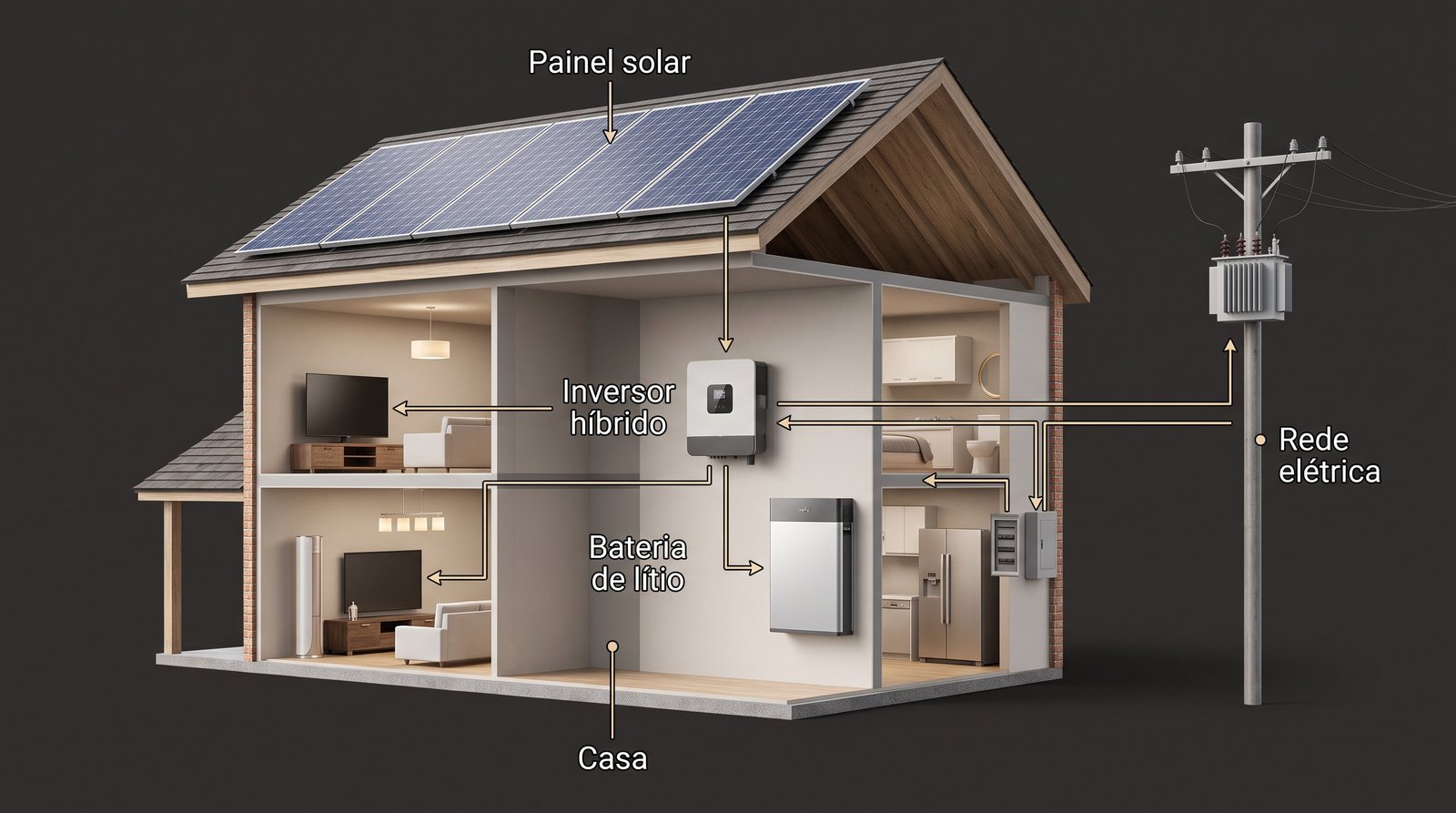
It is the pair that keeps the sun for the night. The residential lithium battery, almost always lithium iron phosphate (LFP, the safest and most durable chemistry in the segment), comes in modules of a few kWh, in a wall box or a rack, and adds up to the capacity the home needs. The hybrid inverter is the brain: it converts the panel's energy, charges the battery, powers the home and talks to the grid, and on models with an emergency output it delivers the stored energy when the grid goes down, like a UPS.
The end customer's sum is simple: the panel produces at midday, the home consumes more at night, and the battery bridges the two. For the integrator, the difference between a good product and a bad one shows up in three numbers on the datasheet: the usable capacity in kWh (not the nominal one), the output power the inverter sustains and the number of cycles the battery promises.
Why this is an opportunity for Brazil
The battery is the product missing from the catalogue of whoever already sells solar, and the market's pace shows the size of the window. The sale does not require a new buyer: it requires the right product in the hands of the integrator who already has the customer.
- Timing without a season: storage has no holiday calendar, and the 60 to 120 day lead time does not clash with any window. What matters is the pace of demand: whoever closes stock now sells on the growth curve, and whoever waits finds the competitor arrived first.
- Profit logic: the price of the battery pack has fallen sharply at origin in recent years, and the importer's margin lives in the distance between the cost at the factory and the final installed price. It is a high-ticket product, where each sale carries the profit of several accessory sales.
- Identifiable audience: solar integrators, electrical engineering firms, photovoltaic supply resellers, high-end builders and rural properties with an unstable grid.
- Ready-made content: "the house that does not go dark" is a video demonstration the integrator can do alone, cutting the grid with the customer watching.
- It stands apart from what is already on the Showcase. The solar energy kit for installers sells the set of panel, structure and inverter, and the portable solar power station sells energy in a bag, for the end consumer. Here the product is fixed storage, and the buyer is the integrator who already sells solar.
Before importing, the whole rule: the battery is not a free product. Portaria Inmetro 140/2022, supplemented by 515/2023, regulates photovoltaic system equipment, and batteries for photovoltaic use (lithium, lead-acid and other technologies, with or without BMS), charge controllers and inverters of up to 75 kW, with or without storage, are all inside it. What this changes for the importer, checked on 1 October 2026:
- The adaptation deadlines have already passed. The ordinance has been in force since 2 May 2022. For the battery, there were 24 months to manufacture and import and 30 months for trade, and for the inverter with a battery in the 10 to 75 kW range, 36 months. There is no transition period left.
- The mechanism is the supplier's declaration of conformity, and the supplier is you. The path goes through a laboratory accredited by Inmetro, registration in the Orquestra System, product registration and the ENCE label. The test report from the factory's laboratory in China, on its own, as a rule does not complete that path.
- What the test looks at. The lithium cell must meet IEC 62619:2017 or ABNT NBR 16976:2021, the battery is assessed in cycling under NBR 16767, and the initial real capacity must be at least 95% of nominal, keeping at least 80% after sequences of cycles. Ask the factory for the report with those numbers, not the catalogue sheet.
- Transport is the part that bites most. A lithium battery is class 9 dangerous cargo, with the UN 38.3 test and a safety data sheet (FISPQ). Some shipping lines refuse and some charge extra, and air freight is restricted. Agree the packaging and the documentation with the freight forwarder before the factory produces.
- Grid connection belongs to the integrator and the utility. The access rules change, and the importer does not decide that, but the integrator only buys from whoever supplies the right datasheet and documentation.
It is a rule that changes by ordinance. Confirm the exact model's classification with an accredited body or laboratory before ordering, and inspect the batch before shipment: capacity measured on the bench, not the catalogue's, is what separates a good batch from one that turns into returns. The whole chain, from polysilicon to the battery, is in the guide on solar, battery and electric car.
Where to buy residential lithium batteries in China
Storage has its own hall at the energy fairs, next to the inverter and the panel:
- Canton Fair, Phase 1 (Energy and Environment): solar panels, inverters, batteries and storage systems, in the energy sector that brings integrators together.
- SNEC PV Power Expo, in Shanghai: the largest solar energy fair on the planet, with its 2027 date already published by the organiser, from 2 to 4 June 2027.
Autumn 2026 Canton Fair (140th): Phase 1, with the energy sector, takes place on 15 to 19 October 2026, at the Pazhou complex in Guangzhou. For the following year, the Canton Fair 2027 guide gives the expected dates, and the China trade fair calendar 2027 shows SNEC and the rest of the year.
Read the complete Canton Fair 2026 guide
Storage is the product that decides whether the solar integrator keeps selling only panels or starts selling the whole house. And it is a product where the datasheet, the certification and the transport weigh as much on the margin as the factory price, which rewards whoever arrives with the supplier validated and the paperwork settled before the container.
Frequently asked questions about importing residential lithium batteries
Does a residential lithium battery need Inmetro certification?
Yes. Portaria Inmetro 140/2022, supplemented by 515/2023, covers batteries for use in photovoltaic systems, lithium or other technologies, as well as charge controllers and inverters of up to 75 kW, with or without storage. The path is the supplier's declaration of conformity, with tests at an accredited laboratory, registration in Inmetro's system and the ENCE label. Confirm the model's classification before ordering.
What is the difference between a hybrid inverter and a standard inverter?
A standard grid-tied inverter only converts the panel's energy and feeds it into the grid, and shuts down when the grid goes out. A hybrid does that and also manages the battery: it charges, discharges and, on models with an emergency output, keeps the home powered without the grid.
How is a lithium battery shipped from China to Brazil?
A lithium battery is class 9 dangerous cargo, and needs the UN 38.3 test and the safety data sheet (FISPQ). Some shipping lines refuse the cargo and some charge extra, and air transport is restricted. Agree the packaging and the documentation with the freight forwarder before the factory starts producing.
Where can I find residential lithium battery suppliers in China?
At the Canton Fair (Phase 1, in the energy sector, with panels, inverters, batteries and storage) and at the SNEC PV Power Expo in Shanghai, from 2 to 4 June 2027. BCVN validates the supplier, checks the test report and can accompany your visit to the fairs.